


Move for zero-cost recruitment to Malaysia raises hope

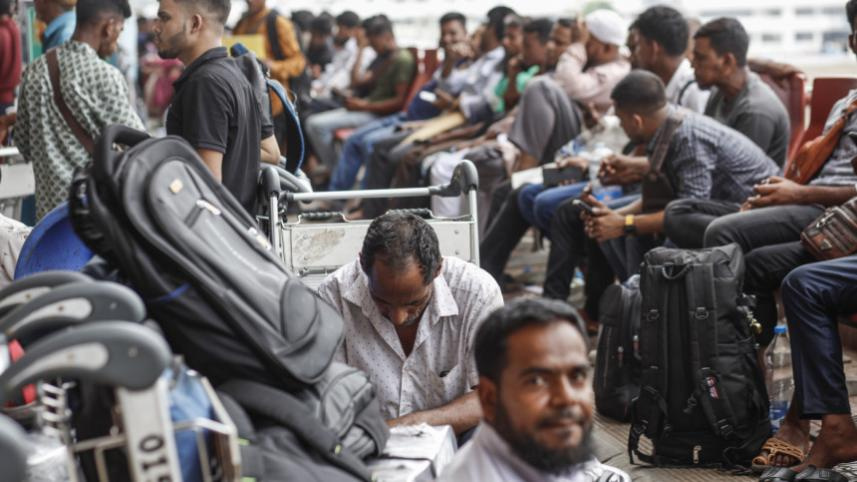
Kuala Lumpur’s recent announcement of a zero-cost recruitment policy for foreign workers is widely seen as a move in the right direction, but doubts persist over its implementation due to longstanding malpractices in the Bangladesh-Malaysia labour migration process.
“The system would ensure that employers bear the full cost of recruitment, resulting in zero cost to workers, in line with the Employer Pays Principle under the guidelines of the International Labour Organization (ILO),” said a joint statement issued by Dhaka and Kuala Lumpur on April 8.

It followed a bilateral meeting between Bangladesh’s Labour and Expatriates’ Welfare Minister Ariful Haque Choudhury and Malaysia’s Human Resources Minister Sri Ramanan Ramakrishnan in Putrajaya, Malaysia.
Labour migration experts have welcomed the statement but cautioned that serious questions remain about the effectiveness of the proposed system.
Their concerns stem from recent experiences. Between 2022 and 24, Bangladeshi migrants reportedly paid between Tk 5 lakh and Tk 6 lakh each to secure jobs in Malaysia even though the government-fixed cost was only Tk 79,000. During the period, Malaysian authorities selected 101 Bangladeshi recruiting agencies to facilitate migration.
Around 450,000 Bangladeshis were recruited until the programme was suspended on May 31, 2024, following allegations of malpractices and a glut of workers in Malaysia.
Prof CR Abrar, former executive director of the Refugee and Migratory Movements Research Unit at Dhaka University, said that recruitment under the ILO guidelines and adherence to the Employer Pays Principle are among major demands from migrant workers and campaigners but they have never been met.
Instead, multiple layers of intermediaries have driven recruitment costs to excessive levels, he said.
Abrar pointed out that Malaysia previously used an IT-based recruitment system -- the Foreign Workers Centralised Management System (FWCMS) -- between 2022 and 2024. Yet issues such as high costs, oversupply, and worker exploitation persisted.
“How can we be sure that the same problems will not recur?” he asked.
Abrar’s concerns are reinforced by past records of the Bangladesh-Malaysia labour migration system through which formal labour recruitment began in 1992.
Following allegations of irregularities and labour abuses, the market was first shut in 1997. Since then, a recurring pattern has emerged: the market reopens and then closes after a few years. Between 1992 and 2024, it reopened and closed five times, drawing widespread media attention both domestically and internationally.
In some cases, international buyers even suspended imports from Malaysian companies accused of labour exploitation.
Last year, following the filing of multiple cases against Bangladeshi agents over allegations of human trafficking and money laundering linked to Malaysia, Azman Mohd Yusof, secretary-general of Malaysia’s human resources ministry, wrote toBangladesh’s expatriates’ welfare ministry on April 23,saying that such allegations had damaged Malaysia’s reputation.
Kuala Lumpur mentioned the matter in the joint statement. It said, “The Malaysian side emphasised the need to address any unfounded or malicious actions that may affect its international reputation, while the Bangladesh side reaffirmed its commitment to the rule of law, ensuring due process, accountability, and timely justice.”
It also said both sides discussed the ongoing cases related to human trafficking carried out under the guise of worker recruitment.
Abrar argued that if Malaysia is serious about ensuring a transparent recruitment system, it should not be overly concerned about such cases.
“Malaysia’s reputation can only be restored by punishing those responsible and dismantling the exploitative system,” he said.
Mohammad Harun-Al Rashid, a researcher specialising in labour migration in Malaysia, said Kuala Lumpur selected 10 agencies in 2016-18 and 101 agencies in 2022-24, deeming all of them “qualified”.
“However, the criteria for qualification were never clearly defined,” he said, adding that Malaysia introduced new conditions for recruiting agencies last year, but those are problematic.
 For all latest news, follow The Daily Star's Google News channel.
 In a letter to the Bangladesh High Commission in Kuala Lumpur on October 27 last year, Malaysia’s foreign affairs ministry outlined the requirements for recruiting agencies. They include a minimum of five years of operational experience, and a record of managing at least 3,000 foreign workers over the past three years as well as sending workers to at least three destination countries.
Additional conditions require agencies to maintain a permanent office spanning at least 10,000 square feet for three years, hold valid licences and certificates of good conduct, submit five references from overseas employers, and run dedicated training and assessment centres with accommodation.
Rashid argued that such conditions will lead to an increase in migration costs.
“Any agency with a valid licence and the capacity to communicate with employers and support documentation should be considered qualified. Whenever an agency is accused of corruption, it should be investigated and punished if found guilty.
“While Malaysia speaks of reducing migration costs, it sets conditions that are likely to raise them,” he added.
Meanwhile, a new controversy has emerged over a proposed digital system for recruiting foreign workers.
On April 16, Bloomberg reported that Malaysia plans to adopt a new recruitment platform developed by Bestinet Sdn Bhd, a company founded by labour tycoon Aminul Islam, a Bangladeshi-born Malaysian businessman also known as Dato Amin.
The system, called the Universal Recruitment Advanced Platform (TURAP), is marketed as a method of allowing companies to hire workers directly, bypassing middlemen who often charge excessive fees.
“This sounds great, but what does the past experience tell us?” Harun said.
Bestinet had previously developed the FWCMS which was operational between 2022 and 2024 -- a period marked by high recruitment costs and the control of a syndicate allegedly linked to political elites in Bangladesh and Malaysia, he pointed out.
Harun explained that under the ILO’s Employer Pays Principle, employers are responsible for all migration-related costs, including document processing, visas, medical examinations, and travel. Migrant workers are expected to bear only the cost of their passports, which are personal documents.
“The governments of both countries must hold accountable those responsible for past abuses in the recruitment sector. Otherwise, a meaningful change will remain elusive,” he added.
Comments