


In the shade of Hirnal’s ancient tree
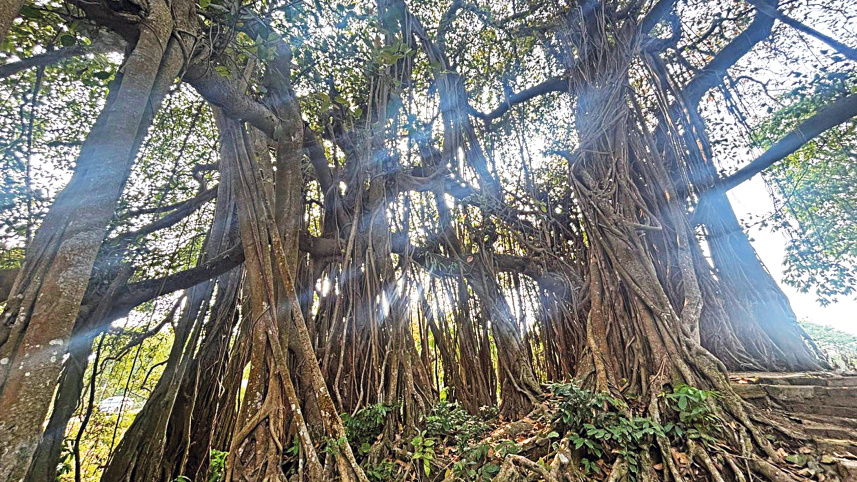
In moments of dreamy, wistful escape, I wish I could live a stranger’s life in a forgotten world, or even stand rooted like an ancient tree, radiating a quiet, zen-like energy to all who come near. It is a strange kind of bohemian pull I feel towards unknown villages, winding roads, ancient trees, and the quiet company of strangers. So when my friend planned a trip to see an old tree in Hirnal village, near the 300 feet Purbachal Expressway, we all jumped on the bandwagon.
We made full use of Dhaka’s empty streets during the Eid holidays. We drove towards this unknown village, surrounded by rain-washed thickets, bamboo groves, and the maddening fragrance of wildflowers near the Purbachal New Town Project. This strange village, tucked deep inside the belly of Dhaka, housed a long-standing living monument: an ancient Khirni tree (Manilkara hexandra), said to have taken root during the Mughal reign, some 500 years ago or even earlier. The recent war-induced fuel crisis could not contain our curiosity to witness the spirit of defiance and individuality of this tree, along with a few other majestic ones in the vicinity.

I have seen old trees on Jessore Road, in Barishal, Faridpur, and Rajshahi, but never one whose aerial roots had thickened into century-old trunks. Just behind the Khirni, probably the only one of its kind in Bangladesh, stood another ancient tree: the banyan. The village’s history is defined by these two giants, the Khirni and the banyan, standing their ground like fraternal twins, treasured for their rarity and historical importance, and revered for their cultural significance.
An absent-minded ascetic wandering under their massive canopies told us, “The Khirni is flowering now. In Falgun and Chaitra, the tree bursts into clusters of yellow, date-like fruits, while its flowers resemble delicate bakul blossoms. When ripe, they fall to the ground, and children eat them. But none of us ever pluck even a leaf. The villagers regard it with reverence. No one touches the orchids, ferns, or undergrowth growing on its branches.”
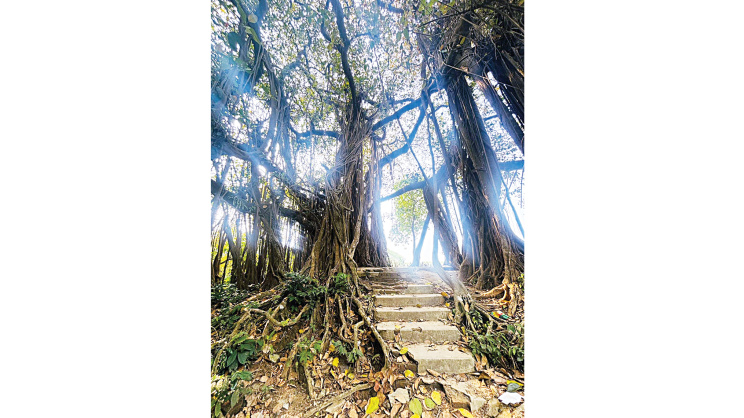
Beside the tree lies a holy shrine, where prayers are offered and vows made beneath its colossal canopy. Once wishes are fulfilled, people return with offerings. The villagers call the tree Shirnigota, a confusion born of mixing the name Khirni with shirni, the traditional sweet offering.
“The Khirni tree of Hirnal has stood through generations. My father said his father saw it just like this. Every elder has always referred to it as a centuries-old tree. At least five generations have passed down the same oral story. Its trunk is so wide that even a circle of people holding hands cannot encircle it. We decided to protect its base with masonry, to honour the powerful, palpable energy it gives out,” the nameless mendicant said. With him, we too bathed in awe.
The village has a spirit that seems to connect you directly with the earth’s grounding energy, promoting calm and balance. Just behind the mighty Khirni stood a twisted, knotted, mystifying, century-old frangipani tree. I have never seen a flowering frangipani that looked so old.
The experience of this short afternoon of forest bathing and tree hugging lifted our dampened spirits. We were grateful to nature for absorbing our negative energy and allowing us to soak in its calm. People in Dhaka should embrace the culture of tree hugging and forest bathing, for the vastness and grandeur of trees inspire gratitude. Gratitude shifts perspective and counteracts negativity.
Dhaka is too fast-paced, and we Dhakaites need only 10–15 minutes of walking or sitting among thickets, groves, and sprawling gardens to let go of piled-up frustration and embrace the electropositive spirituality of our chi, our soul. Trees, after all, provide positive energy.
 For all latest news, follow The Daily Star's Google News channel.
Comments