


Why visiting Satyajit Ray’s ancestral home felt deeply personal
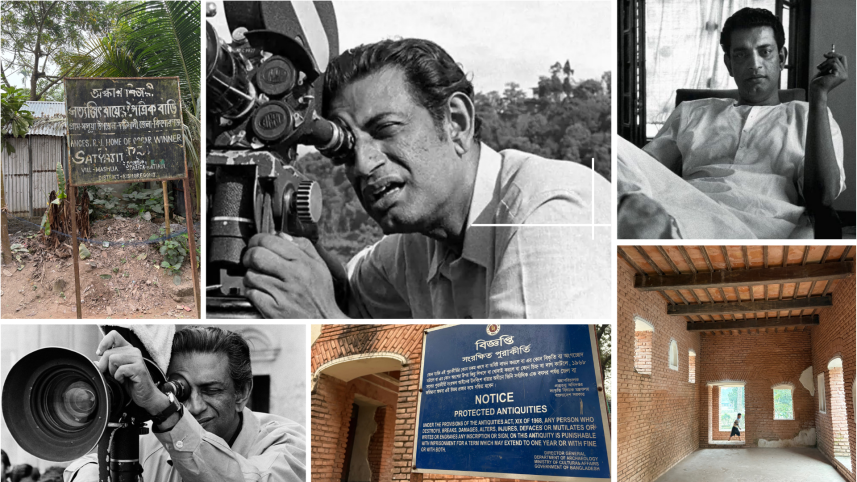
Last year, sitting in Melbourne and sipping a cuppa, I came across a headline that read: “Satyajit Ray’s ancestral home being demolished.” As I followed the story, along with the public outcry, the petitions, and the protests from the wider Mymensingh community, archaeologists, and academics alike, I clung to a quiet hope against hope that the house would survive long enough for me to return to Bangladesh and see it for myself.
Why, one might wonder. Because, unbeknownst to me earlier, I realised the site lay just a few kilometres from my own ancestral home, my mother’s grandparents’ house in Bajitpur, Kishoreganj.

In recent years, several tributes have been paid to Ray on the occasion of his birth centenary. Among them was a Chorki production, Dear Satyajit, starring our late television legend Ahmed Rubel, a performance I watched and loved. Last year also marked seventy years since Ray’s directorial debut. It’s safe to say he had been occupying my thoughts for some time.
Yet, the clarity of why I felt such urgency to return to Bangladesh and visit this house would only reveal itself gradually, much later.
A trip to see my extended family members in Bajitpur was easier than I thought. Instead of driving there, which is actually the shorter route notwithstanding the traffic, I chose the path less travelled. I made my way, on one of the coldest streaks that Bangladesh has experienced at the start of January this year, to Kamlapur railway station.
My entire childhood is stitched together with different memories of this station. The smell of boiled eggs, chicken cutlets and of course, jhalmuri made to order — extra lime or chilli. A magician of a vendor standing on one foot, balancing his arsenal, his life, his livelihood in a rattan basket, performing small feats of wonder, tossing seasoning and peanuts with the flair of a seasoned stage performer.
With a high expectation, I returned to a place that I had last visited more than 25 years ago and to my utter astonishment, found the experience to be quite unchanged. Time certainly stood still inside that chicken cutlet.
I got on the Kishoreganj Express train, which is five stops to Bajitpur station. As I wanted to see my family first, Bajitpur was my stop, but had I gone directly to where Ray’s home is situated in Masua, I would have added one more stop and gotten off at Sararchar station.
The train ride was breathtaking with fields of mustard flowers lining either side of my view, punctuated only by tea and jhalmuri breaks. As I got off at the Bajitpur stop, I was greeted by the all too familiar sight of older male citizens, layered up on this occasion in their white shawls and brown ‘monkey’ caps, drinking tea and watching an extra loud political commentary coming out of the tiny television boxes that lay suspended on the walls of little roadside cafes.
I was almost tempted to stop and ask them their thoughts on the upcoming election.
If Dhaka is the heart, then these small towns and cities are the arteries of Bangladesh, carrying the pulse of the nation for anyone willing to listen. However, I was on a different mission that day and, overcoming the distraction, went into planning mode.
The route to Ray’s ancestral home was familiar to the locals, but at the time, it had not yet been picked up by Google Maps. To my delight, when I checked again this morning, the house is now clearly marked, no doubt thanks to the extensive journalism that brought renewed attention to the site, making it hopefully easier for future visitors to find. As for me, I had the joy of reaching it on a Bangla Tesla!
The distance between Bajitpur and Masua is around 25 km, and the roads are as good as they can be. You could cover most of it via the Mymensingh-Bhairab road past Katiadi, and it was most suitable to cover by a bike or in my case, a Tesla.
Once you enter Masua, however, brace yourselves for some full-body rattle. While it’s not treacherous, and I’ve trekked far worse, even within Dhaka, some of the interlinking roads are narrow, so the driver needs to proceed with caution.
Having lived through harsher winters around the world, I was not as rugged up as everyone else, yet I still felt the sharpest drafts sneaking in through the flap window behind our Tesla seats.
Before I could gather my thoughts, we had arrived.
To my relief, the house was not in ruins as I had feared. Instead, it had been cleaned up and partially restored, thanks to renewed media attention. Clear signage marked it as a historical site and noted that it had once been occupied by Satyajit Ray’s grandfather, Upendrakishore Ray Chowdhury, an eminent Bengali litterateur, and father to the celebrated poet Sukumar Ray.
Harikishore Ray Chowdhury Road, named after one of Ray’s ancestors, and where the house stands, was unusually quiet on that winter morning. The house itself was a standalone structure set in the middle of a wide, open clearing, with only a handful of modest homes tucked behind it. Its architecture was familiar, much like other buildings I had seen across Bangladesh, rooted firmly in the zamindari era: a solid, almost palace-like aura, high ceilings, a wraparound staircase, and what appeared to have once been a rooftop terrace.
Large, open windows offered a sweeping 360-degree view of the surrounding landscape. It felt like the perfect hideout from which to sit and watch life unfold outside. Lost in that reverie, I almost didn’t notice someone doing exactly that, sitting upstairs in one of the rooms. He was a teenage boy. Much to his chagrin, his quiet refuge had been discovered, and despite my protests, he grudgingly emerged from his hiding spot and left me alone with my wonder.
A small group of boys lingered behind the site, observing my enthusiasm and giddiness through groggy eyes, perhaps quietly wondering what all the excitement was about. And one might ask, what, really, was the source of my excitement?
 For all latest news, follow The Daily Star's Google News channel.
 The thing about the past is that it is shared, and in memory, almost always beautiful. It exists outside of time now, yet remains a reminder of our collective experiences and sense of belonging. Somewhere along the way, as I traced the contours of Satyajit Ray’s possible childhood, I found myself quietly retracing the path to my own.
Photo: Naaz Fahmida and Aheteshamul Haque Mamun
Comments