


Why is everyone obsessed with this monkey and his toy?

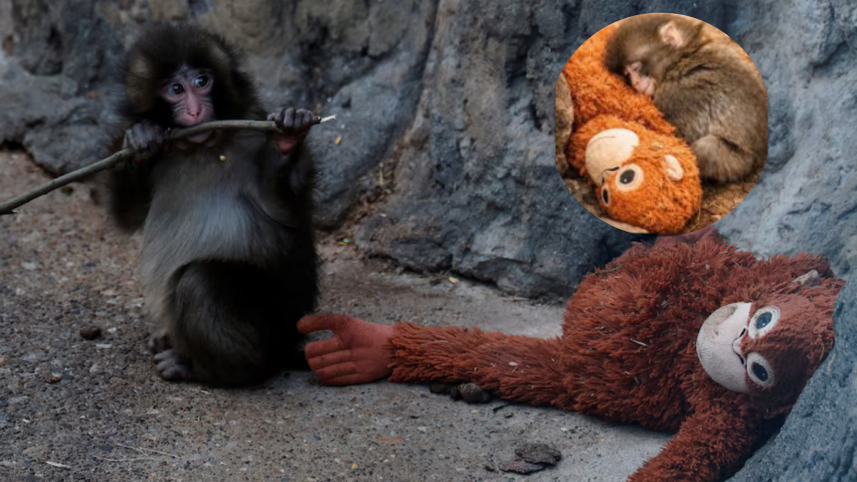
By now, everyone already knows Punch, a seven-month-old Japanese macaque at Japan’s Ichikawa City Zoo, who has gone viral for playing with and hugging his orange orangutan stuffed toy. With his pair of wide, glassy eyes and two tiny arms wrapped tightly around his toy-friend, he keeps breaking millions of hearts online.
Punch wasn't born into a life of luxury. Abandoned by his mother shortly after birth, he was raised by zookeepers. Afterward, the staff gave him the toy because baby monkeys tend to cling to their mother for comfort and security. What follows is a battle to survive in an anxiety-ridden world, while learning to create new friends.

One minute he’s trying to play with the "cool kids" in the enclosure, and the next, he’s being shoved or ignored. It’s brutal. It’s awkward. It’s basically every middle-school cafeteria experience condensed into a primate enclosure. And every time the world gets a little too loud or the other monkeys get a little too mean, Punch does the one thing we all secretly crave. He sprints back to his plushie, buries his face in that polyester fur, and recharges.
There is something deeply satisfying about seeing a wild animal find peace in a mass-produced Swedish toy. The brand, IKEA, is actually struggling to keep the toy, which they marketed as “Punch’s comfort orangutan” in stock because everyone wants a piece of that warmth. But why are we so obsessed?
It’s because Punch is holding a mirror up to our own childhoods.
Think back to your first "main character" object. Maybe it was a teddy bear with one eye dangling by a thread, a blue blanket that had been washed so many times it felt like gauze, or a specific pillow that was the only thing standing between you and the monsters under the bed. That object wasn't just "stuff." It was a shield. It was the only thing in the world that didn't judge you, scold you, or tell you to "be brave."
Back in the 1950s, an American psychologist Harry Harlow conducted an experiment with monkeys that showed the young ones need comfort and affection as much as food. Punch is living proof that emotional security is a primal survival tool.
Social bonds are what help us survive stress and uncertainty. One day, the caregivers we rely on most will not be here. We will be forced to navigate the world's "mountains" on our own. Life requires us to find new anchors and the support of others to stay happy.
Yet, look at Punch’s resilience. He gets bullied. He gets scolded. He runs to his plushie, recharges his mental battery, and goes right back in. This is the same mental strength we’ve been building since the day our mothers first left us at the school gates. We found comfort in a toy or a familiar scent until we were brave enough to make our first friend.
Life doesn't stop because we're scared or rejected. It moves on, and we move with it. Punch’s toy isn’t a sign of weakness. He’s teaching us that it’s okay to lean on something to lessen the adversities of a world that doesn’t always play nice.
We all have our version of that orange stuffed toy hidden in our lives. One day we will also be able to find our calm, leave the toy behind like Punch and move on. After all, life goes on, and we’re stronger than we think.
 For all latest news, follow The Daily Star's Google News channel.
Comments