


The chaos, beauty, and tradition of Gabtoli cattle market
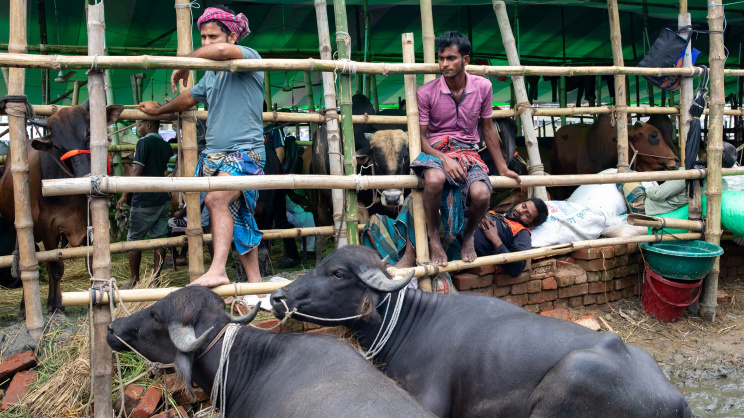
An elderly breeder from Kushtia sits on a plastic bag beside three medium-sized cows, answering queries from curious buyers. Like the previous year, and many years like it before, he arrived with a sizeable number of sacrificial animals. By the fifth day, he is now left with three, and the farmer rarely leaves them unattended. The trader shouts his final price for one of the prized beasts, but the unhappy buyers push through the crowd in their search for the right cow at the right price, without a word.
It’s two in the morning, yet the place is wide awake and busy. Trucks continue to arrive from faraway regions of the country, constantly replacing the animals sold with fresh stock. And as more cows and people come pouring in, the stench of wet hay, sweat, cigarette, and dung hangs heavy in the air.

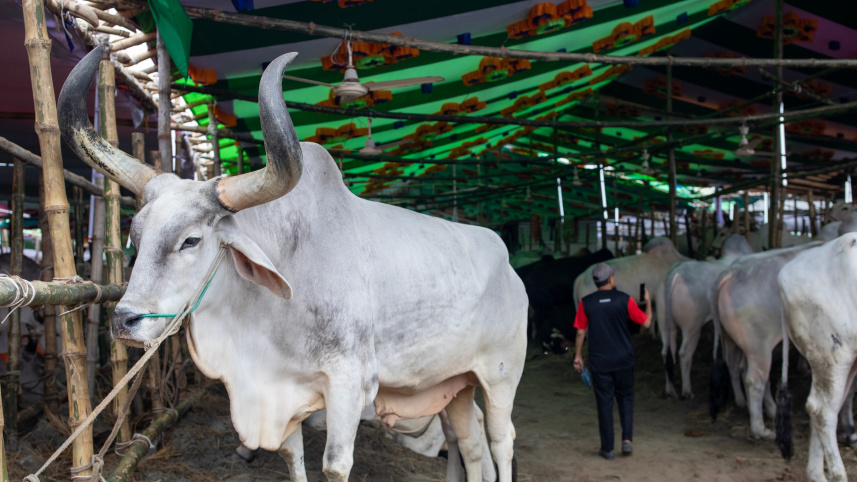
Thousands of animals — cows, buffaloes, goats, lambs (even camels) — stand on their four feet across the ground in endless rows. The bigger, more expensive ones get the comfort of the tin shade; some rest under the breeze of a blowing table fan. Many of these prized bulls gain minor celebrity status before they are sold, attracting crowds eager to take photos and share on social media. Most animals are, however, left out in the open, their harnesses fastened to makeshift bamboo posts so tightly that at times the poor beasts cannot even sit.
These have been the familiar sight at Dhaka’s largest cattle market for as long as one can remember. Chances are, you have experienced this in the same way at Nayabazar, Aftabnagar, or any other cattle market in the city. However, the vastness of Gabtoli truly is a spectacle. And of course, visiting the same place year after year creates a feeling that is strangely and deeply satisfying.
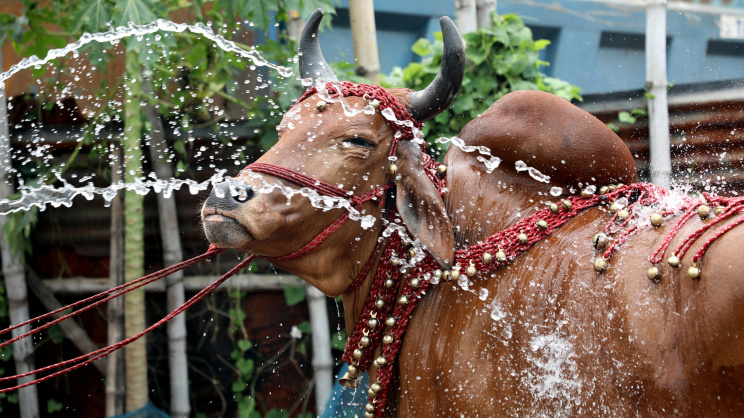
Navigating through the crowd at Gabtoli is quite an achievement, and just when you pat yourself on the back for surviving a good squeeze between two enormous bulls, you stand the chance of being crushed to the ground by a solitary cow on the loose. One must also watch their every step as the animals are usually exhausted from their long journey and irritable from the sights and sounds of the haat. They can, in all likelihood, give a sudden hind kick or a violent ram.
Sometimes, rain pours without any warning whatsoever, turning the pitch muddy enough for shoes to sink into the ground. As the heavens come splashing down, most people try to take cover under plastic sheets, while traders well-versed with such calamities continue bargaining as if nothing has happened! Often, the extreme opposite is the case: the merciless sun scorches the pitch so fiercely that the heat rises visibly from the ground, making the people and the animals ill.
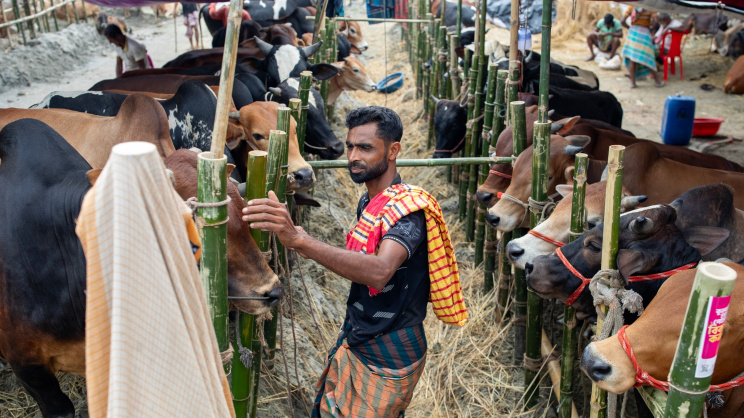
While most can recall the visual spectacle, few notice the sounds that add to the uniqueness of the place. It’s never quiet, as if the market breathes through noise: buyers asking for prices, traders replying in high-pitched voices swearing by the quality of the cattle they offer, and middlemen/brokers intruding loudly into the conversations.
And that’s not it. Deep groaning of cows mixes with the bleating of goats. Overhead loudspeakers constantly declare, much to everyone’s annoyance, that no animal should leave the haat without paying the “hasil” (consider it as a ‘tax’ of sorts for your purchase).
Recently, Gabtoli haat has added another jewel in its crown. It has found a new life online!
TikTokers now interview traders, and buyers and vloggers move through the crowd and narrate their “haat experience.” Aspiring content creators pose beside massive cattle as though attending a festival. Even amateurs capture videos with their mobile phones, filming reels of red bulls and the dramatic bargaining session that precedes the act of buying them.
For generations, Gabtoli is not just a cattle market, it’s the name of an emotion. For a few individuals, the cattle trade is a year-long profession, and the place offers a livelihood. For most buyers, however, it is a seasonal passion, synonymous with everything that spells Eid ul Adha.
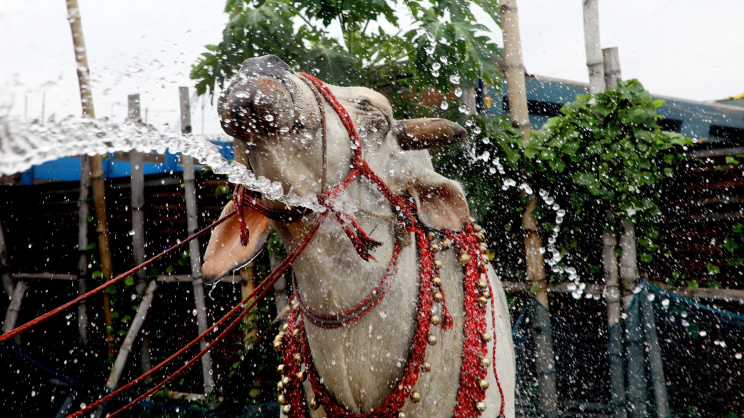
Visiting this cattle market is more than a chore; it is a ritual passed down through generations. Over time, the act of buying the sacrificial animal turns into something deeply woven into family memory, becoming as much a part of Eid as the feast itself.
There are, of course, 20 or more cattle markets in the city, places that Dhakaites can easily visit to make a purchase, and some of these are delightfully closer to where you might live. However, rest assured, for many of us at least, all the other haats pale in comparison to the commotion of Gabtoli.
I can faintly recall the first time I went there, but vividly recall the last, which was a few years ago.
When one reaches middle age, convenience takes precedence even over family rituals! The exhaustion of walking through mud for hours, the thrill of spotting the perfect buy, and even experiencing the ethereal beauty of the market are now replaced with online orders and cash-on-delivery options.
Am I swapping the whole Gabtoli experience with a shortcut? Perhaps. But truth be told, Gabtoli is something I can go back to, but the experience of dealing with the butcher is something I have left behind for good.
 For all latest news, follow The Daily Star's Google News channel.
 That, however, is a story for another day!
Comments