


This brave mother takes the wheel on the roads of Dhaka

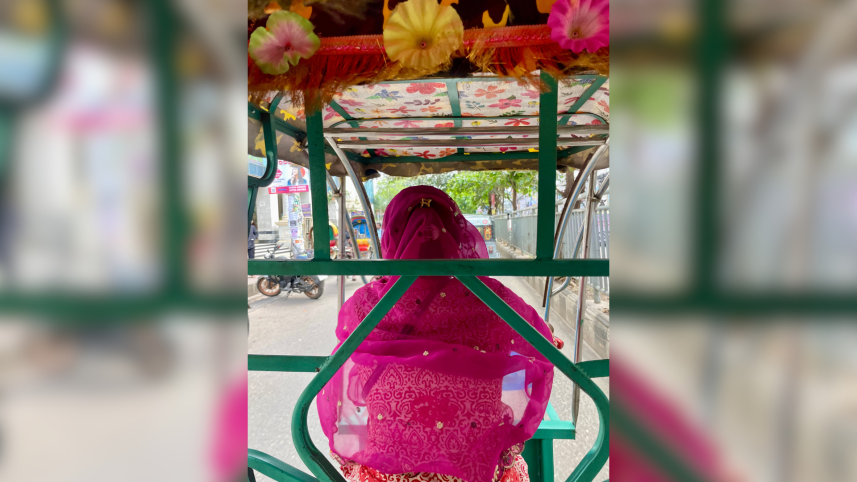
Every morning, the roads of Dhaka fill the same way — crowded, impatient, and indifferent. Among the many auto-rickshaws weaving through traffic, one of them carries a quieter story. A woman sits behind the wheel, not to make a statement, but because life has left her with no other choices.
Shahida (not her real name) came to the city with her two daughters after the death of her husband. There was no one to fall back on, no safety net waiting to catch her. Only the weight of responsibilities and the urgency to survive.

“After my husband died, I came here with my two daughters. There was no one to look after us. I had to change our luck on my own.”
Before this, she tried to find other work. But opportunity is often selective. Education, or the lack of it, quietly closes doors long before one even reaches them. What remained open was the road.
Driving an auto-rickshaw was not an obvious choice. It became the only way forward.
Six months in, Shahida has learned that the road is not just about traffic. It is about resistance, and exhausting. Male drivers pass comments. Some try to intimidate her, edging too close, testing her space, reminding her that she does not quite belong.
And yet, she continues.
Because stopping is not an option.
There are moments, however, when the city feels less unkind. Some passengers offer quiet words of support, small gestures that stay with her.
“Women passengers tell me I am brave. These words give me strength to keep going.”
It is a small thing, perhaps. But on difficult days, small things matter.
Safety is never a certainty. A careless word, an inappropriate remark, a situation that could turn without warning, these are not distant fears, but lived realities. And behind all of it sits a quieter, heavier question she carries with her every day: what happens to her daughters if something happens to her?
There is no easy answer to that.
And yet, there is movement. There is change, however fragile.
This year, she admitted her elder daughter into a government school. It is a simple milestone, one that many take for granted. But for Shahida, it is proof that something is shifting, that despite everything, the future can still be negotiated, step by step.
“I want my daughters to be educated so they don’t have to depend on anyone.”
It is not ambition in the grand sense. It is something more grounded. More urgent.
To be able to earn. To be able to eat. To make sure her children have just enough.
Not everything. Just enough.
She believes people are beginning to see differently now. That perhaps, slowly, it matters less who is behind the wheel, and more how they drive. It is a quiet kind of hope, one that does not demand attention.
 For all latest news, follow The Daily Star's Google News channel.
 But hope, like survival, is often quiet.
So, she keeps going. Past the stares, past the comments, past the doubt.
“I don’t care what people say. I will keep working.”
And maybe that is where her story rests, not in defiance, not even in courage, but in persistence. The kind that does not announce itself, but shows up every day, on the same roads, under the same weight.
Because for some, there is no other way forward.
Comments