


IUB holds seminar on global legal governance
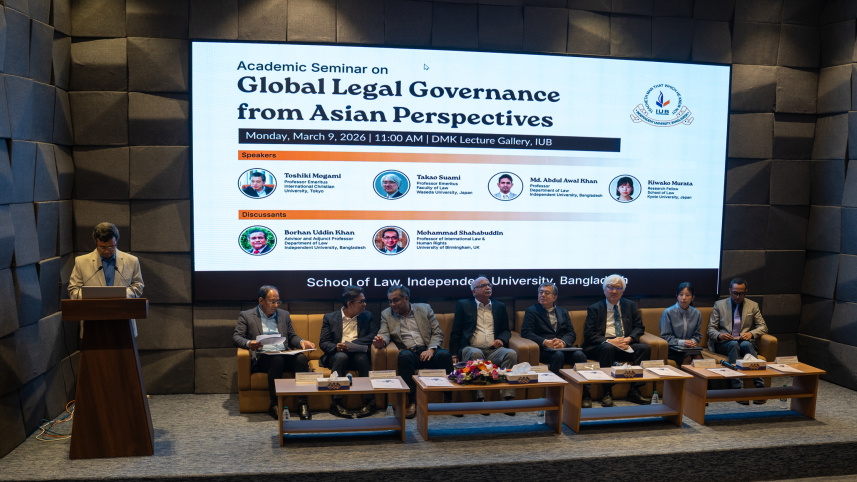
On 9 March 2026, the School of Law, IUB hosted an academic seminar titled Global Legal Governance from Asian Perspectives, bringing together legal theorists and scholars from Bangladesh, Japan and the UK to examine the deepening crisis of rules-based international law governance and the role of Global South. The session was moderated by Professor Dr Mohammad Nazmuzzaman Bhuian, Dean of the School of Law, IUB.
In his welcome speech, Dr Muhammad Mahbubur Rahman, Professor and Head of the Department of Law, IUB, traced the rise of Global South approach to international law since the Bandung Conference of 1955 reiterating the necessity of crafting an Asian perspective in light of contemporary challenges, including recent geopolitical developments. The Vice-Chancellor of IUB, Prof M Tamim, the Chief Guest of the Session, noted that as the old-world order is crumbling the countries from the Global South are set to suffer the most.

Next, Dr Takao Suami, Professor Emeritus at Waseda University, Japan, presented a rough sketch of the future of international law in his talk ‘Global Constitutionalism and the Future of International Law’. He argued that the current moment is neither unique nor a turning point as unlawful uses of force have been a recurring feature in international politics from Kosovo to Iraq to Afghanistan to Ukraine. Different is how the primary perpetrator, the US, has not invoked international law to justify its conduct rather side-stepped it altogether. The way forward, he contended, lies in fortifying international law through multiperspectivalism from the ground up, with universal elements, sifted through transnational dialogue.
The second paper titled, ‘Let’s Ruminate the Alleged “Death” of International Law’ presented by Dr Toshiki Mogami, Professor Emeritus, International Christian University, Tokyo, engaged with scholars who argue that international law is already dead or dying. International law, he argued, is not dying but is in a state of diapause- dormant, latent and waiting.
Moreover, Md Abdul Awal Khan, Professor, IUB presenting a paper titled, ‘Constitutional Supremacy, State Sovereignty, and the Challenge of Cross-Border Climate Mobility in South Asia’ addressed climate-induced displacement across South Asia. Nearly five million people alone within Bangladesh have already been internally displaced, with far larger aggregate figures across Bangladesh, India, Nepal, Sri Lanka, and the Maldives. His central argument was that neither traditional refugee law nor migration frameworks adequately protect climate displaced persons.
Finally, the Research Fellow of Kyoto University, Ms Kiwako Murata, added a sharp postcolonial dimension to the discussion. Her paper titled, ‘Postcolonial Normalisation of Exception: Criminal Procedure, Habeas Corpus, and the Rule of Law in Bangladesh’ proposed that preventive detention far from being an aberration is normalised and institutionalised through legal procedure. Exception, she concluded, is not the absence of law, rather its product which the Special Powers Act has made operable within the law through dual track governance.
In the closing, the two discussants Dr Borhan Uddin Khan, Advisor and Adjunct Professor, IUB and Dr Mohammad Shahabuddin, Professor, University of Birmingham shared their remarks. Professor Khan cautioned that the world appears to have slid from the rule of law through the rule of force into a rule by force where powerful states claim a say not merely in conflict but also in other nations' governance itself. Conversely, Dr Shahabuddin observed that declaring death of international law is a privilege only available to those insulated from it; for smaller states the full force of the law remains an everyday reality even when it fails.
Event covered by Law Desk.
 For all latest news, follow The Daily Star's Google News channel.
Comments