


Modi, Sharif agree to work closely
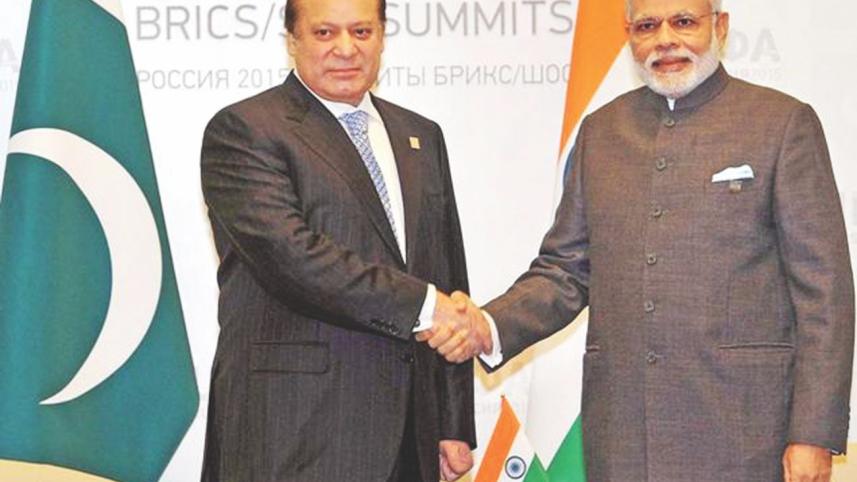
The prime ministers of nuclear-armed rivals Pakistan and India agreed at a rare meeting yesterday to cooperate on eliminating terrorism in South Asia, Pakistan's foreign ministry said.
In a sign of easing relations, Indian Prime Minister Narendra Modi also accepted his Pakistani counterpart Nawaz Sharif's invitation to attend a South Asian regional summit to be held in Islamabad next year.

"Both sides condemned terrorism in all its forms and agreed to cooperate with each other to eliminate the menace of terrorism from South Asia," Pakistani Foreign Secretary Aizaz Ahmad Chaudhry said in a statement.
Sharif and Modi met in the Russian city of Ufa, where they are attending summits of the BRICS trade group and the Shanghai Cooperation Organisation, writes AP.
The hostility between Pakistan and India dates back seven decades, but strains have grown since nationalist Indian Prime Minister Narendra Modi took office a year ago. Last month, US Secretary of State John Kerry voiced "enormous" concern over heightened tensions between the two countries.
Both sides have accused the other of fomenting terrorism. Pakistan alleges that India's spy agency is behind violence in the southwestern Baluchistan province and northwestern tribal regions.
New Delhi denies the charge, saying Pakistan should present solid evidence to back up its claim.
Meanwhile, India wants Pakistan to punish those who carried out deadly attacks in the heart of Mumbai in 2008 that left 166 people dead. Relations have deteriorated since April, when a Pakistani court freed Zaki-ur-Rehman Lakhvi, the suspected mastermind of the attacks, on bail.
Both sides agreed yesterday to find ways to expedite the Mumbai case, Chaudhry said.
"It is the first time Pakistan has accepted to combat terrorism in 'all its forms'," said MJ Akbar, spokesman for India's governing Bharatiya Janata Party. "After years of unclear delays, it is the first time Pakistan has promised to expedite" the Mumbai attacks trials, he said.
Modi has agreed to make a landmark visit to Pakistan next year to attend a meeting of South Asian leaders in Islamabad, India's Foreign Secretary Subrahmanyam Jaishankar said yesterday, signalling a warming of ties between the nuclear-armed neighbours after a year of tensions.
Experts warned Modi's trip could yet fall through, but if he goes, it would be the first time an Indian leader has visited the country since Atal Bihari Vajpayee in 2004.
The move demonstrates a readiness to engage with India's longtime rival despite the hawkish stance Modi's government has often taken.
The leaders also agreed on yesterday to work together to rein in regional militancy, scheduling rare meetings between national security advisers and heads of border security.
Modi and Sharif shook hands for about 15 seconds, smiling, before sitting down for talks, reports Reuters.
"The very fact that they've met is good," said Ayaz Amir, a political analyst and former lawmaker in Pakistan. "If they perhaps agreed to try to tone down the extremist rhetoric coming from both sides, that would be even better."
Modi's government has adopted a tough posture on Pakistan, insisting that it show greater progress in prosecuting members of the Pakistan-based group charged with carrying out the Mumbai attacks in which 166 people were killed.
In April, when a Pakistani court freed on bail Zaki-ur-Rehman Lakhvi, accused of plotting the attacks, the move drew swift condemnation from India, which warned that relations were deteriorating.
Clashes on the border in disputed Kashmir have also intensified during Modi's first year in office. On the eve of Friday's talks, an Indian border guard was shot dead by a Pakistani sniper in northern Kashmir, Indian officials said.
Sharif was elected in Pakistan in 2013 on the back of promises to rebuild relations with India, but has come under pressure to toughen his stance from hardliners at home, particularly within the army.
 For all latest news, follow The Daily Star's Google News channel.
 CORE ISSUE
Islamabad has long said that Kashmir remains the core dispute with India, and wants New Delhi to hold talks to resolve the row before moving forward on other issues such as trade.
The neighbours have fought three wars since independence in 1947, two of them over Muslim-majority Kashmir.
Yesterday's was the first meeting between the prime ministers in over seven months, when they shared a handshake and a few words at a South Asia summit in Nepal in November.
Their last formal talks were in May, 2014, after Sharif attended Modi's inauguration in New Delhi, a first for a Pakistani leader.
During that meeting, the newly anointed Indian prime minister issued a stern warning that Islamabad must stop militants from attacking India.
Friday's raft of announcements, made during a joint briefing by Jaishankar and his Pakistani counterpart after the bilateral meeting, were welcomed by Modi's colleagues in New Delhi.
Comments