


Ethical use of artificial intelligence in Bangladeshi news media

Media Resources Development Initiative (MRDI) and The Daily Star, with support from United Nations Development Programme (UNDP), held a roundtable on April 06, 2026. The roundtable brought together key stakeholders to examine the growing role of artificial intelligence in journalism worldwide, develop ethical frameworks for the use of AI in news media, strengthen professional capacity, reinforce information integrity, and promote responsible, transparent, and trustworthy journalism practices. Here is a summary of the discussion.

Syed Samiul Basher Anik
Manager, Programme
Media Resources Development Initiative (MRDI)

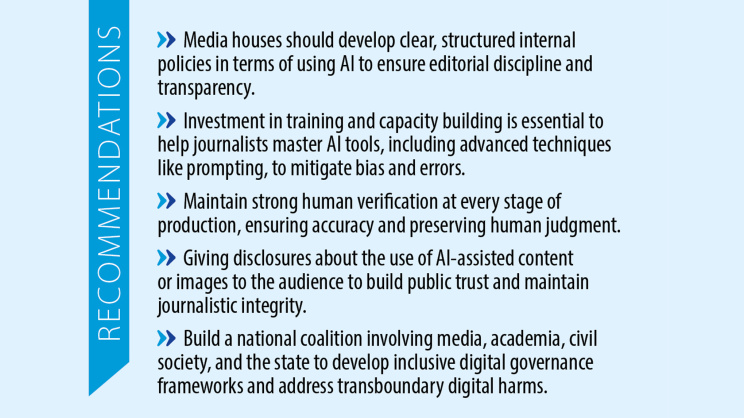
AI is already being used in Bangladeshi newsrooms, mainly for translation, content creation, data processing, and audience engagement. With this growing use comes important gaps, especially in editorial supervision and ethical oversight, which can affect the quality and reliability of information reaching readers. Findings from recent assessments show that many journalists use AI tools regularly, often relying on free platforms, yet face challenges due to limited knowledge and training. Moreover, awareness at the institutional level remains low, as most media houses lack clear policies or guidelines on the use of AI. Although AI use has expanded into research, verification, and data analysis, the process largely remains informal and ad hoc. As a result, transparency and disclosure are not consistently ensured, which may create confusion among audiences. As a solution to these, structured policies, capacity building, and ethical guidelines are needed. Greater collaboration among media, academia, and development partners, along with human oversight and training, can help secure responsible AI use while strengthening public trust and sustainability in journalism.

Shakhawat Liton
Executive Editor
The Business Standard
Ethical journalism is not only about personal honesty; it also requires the ability to question power, ensure accuracy, and avoid agenda-driven reporting. While artificial intelligence is emerging as a powerful tool that can improve efficiency, limited awareness and skills in newsrooms create risks of misuse, highlighting the need for better understanding and responsible application of AI. However, to guarantee the proper use of AI, relying only on legal solutions may not be sufficient, as too much control can restrict freedom. Instead, increasing investment in journalists to develop their skills is essential. A coordinated and long-term effort can gradually build a more ethical and capable media environment.

Ananya Raihan
Chairperson
iSocial
Clear newsroom policies and regular training are essential for the responsible use of AI in journalism, and these can be developed individually or through coordinated efforts. At the same time, along with generative AI, attention must be expanded towards the use of agentic AI, since it can pose greater risks in spreading propaganda. AI tools should not be treated as neutral, as they may carry ideological biases. Therefore, careful selection and critical use are necessary to avoid conflicts with editorial values. Accountability also remains a central point, and this can be strengthened through transparent correction policies and maintaining logs of AI use. Furthermore, policies should clearly define both acceptable and restricted uses. Broader efforts should be taken to address misinformation spreading outside traditional media platforms in a balanced and effective way, while mainstream media can strengthen internal practices.

Talat Mamun
Managing Director
Live TV
Ethical challenges in Bangladeshi journalism remain significant, with limited clarity in self-regulation and professional standards across media platforms. Artificial intelligence will be a prominent tool in the coming years, and it is likely to be used as a regular tool in newsrooms, offering speed and efficiency. However, without strong ethical awareness, the risk of misuse may also increase. Building internal responsibility within media houses is essential, as an external regulation system alone may not bring meaningful change. If leading media organisations take the initiative and set clear ethical standards for AI use, it can gradually influence the wider industry. At the same time, AI can also be seen as an opportunity to strengthen ethical practices and improve content quality. By using this technology responsibly, there is potential to create a more reliable and ethical media environment.

Shawkat Hossain Masum
Head of Online
Prothom Alo
In Bangladeshi journalism, readers’ demands are barely taken into account, whereas global trends emphasise bridging the gap between editorial output and reader behaviour. Today’s readers prefer question–answer-based searching and direct information access rather than long narrative formats. To remain relevant, news organisations need to shift toward a reader-centric model by restructuring content into scannable summaries, audio formats, and structured FAQs. This approach is essential in an evolving digital landscape where traditional SEO is being replaced by answer-based search systems. However, financial constraints and technological shortcomings can pose challenges to this transition; yet the focus must remain on constructive adaptation. Establishing internal ethical guidelines and leveraging agentic tools are necessary. Ultimately, embracing AI is not about replacing staff, but about enhancing efficiency and relevance in an increasingly competitive digital ecosystem.

Tanim Ahmed
Digital Editor
The Daily Star
As long as journalistic ethics are practised by the news media, the process of content production and quality assurance remain structured, credible, and reliable automatically. Thus, a separate ethical guideline for the use of AI is unnecessary; instead, existing codes of ethics must govern all technological applications. Consequently, regulation should focus on the final output, ensuring accuracy and legality rather than the specific tools used during production. Maintaining a human touch is essential, as content should never feel purely “AI-generated” or mechanical. Moving forward, greater research should be done to reach the optimum capacity of these tools. By prioritising human oversight and transparent disclosure of AI-assisted content, newsrooms can ensure that technology enhances rather than diminishes the quality of reporting.

Md. Al Mamun
Country Director, Bangladesh
BBC Media Action
Adhering to core journalistic ethics remains the most effective way to navigate the challenges posed by emerging technologies. Since AI can produce errors with great confidence, including fabricated references, maintaining high levels of efficiency is vital. Without significant investment in training, there is a risk of mishandling sensitive data or falling behind global media houses. Transparency through disclosure is equally important, yet it remains a delicate balance. While audiences demand to know when AI is used, clear communication is necessary to guarantee that such disclosures do not inadvertently undermine trust. Therefore, media houses must educate both their staff and their readers on how AI functions as a tool within the reporting process. Ultimately, while technology may automate certain tasks, it can never replace human judgment. Thus, producing skilled professionals by investing in training programmes is essential to have strong oversight to prevent disasters and ensure that AI serves the truth. Also, informal media that spread misinformation must be brought under government policy to save the audience’s trust in the mainstream media intact.

Din M. Sumon Rahman
Professor & Head, Media Studies & Journalism
University of Liberal Arts Bangladesh (ULAB)
The rise of AI has transformed the academic and media landscape. With the help of AI, generating research and content overnight has become much easier. Since it is an era of AI, there is no other way than embracing it. Thus, the focus must shift from resisting technology to mastering it. However, awareness should be raised about the significant risks of sophisticated disinformation that AI produces. In a post-truth era, where AI-generated videos are increasingly difficult to debunk, maintaining ethical standards is more important than ever. Ethical journalism requires a commitment to maintaining transparency through disclosure, regardless of potential audience loss. While newsrooms develop internal policies, there is an urgent need to improve the AI literacy of both journalists and the general public. Mastering the art of prompting is crucial to minimising AI bias and hallucinations. By investing in these skills, the media can ensure that human intelligence continues to guide and verify the outputs of artificial tools.

Maliha Tabassum
Assistant Professor, Department of Mass Communication and Journalism
Bangladesh University of Professionals
The journey toward responsible AI integration must begin with a strong emphasis on ethics. Moral education should be instilled at every level, from schools to universities, to ensure that professionals in all fields uphold high standards of integrity. Since self-regulation alone may not suffice, formalising these ethics into clear regulatory frameworks is essential for the current era. Alongside moral grounding, there is a pressing need for deeper AI literacy. Understanding the “black box” of how AI models process data is crucial for informed usage. Furthermore, as advanced tools like agentic AI become more common, fostering awareness about their information generation and filtering processes is vital. Combining technical knowledge with a clear understanding of personal limitations will ensure that technology remains a force for good.

Arun Devnath
Deputy Editor
The Daily Star
 For all latest news, follow The Daily Star's Google News channel.
 In the context of AI adoption in newsrooms, accuracy must take precedence over speed, as the primary responsibility of journalism is to produce authentic and reliable information. While the cost of adopting AI is often perceived as high, many tools can actually be implemented at relatively low expense and shared across teams, making them more accessible. In terms of AI use, the main challenge lies not in individual skills but in integrating AI into institutional systems. Progress in this area is expected to improve workflows. Moreover, AI is helping journalists focus more on meaningful work by reducing routine tasks. Although concerns about job loss exist, roles are more likely to evolve into hybrid positions combining reporting and editing. Finally, the responsible use of AI, supported by clear guidelines and strong human verification, remains essential for maintaining ethical and effective journalism.

Saiful Alam Chowdhury
Associate Professor
Department of Mass Communication & Journalism, University of Dhaka
In Bangladesh’s media, context often matters more than content, shaped by both political and technological realities. Newsrooms here are mostly structured into print, online, and multimedia wings and some online sections rely heavily on fast content sharing instead of original reporting. As a result, speed sometimes takes priority over authenticity. Moreover, AI brings opportunities but also challenges, especially due to ideological bias in datasets, which can lead to various inaccuracies. Alongside this, limited awareness about advanced tools remains a barrier. However, regulation should be approached carefully, as journalism already depends on accuracy, balance, and clarity. Verification remains essential, particularly in fast-moving situations. Therefore, a stronger understanding, responsible use of technology, and gradual capacity building can support a more effective media future.

Hasibur Rahman
Executive Director
Media Resources Development Initiative (MRDI)
Investment decisions have become more complex, as technology changes quickly and long-term planning carries uncertainty. Moreover, finding the right expertise remains a challenge. Many technology specialists lack newsroom understanding, which limits their effectiveness. Therefore, experts with both technical and newsroom knowledge are essential. On ethics, stronger self-regulation and updated guidelines are needed, including clear sections on AI. Finally, sharing good practices across newsrooms can build collective progress, while open discussion of challenges can help the industry move forward more effectively.

Sheela Tasneem Haq
Senior Governance Specialist
UNDP Bangladesh
While technology serves as a powerful enabler, it also introduces significant challenges like algorithmic bias and information disorder. In this evolving environment, the human must remain the pilot while AI acts as the co-pilot. Therefore, the focus should be on building a value-based system where ethical use is driven by personal integrity and accountability. Addressing transboundary issues like digital harm and technology-facilitated violence requires more than just policy frameworks; it demands a multi-stakeholder coalition. A plural digital ecosystem is essential, bringing together civil society, media houses, and the state to ensure information integrity. Investing in regional cooperation and early warning systems can help manage the risks of a profit-driven digital world. Ultimately, the goal is to develop an inclusive AI policy that prioritises sectoral implications and keeps human needs at the heart of technological progress.

Dr. Susan Vize
Head of Office and Representative to Bangladesh
UNESCO
At present, trust in the media is already low, and AI may further affect it, so this issue needs careful attention. At the same time, broader digital governance, including data protection and AI policy, will shape how the media operates. Therefore, media voices should be included in discussions with the government through multi-stakeholder dialogue. Global ethical frameworks on AI provide useful guidance, but they should be adapted to local values and diverse social realities. Moreover, capacity gaps remain a major concern, both in producing content and in helping audiences understand it. AI literacy is essential, not only for journalists but also for the public. AI offers clear benefits, such as faster research and automation, but it must always support reliable information. Hence, strong ethical guidelines, continuous learning, and adaptable policies are necessary to respond to rapid technological change.

Kamal Ahmed
Consulting Editor
The Daily Star (Moderator of the Session)
AI use in Bangladesh’s media is still limited and often lacks clear guidelines, which can create confusion. Some instances of the misuse of AI show the risks clearly, though major incidents have not yet been widely reported. Therefore, strong self-regulation within the media is essential, as reliance on external control may increase if internal standards remain weak. At the same time, AI tools are not always accurate or updated, which makes human oversight necessary at every stage. Transparency about AI use is also important to maintain trust. Moreover, the media landscape has already shifted to a multimedia environment, where AI use is unavoidable. However, without clear ethical practices and editorial discipline, the risks of misinformation and bias cannot be eliminated. So, setting shared standards, strengthening ethics, and ensuring responsible use of AI can help reduce confusion and support a more credible media system.
Comments