


Gas bills paid, cylinders bought, dinner still pending
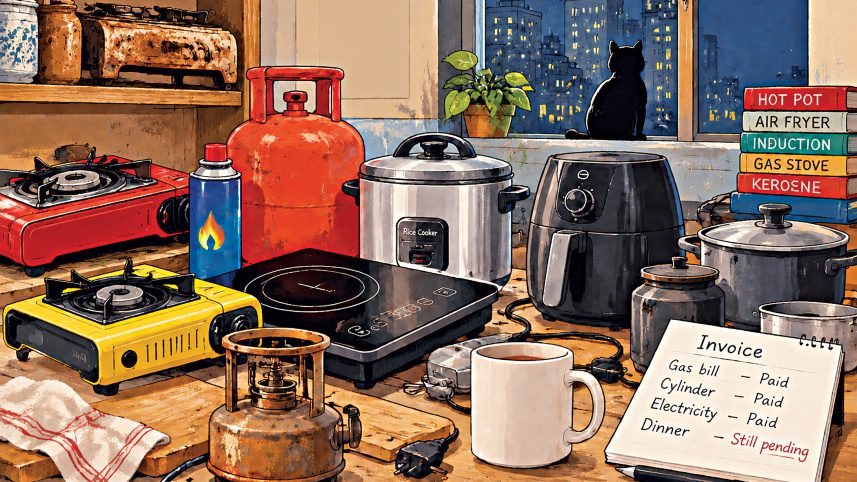
A trivial thought keeps pestering me like a mosquito on a humid Dhaka night -- how many burners does a kitchen actually boast, and why does it feel like the answer might upend my peace of mind?
For most of my life, I survived on a humble two‑burner gas stove. Now, somehow, I’ve ended up with a motley parade of fancy contraptions -- some gleaming in tip‑top condition, others rusting away in forgotten corners of my store. My old‑styled house does not have the functional kitchens of modern interiors; mine is more of a museum of cookers -- or perhaps a shrine to old cookers -- as if modernity skipped my address entirely, leaving me far from design magazine fantasies.

There’s the cherry‑red Korean tabletop gas burner with disposable butane canisters, an impulsive purchase during Dhaka’s initial gas crisis days. I was convinced it was the perfect solution back then. I thought this fancy and interactive dining cooker, almost like a tabletop BBQ or hot pot, would be just the thing for those few hours when the gas pressure in Titas’s pipelines dipped low. That was five years ago.
Now the tables have turned: the supply line remains empty for 23 hours a day, and the one hour it makes a feeble attempt to ignite is at midnight. You can manage without cooking, sure, but sacrificing sleep for a pot of rice is madness -- almost as mad as expecting fixed gas burners to stage a midnight comeback.
Yes, I am cribbing about Dhaka’s gas crisis while simultaneously praising the market’s modern innovation to solve it. By then I had fallen for the induction‑cooker craze, a sleek companion to my Korean burner. Of course, it demanded flat‑bottomed utensils, which felt like a cosmic joke. When the gas disruptions grew unbearable, I went full caveman and bought a kerosene stove. Ridiculous, yes -- but I’ll admit I loved the smoky perfume when dousing the fire with water. Still, it was a wasteful experiment.
Eventually, I surrendered to the whims of supply lines, rationing my butane canisters like wartime rations. A year ago, I finally installed a portable cylinder, which gets replaced for Tk 1700 when it runs dry. And just this January, I picked up another induction cooker from Kiam Metal Industries Limited at the Dhaka International Trade Fair -- this one mercifully indifferent to pot shapes. Somewhere along the way, a canary‑yellow butane stove joined the circus. I’ve lost count.
Sometimes I wonder if Dhaka’s gas crisis has turned us all into accidental appliance collectors. What began as survival tactics -- snapping up burners, cylinders, and induction cookers -- now feels like curating a bizarre museum of kitchen gadgets. Each shiny contraption promises salvation, yet ends up mocking me when the pipelines wheeze at 2:00am. It’s less cooking, more comedy of errors, and I’m the unwilling curator of this absurd exhibition.
Meanwhile, Dhaka’s market is flooded with “solutions”: rice cookers, soup makers, air fryers, gadgets galore. My hunch? Home cooking will vanish, replaced by restaurant meals churned out on industrial burners immune to Titas’s tantrums -- or perhaps we’ll regress to mud stoves and biofuel. Either way, the gas crisis is burning at both ends.
My friend in Dhanmondi says she hasn’t had a whiff of gas for two weeks. The induction cooker is their lifeline. Rumour has it the pipelines cough back to life at odd hours of the night, but she is no owl to cater to midnight picnics. Honestly, who plans dinner at that ungodly hour?
And then there’s Uttara -- where residents pay prepaid gas bills, shell out cash for those hulking cylinders, and still foot hefty electricity bills for induction burners and curry makers. The irony? We’re paying for gas, paying for cylinders, paying for electricity, and yet the kitchen remains hostage to a crisis that refuses to cook itself away. If you drew up an invoice, it would read: ‘Gas bill -- paid. Cylinder -- paid. Electricity -- paid. Dinner -- still pending.’
Dhaka’s home kitchens, it seems, are the only places where you can pay three times over and still go hungry.
 For all latest news, follow The Daily Star's Google News channel.
Comments