



Law Views / How the built environment shapes the realities of human rights
19 August 2026
•
Law & Our Rights

For Your Information / When confessional statements may not lead to conviction
19 August 2026
•
Law & Our Rights

Daily Life Blues / Remedies for excessive electricity bills
19 August 2026
•
Law & Our Rights

Law Vision / The danger of using AI in legal submissions
12 August 2026
•
Law & Our Rights

Law Views / Constitutional environmental rights in South Asia
12 August 2026
•
Law & Our Rights

Law Opinion / Cyber-attacks and a state’s right to self-defence
12 August 2026
•
Law & Our Rights

How negligence and lack of law enforcement led to Sitakunda tragedy
18 August 2026
•
Law & Our Rights

Law Opinion / The sleeping giant
8 July 2026
•
Law & Our Rights

Law views / Refusal of entry visa in a global sporting event and international law
2 July 2026
•
Law & Our Rights

Law Vision / The need to protect our data
2 July 2026
•
Law & Our Rights

Who owns what?
More often than not, the statutes remain silent or they do not have enough words to meet the requirements of establishing justice.
26 May 2022

Is arbitration becoming more expensive than litigation?
Alternative Dispute Resolution methods, particularly arbitration has become increasingly popular in Bangladesh over the last two decades, so much so that a separate law on arbitration was enacted to accommodate it.
19 May 2022

Business and Human Rights: The Pathway for Bangladesh
Surya Deva is a Professor at the Macquarie Law School and a founding Editor-in-Chief of Business and Human Rights Journal.
19 May 2022

The Anti-Discrimination Bill 2022
The draft law appears to have been only prepared to fulfill the state’s prior commitments to enact an anti-discrimination law, but there is clear lack of thought behind making the law effective.
17 May 2022

The Anti-Discrimination Bill 2022: What experts say
On 5 April 2022, Law Minister Anisul Huq has placed the ‘Anti-Discrimination Bill 2022' in the parliament. The Bill is now with the parliamentary committee of the respective ministry for further examination.
15 May 2022

Competition Law Concerns for Trade Associations and Businesses
Consumers want goods or services from businesses at competitive prices. Competitive business enterprises come together to form trade associations in the hope of furthering their common interests.
15 May 2022

ILO Convention No. 190: A monumental development to address violence and harassment at workplace
Until June 2019, various international instruments, norms, and practices were developed by both the International Labour Organisation (ILO) and the United Nations to deal with violence and harassment at workplace.
6 May 2022

In quest for rules to be laid down under the Arbitration Act, 2001
In many instances, an Act of Parliament includes a provision allowing the government or the relevant authority to make rules for carrying out the provisions of the concerned Act. Under an Act of Parliament, the rules are framed as directives and/or instructions for the users of the legislation in question. If rules are framed as such, more clarity is brought about and confusion about many provisions of the relevant statute gets dispelled. It also helps to carry out the purpose of the legislation in line with the intention of the legislature.
6 May 2022
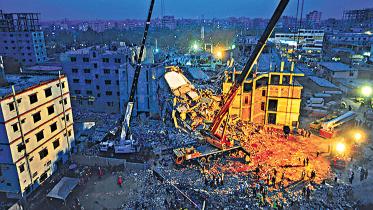
Compensation for the victims of psychological trauma
After the demise of her only daughter in the Rana Plaza tragedy, 55-year-old Rahima Begum (not her real name) has lost her psychological state and is suffering from Post Traumatic Stress Disorder (PTSD).
29 April 2022

Ignorance abrogates the enjoyment of trademark protection
Bangladesh holds a strong legal framework on trademark protection under the Trademark Act, 2009. The Act has clear provisions about the use of trademarks, the rights and the consequence of violation of rights, etc. The significances of trademark laws are mostly unknown to the common people. The Trademark Act contains definitions of all the aspects related to trademark such as ‘mark’, ‘registration’ ‘distinctive’ etc., so that no confusion can arise on interpreting the trademark law.
29 April 2022

On the draft income tax law
A draft income tax law has been pending enactment for a long time and it has many provisions which need to be evaluated and revised. The major drawback of the existing law is the lack of transparency and excessive prerogative power given to the officials. The draft law has proposed to increase the power of the NBR to deduct, reduce and exempt tax of the assessee. However, the existing law makes the responsibility of the NBR negligible as more than 90% of the tax collected by the government comes from businesses and individuals in the form of deduction at sources.
29 April 2022

Effectiveness of ‘local settlement’ practice for protection of Rohingyas
Since 2020, the Government of Bangladesh has been relocating the Rohingyas to Bhashan Char. The UN and other agencies initially criticised the relocation process.
22 April 2022

To improve ADR system under the labour law in Bangladesh
For dispute resolution through alternative methods, prior to making a claim in courts, Bangladesh Labour Act, 2006 (herein after ‘the Act’) has provided for two mechanisms, one is available under section 33 of the Act (a complaint in writing to the employer) and the other is accessible only when it is an industrial dispute and raised by a collective bargaining agent or employer within the meaning of section 2(62) read with section 209 of the Act.
22 April 2022

New Patent law passed in the parliament
Particularly in light of the global discourse on patent law in relation to the availability of vaccines for the COVID-19 pandemic, the need for a comprehensive and up-to-date regime on patent law was highlighted by academics and policymakers.
15 April 2022

What was the aspiration of the mother language movement?
This year we commemorated the 70th anniversary of our language movement, which established the syncretic character as a nation and outstretched the notion of the right to mother language all over the world.
15 April 2022
Bankruptcy by the debtor: A legal analysis
In Bangladesh, bankruptcy is governed by the Bankruptcy Act, 1997. An individual can be declared ‘bankrupt’ through an order of adjudication by the bankruptcy court if he commits an act of bankruptcy as described in section 9 of the said Act.
8 April 2022

Observation on the draft National Pension Authority Act
The government has published the draft National Pension Authority Act, 2022 and proposed a self-contributory pension scheme for citizens within age ranging from 18 to 50 years having National Identity Card (NID) and living in home or abroad.
8 April 2022
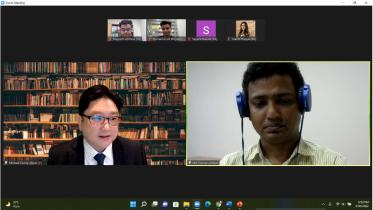
NSU organises webinar on trade in vaccines, medicines, and essentials in the post-pandemic world
The Department of Law, North South University organised a webinar on the topic 'From Self Sufficiency to Collective Security: How the Covid Pandemic
5 April 2022
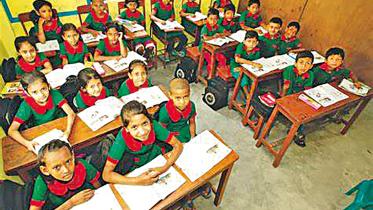
Banning notebooks: Legal framework and shortcomings
The purpose of education is not only to acquire knowledge, rather it is the process which contributes to the overall development of individuals. Creative education systems (hereinafter called as CES) generate critical thoughts among the students, and promote innovativeness.
1 April 2022
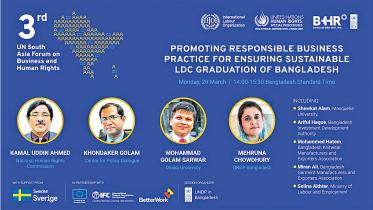
Promoting Responsible Business Practice for Sustainable LDC Graduation
The Bangladesh Country Session at 3rd UN South Asia Forum on Business and Human Rights was held on 28 March, 2022 under the theme ‘Promoting Responsible Business Practice for Ensuring Sustainable LDC Graduation of Bangladesh’ in a hybrid format.
1 April 2022
Seven parties including NCP, BJP, AB party failed to submit poll expenses to EC
26 June 2026
•
National Election 2026
2026 Bangladesh elections 'a democratic milestone': Commonwealth Observer Group
15 June 2026
•
National Election 2026
EC gives 21 candidates until June 14 to file election expenditure reports
24 May 2026
•
National Election 2026
Local govt polls ‘challenging’, but no lack of effort: CEC
21 May 2026
•
National Election 2026