


The proposed Cyber Protection (Amendment) Act and free speech
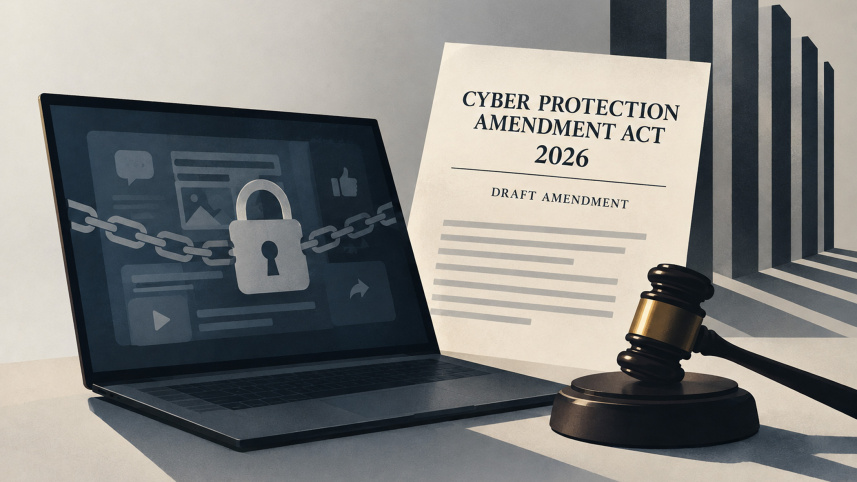
The Cyber Protection Act, 2026 (the ‘Act’) is the primary law regulating Bangladeshi citizens’ activities online. Recently, an Amendment bill has been proposed, and it has garnered the attention of netizens for some of its vague provisions.
Firstly, the proposed amendment introduces section 26A, which criminalises sharing ‘unverified information’ (not false information) online with up to 10 years of imprisonment. Due to the ambiguous nature of the term, it may be interpreted as any information pending confirmation by the government, thereby broadening the ambit of police powers. As a result, it may impede the ordinary functions of a free press, e.g., journalism, eyewitness reporting, and citizen accounts of a death during a protest, published before an official statement arrives.

“The incoherence of the maximum penalties prescribed in the new draft is also noticeable. The draft amendment prescribes ten years of punishment for both cyber-terrorism causing death or serious injury and the offence of sharing fake news online. This cannot be explained by any theory of proportionate punishment. A law that punishes the ‘offence’ of sharing unverified information as severely as an act of terrorism cannot be deemed to be concerned about preventing harm but about preventing speech.”
Next, section 25 currently covers sexual harassment, blackmail, revenge pornography, and child sexual abuse material. However, the proposed amendment quietly folds ‘defamation’ and ‘humiliation’ into that same list and doubles the penalties across the board: from 2 years of imprisonment to 5 years in general, and from 5 years of imprisonment to 10 years for offences against women. The vagueness in the newly added definitions is, arguably, a deliberate choice, not a lapse in drafting skill.
On the other hand, section 8 currently allows only law enforcement agencies to seek the blocking of online content for narrowly listed reasons. However, under the proposed amendment, the Ministry of Information, along with other unnamed empowered agencies, is also granted the same powers. Moreover, the requirement of obtaining judicial approval after blocking or removing content is also done away with. Rather, the proposed amended section requires the aggrieved person to apply before the agency or the court to make the removed or blocked content accessible again. Meaning, in practice, the same body imposing a block will also become the adjudicating forum for its own cause, violating the cardinal principle of natural justice - ‘No one should be the judge of their own case.’
The incoherence of the maximum penalties prescribed in the new draft is also noticeable. The draft amendment prescribes ten years of punishment for both cyber-terrorism causing death or serious injury and the offence of sharing fake news online. This cannot be explained by any theory of proportionate punishment. A law that punishes the ‘offence’ of sharing unverified information as severely as an act of terrorism cannot be deemed to be concerned about preventing harm but about preventing speech.
Unfortunately, Bangladesh has run this experiment before. The Digital Security Act of 2018 produced over a thousand cases and arrests in five years, disproportionately targeting politicians and journalists. Notably, the writer Mushtaq Ahmed died in prison, and Ahmed Kishore was arrested for drawing cartoons under that repressive law. Renamed as the Cyber Security Act in 2023, the law kept nearly all of its repressive provisions intact, according to Amnesty International's own review. It took Bangladesh years and a change of government to undo that structure and enact a better law. Unfortunately, this amendment is once again taking us backwards.
To conclude, a cyber security law which curtails freedom of expression disproportionately fails its stated purpose. The remedy for wrong information has always been better information, not imprisonment. I believe the Parliament should withdraw the amendment and let the current Act remain intact.
The writer is a civil and political activist and a researcher at Human Rights Support Society.
 For all latest news, follow The Daily Star's Google News channel.
Comments