


Nazrul cannot be contained within a singular frame

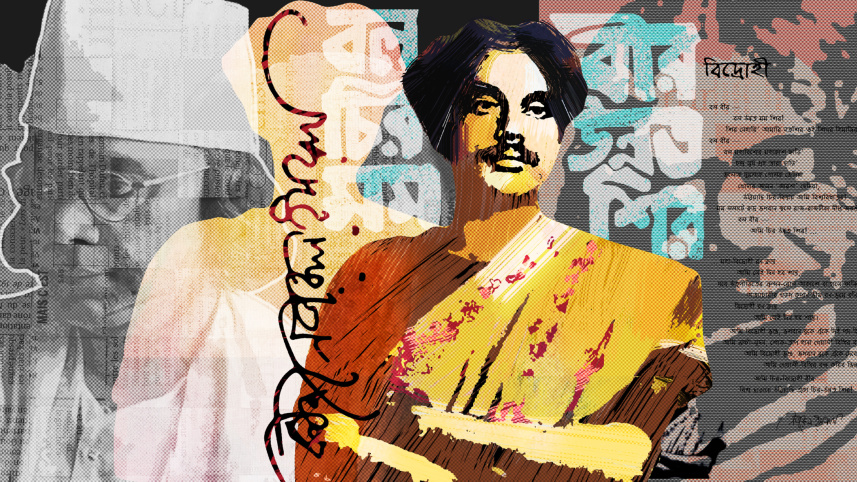
Nearly 50 years have passed since the death of Kazi Nazrul Islam, born on May 24, 1899, whose 127th birth anniversary is being marked today, and between his birth and death lies a body of work that has never behaved like still literature.
Nazrul’s “Rebel Poet” identity is too constrained to limit him within a single frame. Nazrul’s poetry moves, shifts beyond even its historical significance. They take rebirth, reverberates, enter speech, then public conscience, and Nazrul returns as chant—becoming the primary language of people’s struggle for rights, carrying an unyielding spirit in every movement when people most need him.

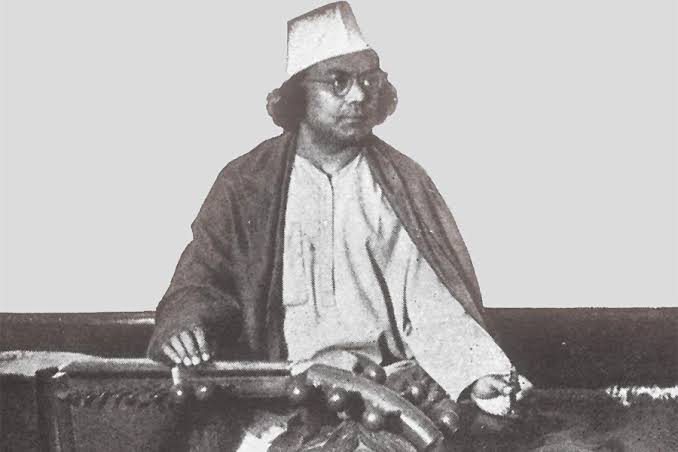
Whenever I, along with my friends, went to protest streets—past Shahbagh, quota reform marches, road safety demonstrations, and earlier anti-authoritarian mobilisations and even now when as national being we voice our dissent—his lines arrived as declarations of our deepest strength, as a call for justice, equality, and a human resilience that refuses to be subdued. For Bengalis, Nazrul is not only a poet; he exists in constant form—as voice, force, and presence whenever power feels absolute.
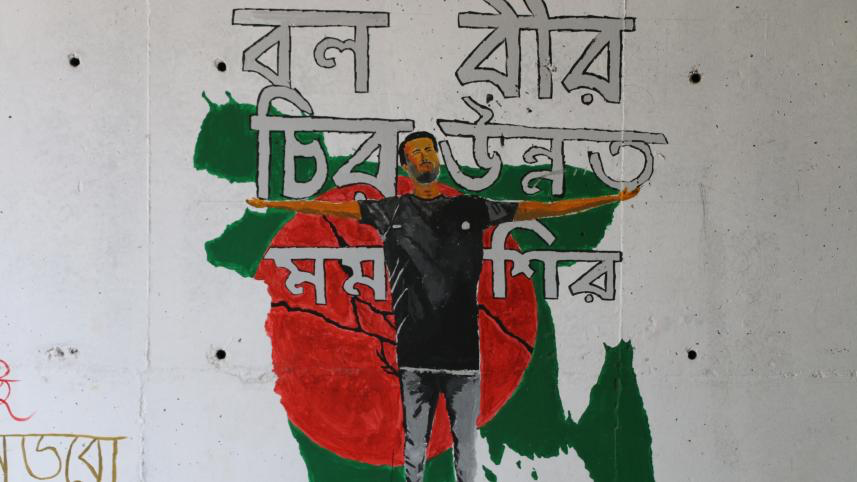
“Bolo bir—
bolo unnoto momo shir!”
(Speak, O hero—
lift my head high!)
Then comes “Bidrohi”—not as a poem we recite fully, but as fragments that survive in memory and pressure.
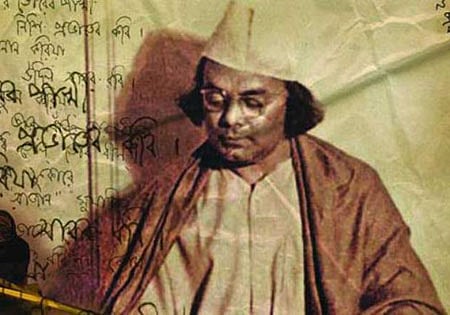
“Moha bidrohi rana klanto, ami shei din hobo shanto—
Jobe utpiriter krondon-roul akashe batase dhonibe na,
Atyacharie khargo kripan rana-bhume ar runjito hobe na.”
In these lines, the meaning is not only rebellion, but exhaustion turned into refusal. It is a declaration that violence and oppression have to disappear before peace can even be imagined. That is why the lines never stay inside literature. They spill into speech and movement.
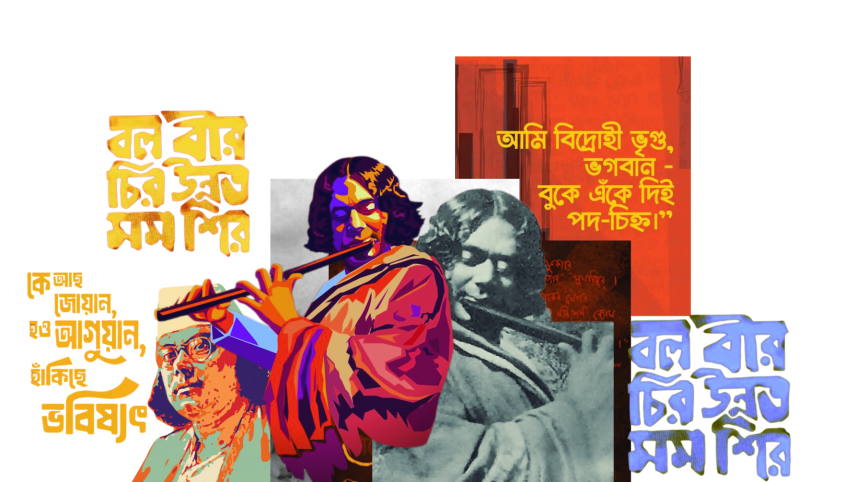
“Ami bidrohi bhṛigu, bhogoban buke eke dei podo-chinho,
Ami sroshtha-sudon, shok-tap hana kheyali bidhir bokkho koribo bhinno!”
This is not only mythic language. It is a break from fixed authority itself. God, power, fate—everything becomes contestable in the grammar of these lines. That is why they survive in public chant, not in quiet reading.
“Ami chiro-bidrohi bir—
Bishwo charaye uthiyachi eka chiro-unnoto shir!”
These lines are nationally memorised and chanted, not because he is simply a national poet, but because he understood what the Bengali human spirit should sound like when it refuses submission. Even when not fully remembered, the rhythm survives, and people complete it in their own way.
This is where Nazrul stops functioning as author and begins functioning as a shared vocal and national conscience infrastructure. His poetry has never been confined only to textbooks or formal reading spaces. Rather, he is who we go to every time we face atrocity, silence, or pressure from power, and we each become fragmented extensions of that same rebellious voice.
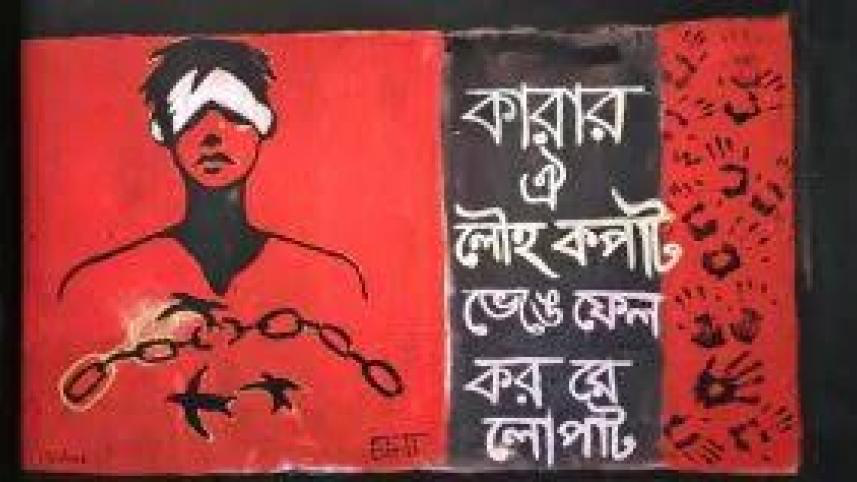
A second line appears, more forceful in form and usage, as if it refuses silence:
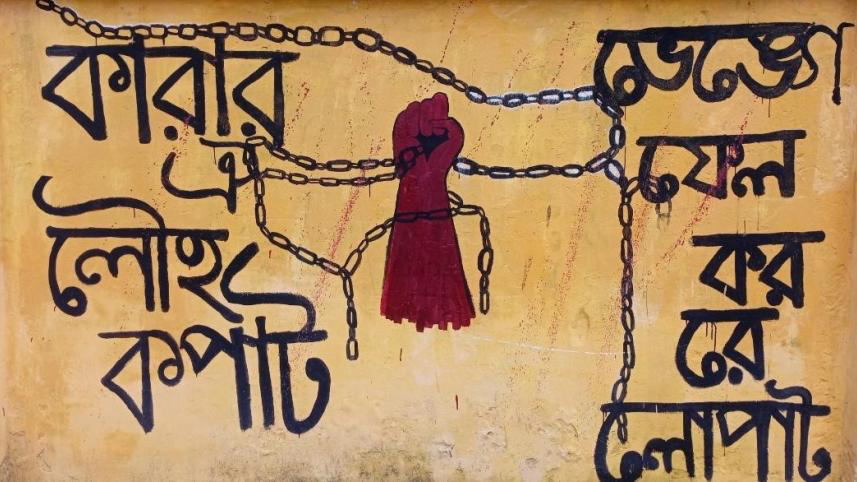
“Karar oi louho kopat, Bhenge fel kor re lopat”
(Break the iron gates of prison, tear them apart)
It is a line that does not describe confinement; it performs its collapse. In chants, it is not only recited—it is struck, like a sound that refuses to stay inside the throat.
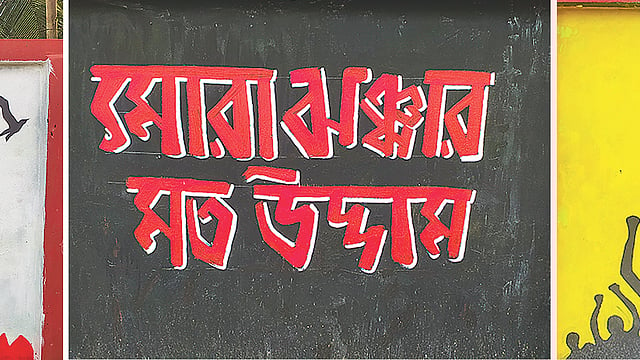
Walk through older protest memories and the pattern repeats. Walls in the capital and across the country carry another familiar fragment:
“Mora jhanjhar moto uddam..”
(We are wild like storms)
Painted quickly, half-faded, overwritten by newer slogans, it still returns in cycles—not as heritage, but as usable speed, as if reminding passersby, students, and children of what collective force feels like when it becomes uncontained.
Nazrul’s language survives because it is structurally suited to rupture. His poetry is built with mythic memory, commands, reversals, calls, and refusals. It does not wait for interpretation; it insists on continuation.
A strange thing happens when Nazrul reappears in uprisings and movements. He is so blended into the collective psyche that he does not feel distant, or even only literary. He becomes present in fragments—spoken, corrected, repeated—like something that never stopped speaking in the first place.
 For all latest news, follow The Daily Star's Google News channel.
 Even when partially remembered, it holds shape:
“Bhangar gaan gao, bhangar gaan”
(Sing the song of breaking)
What breaks is not the line. What breaks is containment.
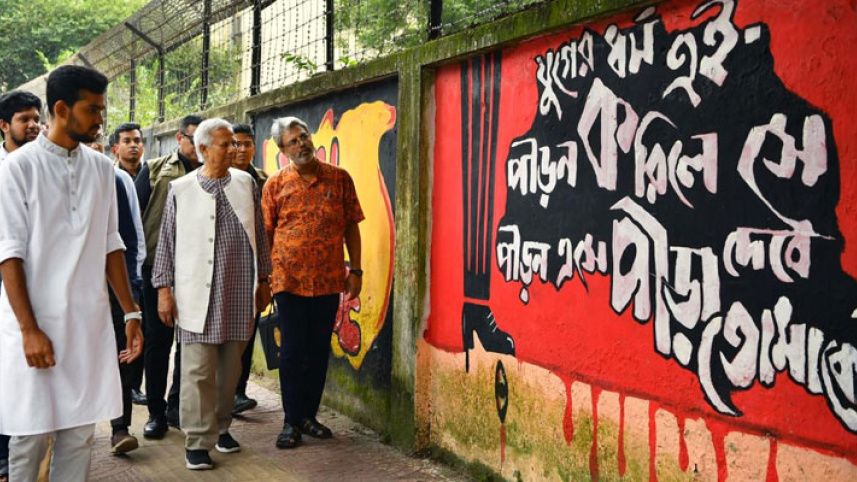
In protest environments, Nazrul creates a specific grammar. Speech becomes collective repair. When hundreds of protesters chant his poetry as slogans, as collective calls, as rights, one voice begins a line, another completes what is missing, a third intensifies rhythm. Meaning is not transmitted; it is reconstructed under pressure.
This is why Nazrul does not appear in these spaces as a literary reference. He appears as something closer to a shared script.
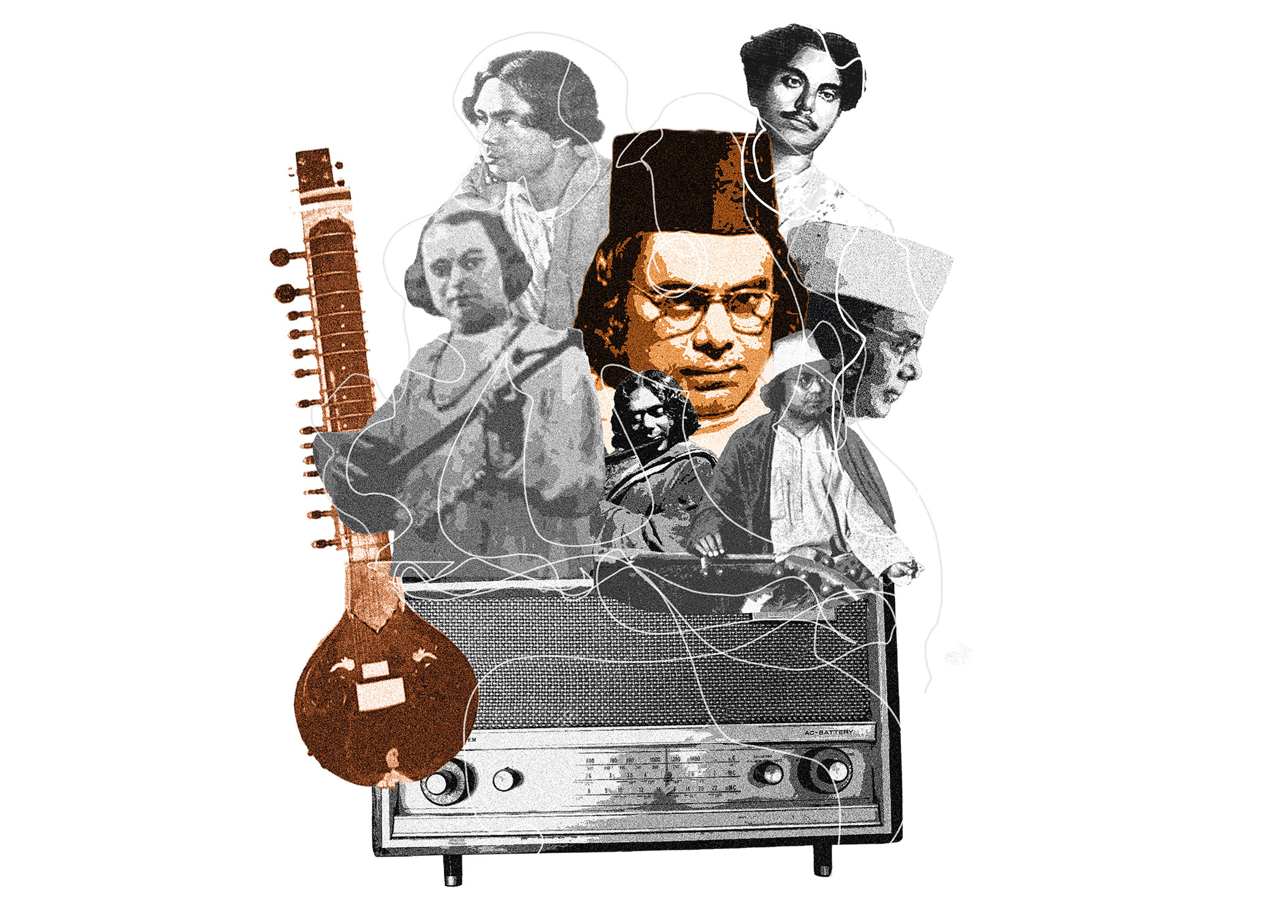
The circulation of his work in Bengal has always carried instability. During colonial rule, his writing travelled through periodicals, theatre, political gatherings, and informal recitation networks. Suppression did not stop circulation; it displaced it into oral form. That displacement never ended. It only changed medium.
Later political moments in the region show the same pattern of return. In mass mobilisations—from the late 20th century into recent student uprisings—Nazrul’s lines re-enter public space without announcement, on banners, in slogans, in shouted bursts that rarely pause for attribution.
Sometimes the poetry arrives as near-invocation:
“Gajoner bajna baja! Ke malik? Ke se raja?”
(Drums of rebellion sound! Who is the owner? Who is the king?)
It is not asked as philosophy. It is shouted as refusal of settled authority.
There is another reason these lines survive street conditions: compression. Nazrul writes in short kinetic units—phrases that survive noise, interruption, and crowd distortion. They are designed, whether intentionally or not, for environments where clarity is constantly under pressure.
“Shikol poriye dao jara, shikol khule felo”
(Those who are chained, break the chains) or the poem ‘Shikol Porar Gaan”. Even when incomplete, the structure completes itself in speech.
Across different protest cycles in Bangladesh, newer forms of mobilisation—social media clips, short-form videos, rapid digital slogans—have not displaced this older archive. Instead, they have accelerated its fragments. A line appears in a 10-second clip, detached from origin, reattached to urgency. In that circulation, authorship becomes irrelevant. What matters is usability.
Nazrul’s work fits this economy because it was never written as static commentary. It was written in the register of movement—political, bodily, sonic.
That is why “Bidrohi” still functions as a latent structure inside protest speech, even when not fully quoted. Its internal logic—assertion without permission, identity without apology—continues to surface in condensed form. Sometimes only its cadence survives.
“Bolo bir…”
What remains consistent is not accuracy of recall, but durability of rhythm.
This is where Nazrul’s afterlife becomes visible: not as a preserved national symbol, but as a repeatedly activated language system. A system that appears when collective speech becomes necessary, and individual speech is no longer enough.
In those moments, he is not remembered. He is spoken again. And spoken, he changes form without losing force.
Nazrul is reborn every time Bengalis need him, every time oppression crosses the threshold of endurance. He continues to live in Bangladesh through oral memory, public speech, and collective conscience.
Comments