


‘Urban Images’ turns art into an act of solidarity
Art has always found ways to document cities through the rhythms, fractures and quiet resilience that define urban life. Veteran artist Kazi Salahuddin Ahmed’s latest solo exhibition, “Urban Images”, does exactly that. Yet beyond the abstract compositions and layered cityscapes lies another, more immediate story—one of artists standing beside one another when it matters most.
The exhibition, currently underway at Alliance Française de Dhaka until July 17, is a charity initiative organised to raise funds for the treatment of fellow artist Mostofa Al-Tahmid Ritu, who is battling advanced abdominal cancer. A graduate of the Faculty of Fine Arts at the University of Dhaka, Ritu was diagnosed during surgery on June 29 and is currently undergoing treatment in Chennai. Friends and fellow artists came together to organise the exhibition, hoping the sale of Ahmed’s works would help ease the financial burden on Ritu’s family.


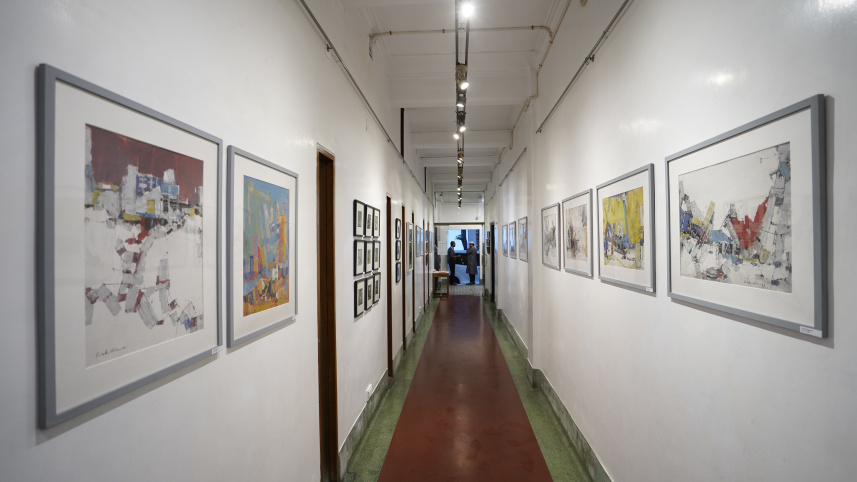
Stepping into Galerie Zoom Open, visitors are greeted not by neatly composed city portraits but by urban landscapes that seem suspended between memory and reconstruction. Acrylic on board paper forms the medium, yet the surfaces carry the texture of lived experience. Blocks of colour intersect with fragmented architectural forms, while patches of white create breathing spaces amid dense arrangements of lines and shapes.
Ahmed’s cities are recognisable without being literal. Buildings dissolve into geometric abstractions. Streets appear only through suggestion. Colours shift from muted greys and earthy browns to sudden bursts of blue, ochre, crimson and green, creating compositions that feel simultaneously weathered and hopeful. Nothing appears perfectly aligned, and that is precisely the point.
The artist has long been recognised for transforming the visual language of Bangladeshi cities into expressive abstractions. Rather than documenting specific neighbourhoods or landmarks, he captures their emotional residue: peeling walls, overlapping structures, afternoon light, tangled electrical lines, construction, decay and renewal coexisting within the same frame. These are cities shaped by accumulation. Every layer hints at another beneath it. Every patch of paint seems to preserve traces of something that once existed before being covered over.

Like urban life itself, the works resist permanence. Looking closely, viewers notice how texture becomes an essential storyteller. Thick brushstrokes coexist with scraped surfaces, while translucent layers allow earlier colours to emerge unexpectedly. Some paintings feel almost architectural, constructed through carefully balanced planes. Others lean towards improvisation, as though the city is still evolving before the viewer’s eyes.
The exhibition never romanticises urban chaos. Instead, it accepts contradiction as the city’s defining quality. The paintings acknowledge congestion without reducing the city to disorder. They embrace incompleteness while revealing moments of quiet harmony. Rusted colours sit comfortably beside luminous whites. Heavy forms are interrupted by empty spaces that allow the compositions to breathe.

It is perhaps this balance between fragmentation and continuity that gives “Urban Images” its emotional resonance. Much like cities themselves, the works suggest that beauty rarely exists in perfection. It emerges through persistence.
As I walked through the exhibition, I came across paintings that differ in palette and composition but remain united by a shared visual vocabulary. Some are dominated by expansive blues that evoke open skies interrupting dense urban blocks. Others lean into warmer yellows and oranges that recall sunlit walls weathered by time. Smaller framed works introduce darker tones, creating more intimate visual narratives where abstraction borders on memory.
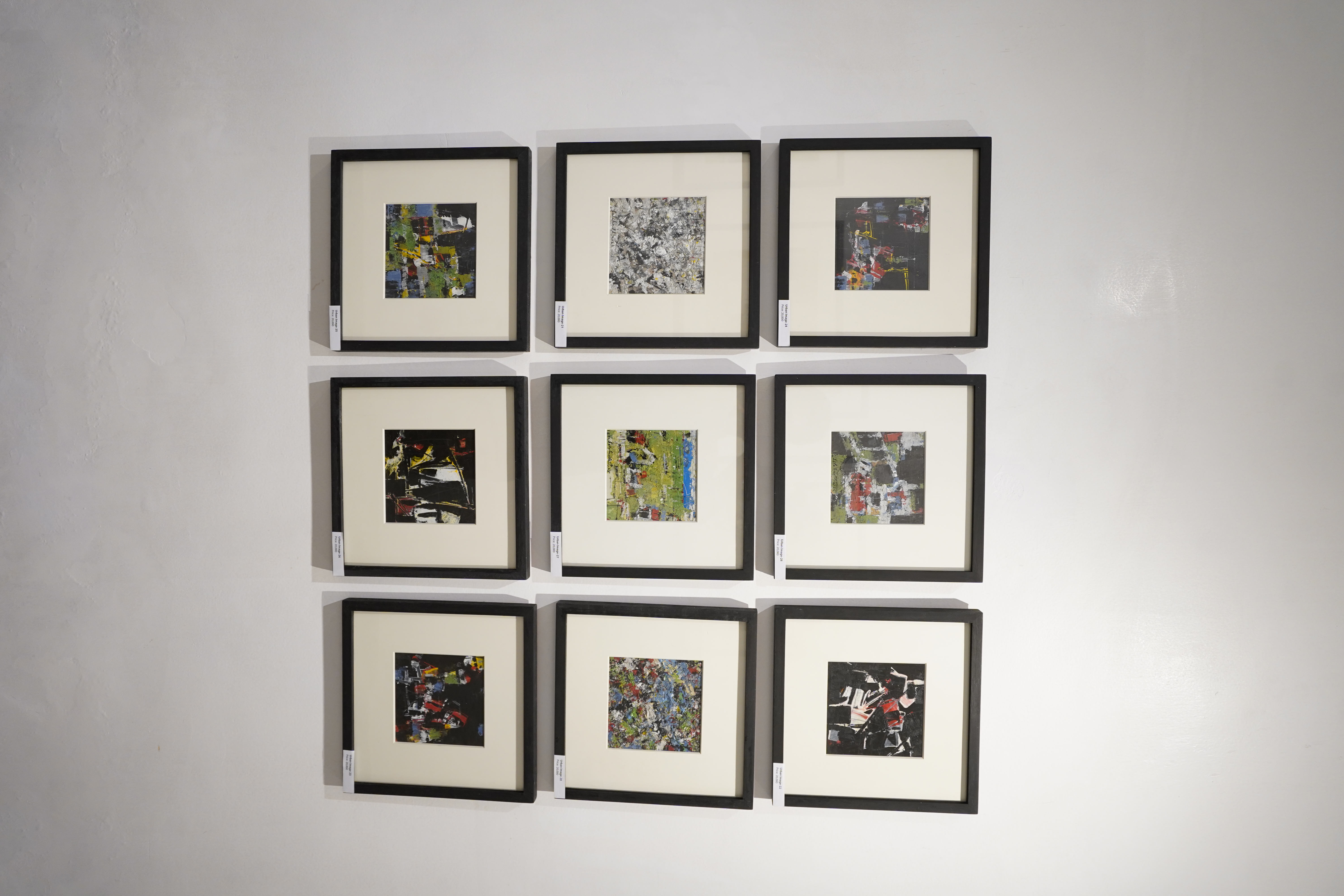
The exhibition invites viewers to slow down. Unlike representational landscapes that reveal themselves immediately, Ahmed’s works ask for repeated observation. Forms gradually assemble in the mind before dissolving again. Each viewer is likely to discover a different city hidden within the same painting.

That openness reflects Ahmed’s decades-long artistic journey. As one of Bangladesh’s most respected modern painters, his practice has consistently explored abstraction rooted in local experience. Rather than borrowing urban imagery from elsewhere, he has built a visual language shaped by Dhaka and the changing landscapes of Bangladesh itself.

In many ways, the exhibition’s title acquires another layer of meaning. Urban images are, after all, collective images. Cities are built not only through concrete and steel but through relationships—between neighbours, strangers, teachers, students and fellow artists who shape each other’s lives over decades. Just as Ahmed’s paintings layer fragments into coherent wholes, the exhibition itself is assembled through acts of generosity from an artistic community refusing to leave one of its own behind.
The paintings may depict broken forms, shifting structures and unfinished spaces, but they ultimately point towards endurance. They suggest that cities survive because people continue rebuilding them. And communities survive for the same reason.

The exhibition is open daily from 3:00pm to 9:00pm, with proceeds supporting the treatment of artist Mostofa Al-Tahmid Ritu.
 For all latest news, follow The Daily Star's Google News channel.
Comments