


The artist who documented collapse and endurance

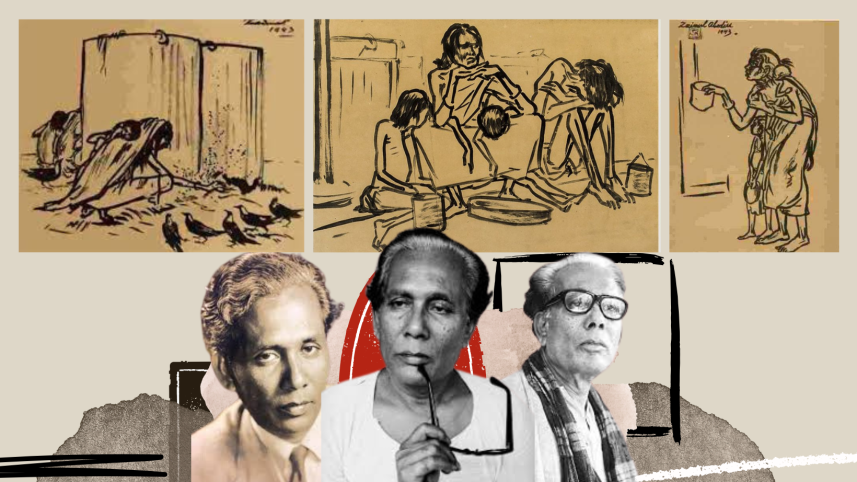
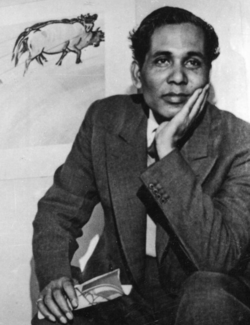
He arrived in Kolkata with almost nothing. A teenager from Mymensingh carrying a stubborn belief that art mattered enough to risk safety for. On his first attempt to enter the Government School of Art, he was slapped by an orange seller in Dharmatala after bargaining too hard over the price of two oranges. He went back, then returned again. Eventually, he would enter that same institution and redraw the visual grammar of Bengal with his minimal yet stern brushstrokes.
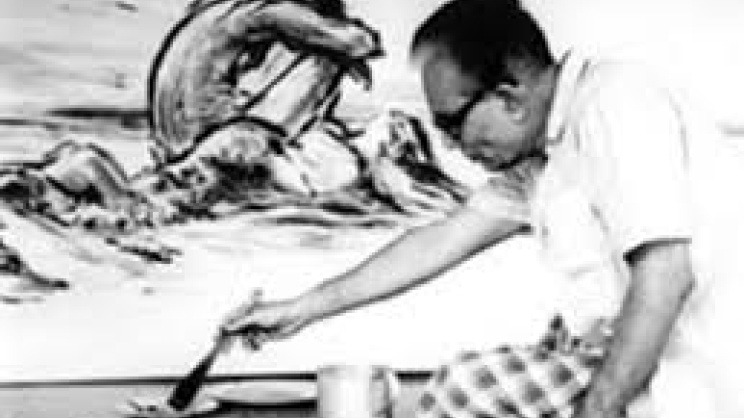
Fifty years after he died in 1976, Zainul Abedin no longer exists as a living presence. What remains is a body of work that has hardened into history, layer by layer: famine sketches, rural labour scenes, scrolls of catastrophe, and figures that still appear to look back at us with unsettling calm. When we talk about Zainul Abedin, we are not only referring to the genius of his work, but also to how his paintings function as omnipresent witnesses—unembellished, never ornamental, depicting reality in its rawest form, stripped of artistic excess. The man is absent for half a century, but the images continue to act.

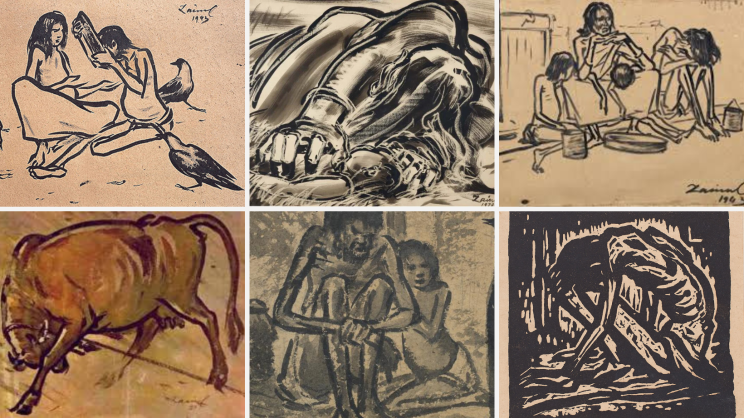
This distance matters. Because Abedin’s career was never simply about producing paintings, it was about repeatedly changing the language of seeing, so that it could still respond to a changing, often collapsing reality.
Born in 1914 in Kishoreganj’s Kendua and raised across districts due to his father’s police postings, Abedin grew up in a landscape of rivers, boats, fields, and labour. These were not aesthetic choices. In his paintings, they existed as conditions of life. Long before formal training, he had already absorbed the movement of working bodies—fishermen pulling nets, farmers bending into soil, boatmen leaning into rope and current—in continuous motion, as if still unfolding before the viewer’s eyes, unconsciously, as fixed truth.
Even when he trained at the Government School of Art in Kolkata and later taught there, winning recognition, including a gold medal for his depiction of the Brahmaputra, he remained wary of beauty detached from lived reality. “I have no interest in the perfect beauty of Greek sculpture,” he once said. “An old villager bent over his hookah, or boatmen pulling a rope against the river current—these forms move me.” The preference is not decorative; it is ethical.
In his early practice, Abedin still worked within academic realism. But the Bengal Famine of 1943 ruptured that trajectory. It was not merely a subject he encountered; it was a structural break in his method of seeing.
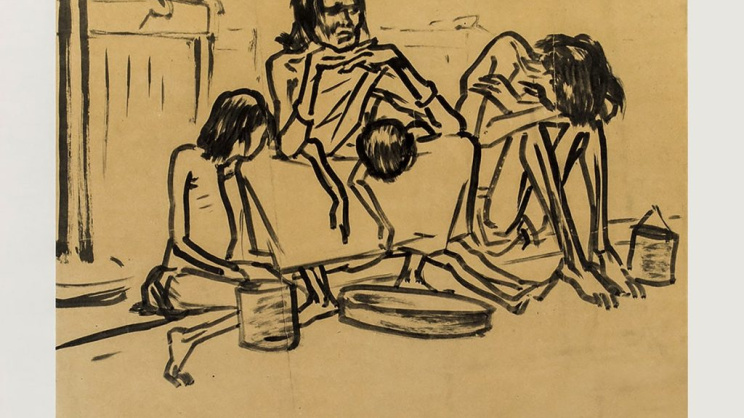
At the time, he was teaching in Kolkata. He witnessed starving migrants arriving in waves from rural Bengal. Men and women collapsed on pavements. Children searched for food in drains. Bodies accumulated in public spaces while colonial administration functioned with indifference. The famine was not a natural disaster. It was the outcome of wartime policy, hoarding, market manipulation, and systemic neglect under colonial rule.
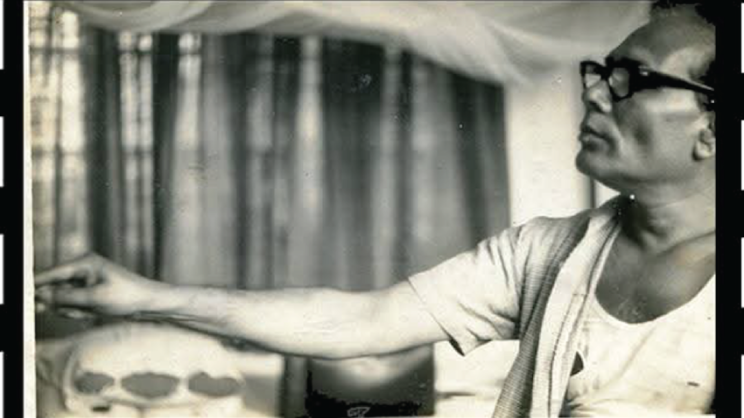
Abedin later drew a sharp distinction: floods belonged to nature; famine belonged to human decision. That moral line shaped everything that followed.
Material scarcity also reshaped his technique. He worked on cheap paper with Chinese ink, charcoal, and dry brush. The shift was not initially aesthetic experimentation but necessity. Yet necessity produced a new visual grammar: stripped lines, urgent gestures, compressed forms. The drawings no longer described Bengal as a landscape. They recorded a Bengal in collapse, and at the same time, one marked by resilience and an unyielding, if fragile, dignity.
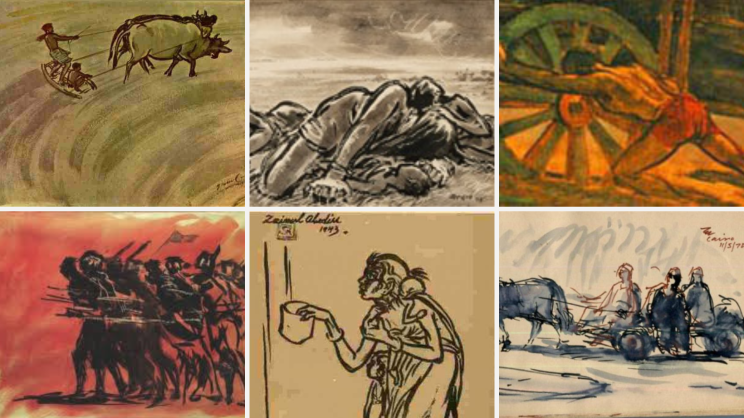
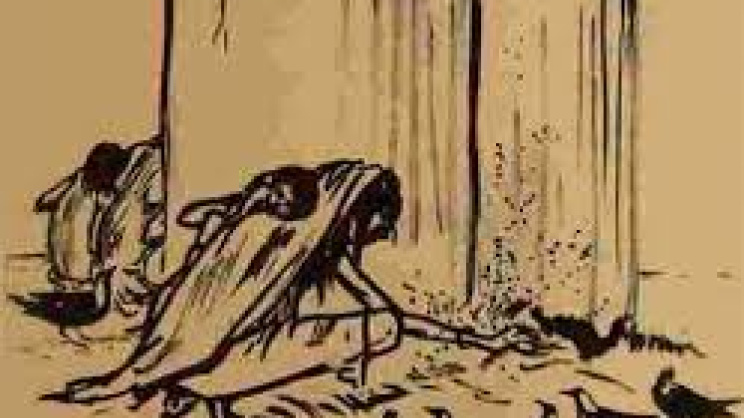
Within these famine sketches, one feature recurs with unusual force: the body as evidence of devastation. Emaciated figures are not romanticised. They are observed with clinical precision—bent torsos, extended limbs, hollowed posture, empty vessels. The human form becomes a register of economic and political failure in sustaining what was otherwise a naturally self-sustaining society.
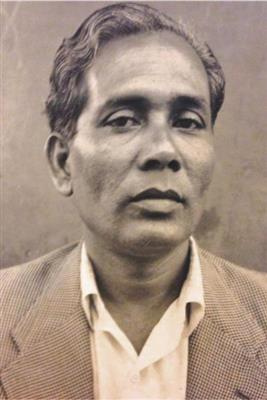
Crows appear repeatedly throughout this body of work. Abedin is known to have disliked them personally, yet he drew them again and again. Sometimes they sit beside dying bodies. Sometimes they hover over corpses. They are not merely natural elements. They function as witnesses to abandonment and political indifference. Critics have read them as symbolic extensions of predatory systems—those who watch suffering without intervening, or who benefit from it indirectly.
Art historian Jaminikanta Sen later described Abedin’s sensibility as “Satyabodh”—a rare capacity to perceive truth without distortion. In this reading, the famine works do not invent tragedy; they reveal what was already structurally present.
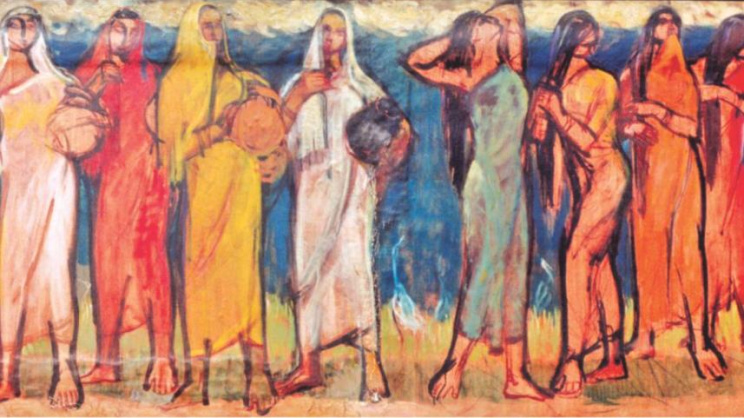
After Partition in 1947, Abedin moved to Dhaka. This transition marked another rupture in his visual language. Instead of repeating the famine idiom, he rebuilt his system of representation. Folk motifs, rural crafts, scroll traditions, and everyday East Bengal life entered his work—not as imitation, but as reconstruction. He simplified forms, adjusted tonal structures, and reconfigured composition, presenting Bengal once again as a witness to itself.
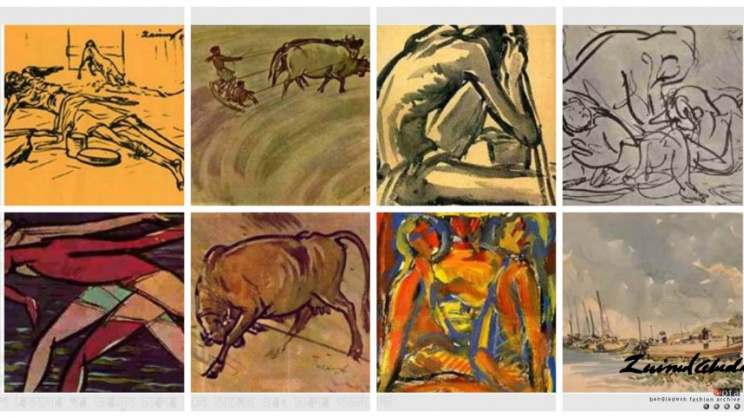
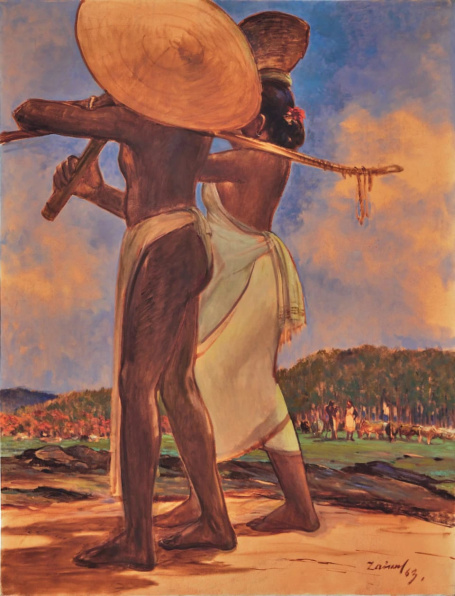
Works such as “Fera”, “Opekkha”, “Guntana”, “Steamer Ghat”, “Moi Dewa”, and “Santal Couple” demonstrate this shift. Labour becomes choreography. Bodies move under weight, resistance, repetition, always on the verge of continuation. A fisherman returns home with wet nets. A woman stands in a doorway facing outward. Men pull rope against the water current. Nothing theatrical occurs. Yet each image carries structural tension and a quiet acceptance of condition.
In “Opekkha”, a woman stands in a threshold space. The composition resists resolution. She does not express emotion. She inhabits waiting. The viewer is not guided toward interpretation; the painting holds ambiguity.
In “Rebel”, a bull strains against a rope tied to its neck. The image is often read alongside the political atmosphere of East Pakistan in the years preceding the Language Movement. Abedin rarely produced explicit political allegory, but his work registers pressure systems. Containment and resistance remain recurring conditions across species and forms.
The political dimension becomes explicit in “Monpura 70”, the large scroll produced after the catastrophic cyclone in coastal East Pakistan. Abedin travelled to affected regions and worked directly with survivors. He did not remain distant from the event. The resulting work combines observational drawing with sequential unfolding, drawing on Bengali pata traditions, Chinese scroll composition, and Mexican mural sensibilities. It functions simultaneously as documentation and collective memory.
Across these phases, Abedin’s method remains consistent in one respect: proximity. He does not construct rural Bengal as a spectacle. He studies labour. He observes physical strain. He records how bodies distribute weight in motion. This attention produces the quiet force of works like “Fera”, where a fisherman walks home carrying soaked nets. The image is structurally simple, but visually weighted. Gravity is not illustrated; it is constructed through line.
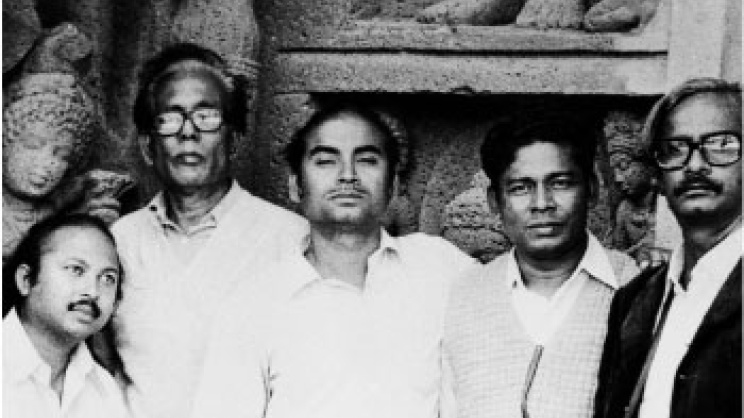
Institutionally, Abedin’s impact is equally significant. He established the Government Institute of Arts in Dhaka, later the Faculty of Fine Arts at the University of Dhaka, and played a central role in forming the Folk Art and Crafts Foundation in Sonargaon. After independence, he contributed to the visual design of Bangladesh’s constitution. These were not auxiliary activities. They reflect his belief that art belongs within public life.
His later reflections reveal persistent dissatisfaction with cultural conditions. “There is a famine of taste everywhere,” he remarked, extending famine beyond food into perception itself.
 For all latest news, follow The Daily Star's Google News channel.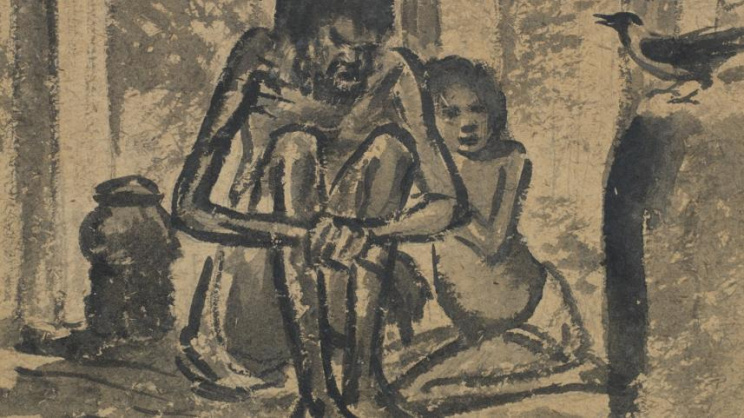
Despite recognition, Abedin remained preoccupied with the limits of representation. During the 1970 cyclone aftermath, he insisted on visiting devastated coastal areas himself. The resulting scroll emerged from direct observation rather than mediated report.
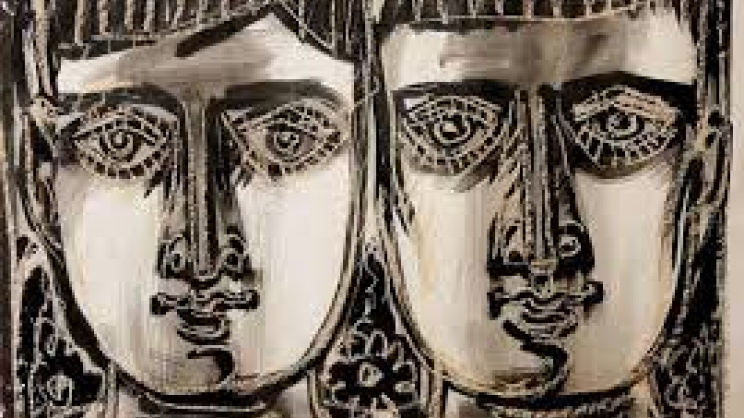
In the final days of his life in 1976, hospitalised and weakened, he was given paper and brush by Mustafa Monwar. He drew two faces in black lines. The work was titled “Two Faces”. Even at the end, he returned to the human figure—not as a symbol, but as a presence.
Fifty years after his death, Zainul Abedin’s works continue to function less as archive and more as evidence. It resists the comfort of distance. The famine drawings still point to a political economy of suffering. The rural studies still insist on labour as structure, not background. Nothing in his work asks to be softened.
What remains consistent is his refusal to separate art from accountability. He did not treat image-making as escape from history, but as a way of staying inside it with precision. That position has not aged into nostalgia. It has only become more difficult to ignore.
Comments