


To pick or not to pick a bone
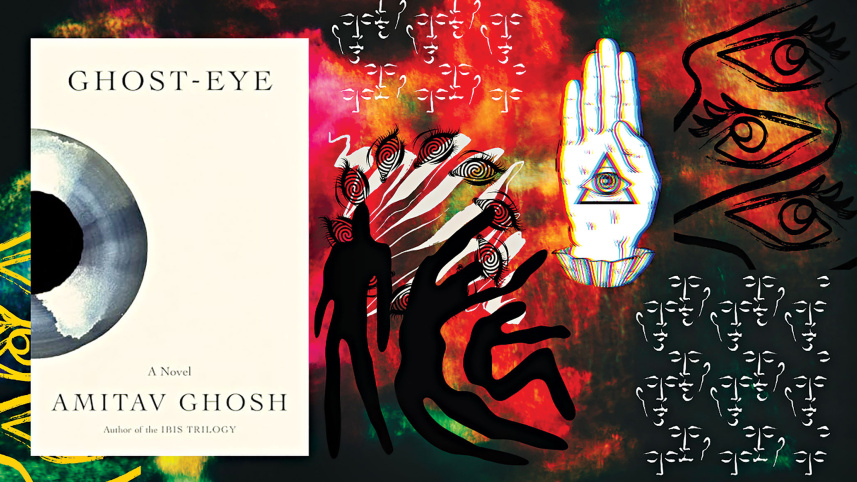
Reading Ghost-Eye felt similar to casually dating someone whose family and friends are more exciting and fascinating than the person themselves. It reminded me of confused decisions I had made earlier in life, when I stuck to someone longer than necessary for some complacent comfort and the additional accessories they brought me. There is at least one break up in these sorts of relationships, and true to nature, I, too, had put down Ghost-Eye for about a week and then went back to it—not for the sake of the narrator, Dinu, but for all that he was connected to.
To my defense—Ghosh’s too, I suppose—the plot of Ghost-Eye is intriguing. If reincarnation, magic realism, slight spiritual twists, and supernatural woo-woo stuff is your thing, then this book will certainly draw you in. I am into all of the above and that’s why even when too many pages chewed around fishes and their bones I stuck around.

The narrative is non linear and skips between the 1960s and the Covid-era. The vivid descriptions of Calcutta and the prose capturing what it felt like to be part of that world in the 1960s and 1970s drew vivid cityscapes in my mind. Occasionally I had to ignore the narrator’s voice which, at times, appeared to be of an uncle or a grandfather reminiscing the good-old days. Some of those sections about growing up in that leftist Bengal with load-shedding and post-colonial fever seemed almost autobiographical.
The Sundarbans, Burma, Calcutta and New York—all the settings of Ghosh’s previous works cropped up and filled the pages. One could wonder if they were leftover notes and characters that didn’t make it to his earlier books which finally found place in this rather character-heavy novel.
I especially found the character of Tipu, a young man who unfortunately spoke in some version of GenZ lingo (the writing by a boomer did no justice), hard to stand. If Tipu was written with normal jargon-free English, I would listen to his messages more seriously—which were driven by spiritual revelation and revolution, as well as that of climate change.
Many of the female characters of the book, Varsha, Shoma, Piya, and Durga were portrayed as independent and strong women doing extraordinary things. The goddess Manasa Devi also takes up a significant space through the book—establishing the power of the feminine and nature.
The story was long-winded and the foreshadowing felt too tell-tell at times. But Ghosh after all is a master storyteller, and he left just enough breadcrumbs for me to follow along to find out what happens next.
What I appreciated about the book were the relationships Ghosh tied between people. Whether they were familial like that of Abhay and Varsha Gupta or romantic like Monty and Shoma’s, Ghosh wrote them with detailed care and compassion, making me yearn for such bonds.
Many of the female characters of the book, Varsha, Shoma, Piya, and Durga were portrayed as independent and strong women doing extraordinary things. The goddess Manasa Devi also takes up a significant space through the book—establishing the power of the feminine and nature.
There were mentions of Bengali folktales, Behula and Lakhindar; names of fishes I had forgotten to spell or the taste of, and nostalgic Bengali words like “shapure” and “bhite bari” were sprinkled through the book—all of which kept the Bangali in me committed till the end.
Would I recommend Ghost-Eye? I would say read it when you need comfort, don’t rush through it, take breaks and read other books in between if you have to. In some ways, the innocence of bygone days and the hope for the future save Ghost-Eye—and I guess at this point in time, we are in need of both.
Iffat Nawaz is a Bangladeshi-American writer based in Pondicherry, India. Her first novel, Shurjo’s Clan, was published by Penguin India (Vintage) in 2022, and was shortlisted for the “Best First Book” Award by Tata Lit Live/Mumbai Literature Festival in 2023.
 For all latest news, follow The Daily Star's Google News channel.
Comments