


Humayun Azad and the courage to dissent
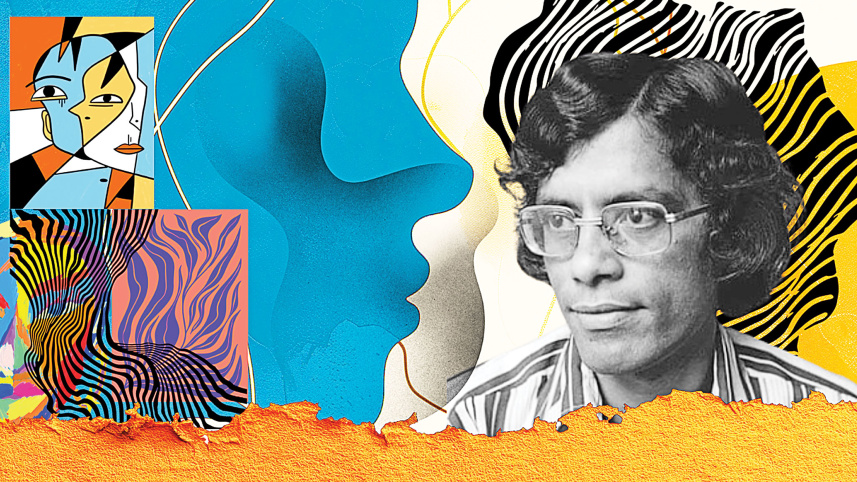
Does our society support free thinking or blindly imitate patriarchy, prejudices, and silence? Humayun Azad was one of the most controversial writers, professors, and researchers in Bangladesh. He explored various branches of Bangla literature. Through his novels, short stories, poems, and essays, he revealed the harsh realities and hypocrisies of Bengali society. This multidimensional writer often described himself as a nonconformist. For his rejection of traditional social and religious norms, he was heavily criticised by reactionaries. At the same time, he became an eyesore to many for fearlessly pointing out the cruel flaws of society. Yet, as a writer and thinker, he only sought to break down unjust customs, patriarchal restrictions imposed on women, and blind religious dogma, and also wanted to spread the spirit of progressivism. For this out of the box thinking and boldness in wielding a pen, he became a unique voice not only among his contemporaries but also among many other writers of Bangla literature.
“Man has called woman a goddess, eternal, benevolent, the household Lakshmi, half-imagined; but has desired her as an eternal servant.” The quotation is excerpted from his magnum opus Nari (1995). This quote exactly aligns with Mary Wollstonecraft’s view in A Vindication of the Rights of Woman (1792). She said, “They are formed into creatures who appear to men as ornaments rather than companions, as if their business were to amuse, not to be useful; to please, not to reason; to be passive, not active; to be obedient, not to govern.” In his book he also states: “A woman must remember that she is a person, not a woman; ‘woman’ is only her sexual identity; she must remember that she differs from man only by one chromosome, for this one chromosome cannot become one master and another maid.” Nari highlights how religion, society, and politics have discriminated against women since ancient times.

To depict the suffering and difficult situations of women who have been raped, Humayun Azad wrote 10,000 Ebong Aro 1ti Dhorshon (2003). In the story, Mayna’s tragic journey highlights the societal stigma, victim blaming, and injustice faced by rape survivors. Moreover, the book highlights how some religious leaders demean women, labeling them as negligible and sinful, attempting to corner and oppress them. In both his books, Pak Sar Jamin Sad Bad (2004) and 10,000 Ebong Aro 1ti Dhorshon, Azad illustrates how minority women are perceived as mere objects, facing oppression and sexual violence, which dehumanises them. Domestic violence is significantly discussed in his books, which is rarely found in most other prominent writers’ works.
He exclaims in Narake Ananta Ritu (1992), “Bengalis are extremely authoritarian, seemingly mild, yet everyone is a Genghis. If we consider each family as a small state, the father is its absolute ruler [...] Even a small child understands whether the father is powerful or uncontrollable and whether the mother is powerless. The mother, like them, is oppressed.” This book challenges the long-standing imbalance within family structures, the struggles over equal rights, power, and authority between men and women in the family, and the weaknesses in parenting that arise from them. Even today, such issues are often considered less important to discuss, and thus, they rarely receive serious attention. However, Azad confronted them directly in his works.
To depict the suffering and difficult situations of women who have been raped, Humayun Azad wrote 10,000 Ebong Aro 1ti Dhorshon (2003). In the story, Mayna’s tragic journey highlights the societal stigma, victim blaming, and injustice faced by rape survivors.
Azad further said in “Manusher Shongo Chara” (2004), “I prefer not to comment on people. /I just wonder how these beasts became so ugly. How do their mouths get filled with trash/ How did they become so ill-natured? There is hatred in everyone’s eyes /desire to enjoy the delightful taste of life.” In this poem, he expresses his grief and condemns societal injustices. In most of his writings, he has exhibited intense resentment against social hypocrisy and moral corruption.
As an example of Bengali double standards, Azad’s remark on Bangladesh’s national poet Kazi Nazrul Islam is particularly relevant. He said in Prabachanguchchho (1992), “While alive, Kazi Nazrul Islam was labeled a ‘heretic-atheist-apostate’ by contemporary mullahs and clerics, but after being half-dead, Bangladesh granted him citizenship and named him the national poet. Bengalis destroy living talent but light incense over the graves of the dead.” Indeed, recurring circumstances have repeated throughout history, with the likes of Socrates and Galileo, and the same goes for Azad—all of whom became revered figures after their deaths.
In the context of religion, Humayun Azad stated: “Secularism means that religion exists in society, and anyone can choose to practice it or not; yet the state will not support any particular religion nor persecute those who do not follow one.” However, over time, across the world, authoritarians have often tried to impose religion, and religious minorities around the world have faced persecution. Even today, building a conflict-free society requires the establishment of a truly secular state, as Azad emphasised. Azad fearlessly criticised social structures, governments, and authorities, challenging entrenched norms that he considered unjust or unnecessary.
Humayun Azad is a true devotee of beauty. In “Kafane Mora Ashrubindu” (1998), he notes: “I’ll probably die for something small/ For a single drop of beauty.” He finds beauty in the petals of flowers, in the songs of birds, in the sparkling sunlight, and even in human generosity and simplicity. In his memoirs, Phuler Gandhe Ghum Ashe Na (1985) and Buk Pokete Jonakipoka (1993), he depicts the simple, honest people of his village magnificently. Even amidst the struggles of the oppressed, he perceives this beauty. In his poem, “The Beauty of the Poor” (1993) the first and last lines convey that, “The poor are not usually beautiful; only when they protest, their beauty shines.”
During his lifetime, this writer faced widespread criticism. In 1995, his book Nari was banned by the government for its writings against conventional religious beliefs and regulations. Though, in 2000, the ban was lifted. In objection to his works, religious extremists erupted into protest, even demanding exemplary punishment on charges of blasphemy. On February 27, 2004, while returning from the Ekushey Boi Mela, he was brutally attacked by extremists with machetes, leaving him severely wounded. After receiving treatment first in Dhaka and later in Thailand, he eventually recovered.
Even today, many continue to hold agonistic views about him, which are often expressed on social media. Some slanderers misinterpret his words, intentionally or unintentionally, to discourage readers from reading him. Humayun Azad never bothered about the criticism. He stated in Prabachanguchchho, “Most great men of the world are still controversial; there is no debate about any donkey anywhere on Earth. From Plato and Aristotle to Marx and Rabindranath, they remain subjects of controversy.”
In today’s world, gender inequality, persecution of minorities, and religious conflicts persist. Moreover, people are often attacked for expressing opinions contrary to the mainstream. The speed and intensity with which hatred spreads on social media, targeting followers of other religions or communities and the despicable comments, slut-shaming, and misogyny directed at women is truly alarming. Throughout his life, this writer expressed intense hatred for and protest against all forms of such conflicts through his writings, which established him as a humanist writer. Yet, discussion about him remains limited, but he is still relevant. May he not be lost to oblivion but live in the hearts of readers.
Rufaiya Zia Nuha is an undergraduate student at the Department of World Religions and Culture, University of Dhaka. She can be reached at rufaiyazia-2021014361@wrc.du.ac.bd.
 For all latest news, follow The Daily Star's Google News channel.
Comments