


How I became Tarini Khuro’s uninvited sixth listener
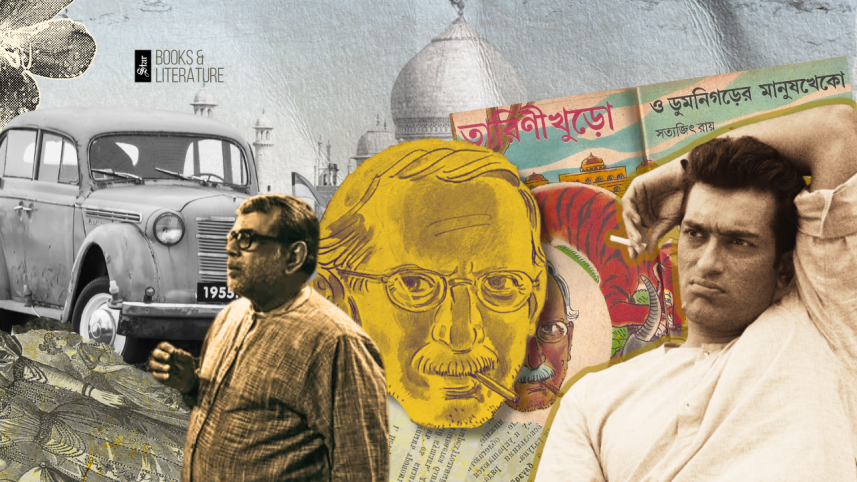
The title might seem like a total fabrication. I have never physically visited Ballygunge, nor do I know Beniatola Lane of Shobhabazar in Kolkata, where Tarini Khuro is supposed to live. Nor did I exist in the same timeline as him. Then why do I feel as though I have always been a participant in his story sessions alongside Poltu and Napla? Is it all inside my head, or is it real? Satyajit Ray would probably be astonished at my question and reply, “Of course it is happening inside your head, Sadman, but why on earth should that mean that it is not real?”, borrowing from the great wizard Albus Dumbledore.
In many ways, Satyajit Ray was a wizard himself. He remains one of the greatest writers of Bengali children’s literature. Many bookworms growing up in Bengali households began their literary journeys with his stories. That was certainly the case for me. The first book I read was Shonar Kella (Sharadiya Desh, 1971). I had never heard of Feluda before, yet the story immediately captivated me and led me to devour Feluda Shamagra within a week. Naturally, the next in line was Professor Shanku.


It was only later, as I explored more of Ray’s work, that I discovered he had written an entire series centred on another character—Tarini Khuro. I first encountered these stories in Aro Satyajit (Ananda Publishers, 2015), and then moved on to Tarini Khuro’s Kirtikalap (Ananda Publishers, 2013), a dedicated collection of his adventures.
Bengali literature had already seen its fair share of tall-tale storytellers—most notably Ghana Da by Premendra Mitra and Tenny Da by Narayan Gangopadhyay. Tarinicharan Banerjee, or Tarini Khuro, is not entirely different in essence. He lives in Beniatola Lane and walks to Ballygunge to narrate his stories to a group of eager listeners—among them Poltu, the narrator, and Napla, a slightly rebellious boy who delights in interrupting him. As I read those stories late into the night, I found myself, willingly or not, becoming the sixth member of their circle.
Yet this is Satyajit Ray we are talking about—he could not simply create another storyteller and leave it at that. He brought a distinctive twist to the genre.
In a deeper sense, Tarini Khuro is not merely a fictional character—we all have a Tarini Khuro in our lives. For generations, grandparents have sown the seeds of imagination in children through stories. They filled our evenings before study sessions or brightened long hours during load-shedding. Dark, stormy nights made those moments even more magical. It is difficult to capture the thrill of listening to ghostly tales while rain lashes outside and thunder rolls in the distance.
Ray, however, captures that feeling perfectly. He immerses the reader in precisely this atmosphere and turns Tarini Khuro into a timeless embodiment of the storytelling grandparent. Interestingly, within the stories, Tarini Khuro is not actually anyone’s “khuro” (uncle); everyone simply calls him that. There is a sense of timelessness about him—no one knows when he first appeared, how long he has lived, or how far he has travelled. What is certain, however, is that he possesses an endless supply of stories—“enough to write The Arabian Nights twice,” as he claims.
At the same time, Tarini Khuro’s stories double as miniature travelogues, a hallmark of Ray’s style. Through him, readers journey across India—to Lucknow, Jaipur, Hyderabad, and beyond. Along the way, Ray introduces us to geography, history, food, and culture with remarkable ease and elegance.
This grounding in reality makes the stories even more mysterious. There is always a lingering sense that, improbable as they sound, they cannot be entirely dismissed. Ghosts, magic, hypnosis, horoscopes, and soothsayers all find a place in his narratives. Even if one begins as a skeptic, it becomes difficult not to be drawn in—especially when the stories unfold in Tarini Khuro’s distinctive voice and setting.
Ray’s deep respect for India’s heritage and history also shines through these tales. Tarini Khuro, having travelled across the country, becomes the perfect vehicle for this exploration. In Mohim Sanyal-er Ghotona, for instance, he encounters a magician who collects indigenous tricks and argues that Indian magic is superior because it relies less on machinery than its Western counterparts. Through such moments, Ray subtly expresses his admiration for India’s artistic legacy.
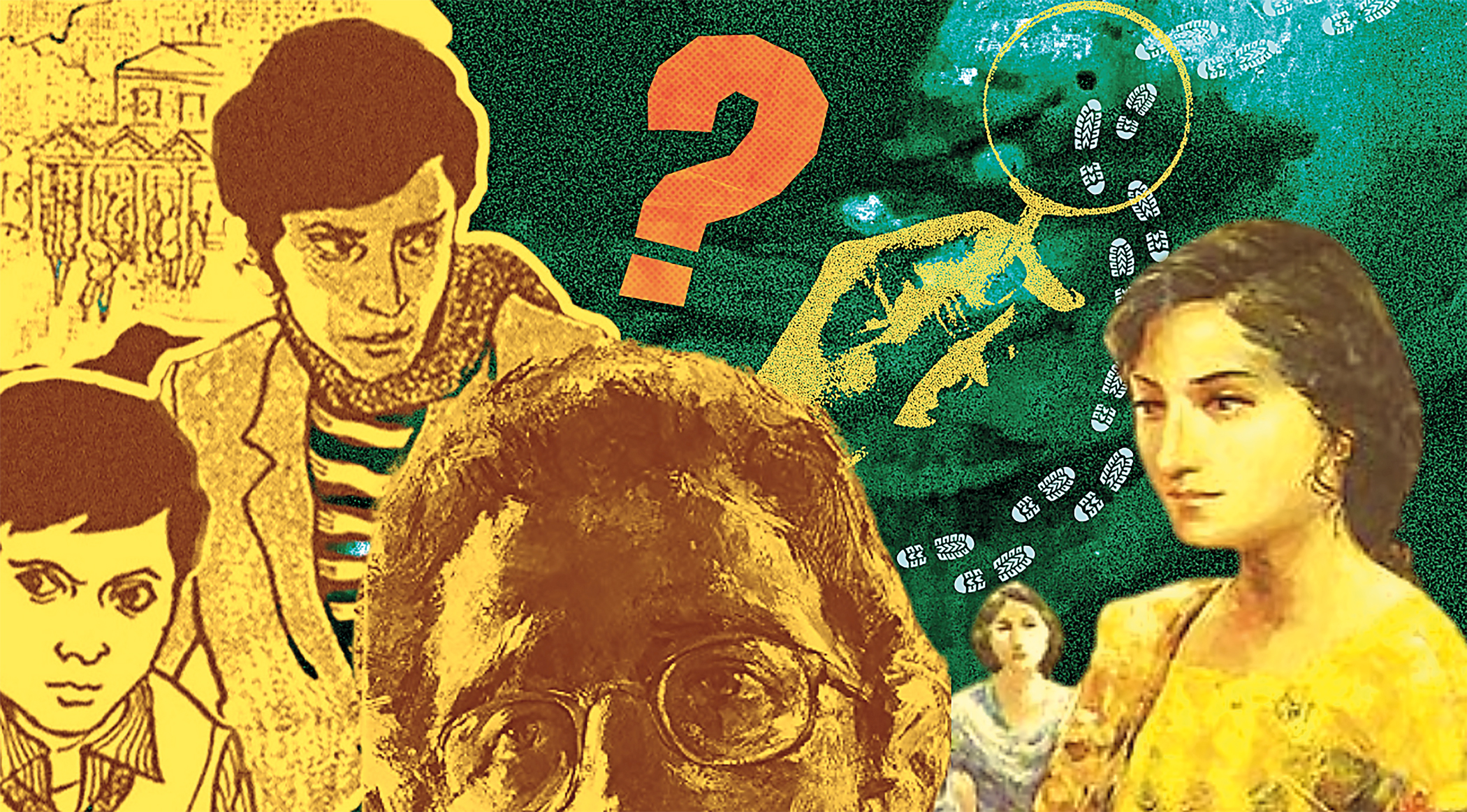
Colonial history, too, occupies a significant place in these stories. As a child, I did not fully grasp the depth of certain narratives—the haunting image of a punkah-puller killed by a British officer, whose ghost continues its task in Conway Castle-er Pretatma (Ananda Publishers,1985) , or the quiet humiliation of Mr. Norris, expelled from a British club after being revealed as Bengali, which ultimately drives him to suicide. Ray did not shy away from such difficult themes, even in stories meant for younger readers. This speaks to how deeply he felt the scars of colonialism and how strongly he believed in passing that awareness to future generations. In another story, Khelowar Tarini Khuro (Ananda Publishers,1985), he even imagines a team of native Indians defeating British tea-planters at cricket—a subtle yet powerful reversal of colonial hierarchy.
All of this raises an intriguing question: was Tarini Khuro, in some sense, a reflection of Satyajit Ray himself? It is tempting to think so. A storyteller deeply rooted in his land; Ray brought that same spirit to both his writing and his films. Through Tarini Khuro, he allowed us to travel—from Kashmir to Jaisalmer, from Howrah to the Amazon, and far beyond—without ever leaving our homes.
In that sense, we have all been the sixth member of Tarini Khuro’s adda.
Sadman Ahmed Siam, as the name suggests, is indeed a sad man. Send him happy quotes at: siamahmed09944@gmail.com.
 For all latest news, follow The Daily Star's Google News channel.
Comments