


Mysterious graffiti appears in India’s Sikkim. Did Subodh cross the border?
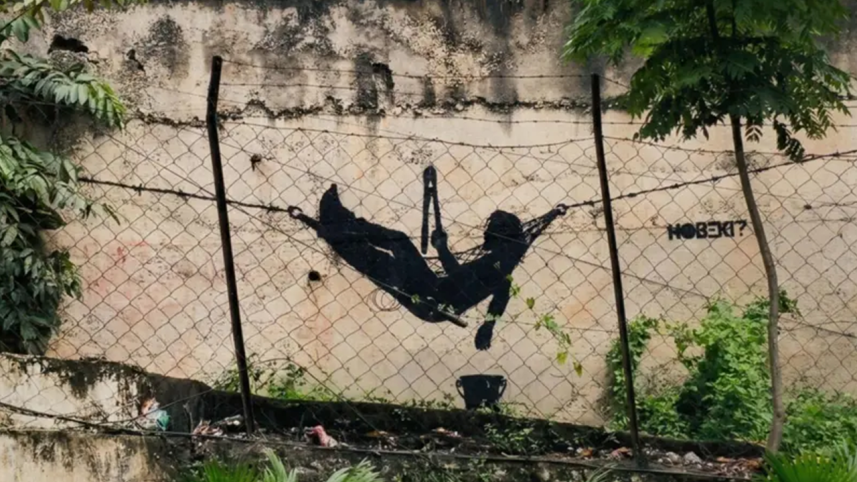
Has the latest work from the Subodh series by the anonymous artist HOBEKI appeared in India's Sikkim?
An Instagram handle named HOBEKI, with the bio “Hawker of Subodh,” posted an image at 6:30pm today showing a graffiti on the south-west wing wall of Majitar Nala Bridge, Gangtok-Rangpo Road. The caption reads: “Rangpo, Sikkim, India.”

The graffiti, executed in stencilling and spray paint on concrete, measures roughly 20 x 12 ft and carries the name tag “HOBEKI?” on the right side, according to ARTCON.
BBC Bangla reported that the graffiti appeared on that wall on June 30.
For years, Subodh has been one of the most recognisable figures in Bangladesh’s contemporary street-art.
While earlier Subodh often appeared as a figure in motion -- pushed by fear, urgency, or collapse -- this Subodh lies across the border not as a refugee, but as a symbolic traveller.
The timing gives the artwork a strong political undertone. India resumed tourist visa services for Bangladeshi citizens from June 28, nearly two years after it was suspended following Bangladesh’s 2024 political changeover.
Applications for Indian visas through five visa centres in Bangladesh were reported to have reopened as part of a gradual normalisation of services and an effort to strengthen people-to-people ties between the two countries. Two days later, Subodh appears in India -- seemingly being Bangladesh’s first symbolic tourist to India after the reopening of tourist visas.
The location, Rangpo, is widely known as a gateway town to Sikkim, situated near the West Bengal border and along the Teesta-Rangpo river corridor. It is one of the key entry points into Sikkim on the route toward Gangtok, where movement, arrival, documentation, and permission are already part of everyday life.
The work shows Subodh in a strikingly altered posture. He is bare-bodied, with messy hair and tattered jeans, lying in a hammock. But the hammock is tied with barbed wire. In his right hand, Subodh holds up a wire cutter. His left arm hangs down toward a water bucket placed on the ground.
At first glance, the scene appears relaxed, almost like a traveller resting after a long journey. But each object quietly complicates that calm.
A hammock usually suggests leisure, rest, tourism, and freedom of movement. Barbed wire suggests division, danger, territorial control, and restricted passage.
By combining the two, HOBEKI? compresses a central contradiction of travel in South Asia -- the dream of movement and the reality of borders.
The wire cutter deepens that reading. It is a tool against obstruction, symbolising the removal of barriers that stand between people. It suggests a desire to cut through fear, suspicion, administrative delay, and inherited distance.
The water bucket placed near Subodh’s hanging hand adds a quieter, more regional layer. Because the work appears near the Teesta River, the bucket may be read as a possible allusion to water, sharing, scarcity, and the unresolved emotional geography of Bangladesh-India relations.
The bridge wall is equally important. A bridge is not only an engineering structure. It is a promise between two sides. By choosing the wing wall of Majitar Nala Bridge, the artwork places Subodh literally on a structure of connection. The bridge becomes both site and metaphor -- Bangladesh and India, departure and arrival, memory and future, restriction and passage.
In 2017, Telegraph India reported that Subodh had inspired appearances in Kolkata, including university spaces, though those were understood as adapted or locally produced versions rather than confirmed HOBEKI? works.
The latest work might be the first in India.
The image is hopeful, but not naïve. It acknowledges strained relations, closed routes, delayed movement, and human waiting. It remembers that borders do not affect everyone equally. Some cross easily. Some wait. Some are stopped. Some remain stuck between systems.
Subodh possibly has crossed as art crosses -- without permission, without passport, and with a question large enough for two countries.
 For all latest news, follow The Daily Star's Google News channel.
 ARK Reepon is the founder of ARTCON
Comments