


Potters busy as Pahela Baishakh approaches
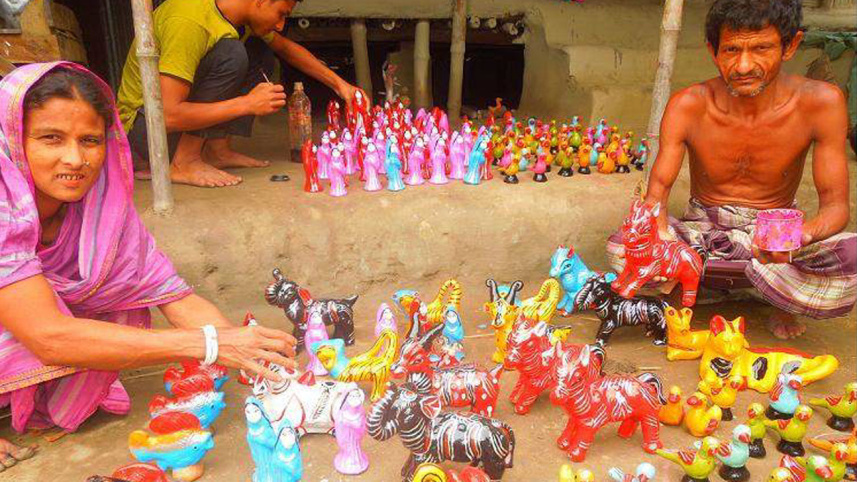
Nilphamari's potters are passing busy days preparing for the upcoming Pahela Baishakh, the first day of the Bangla year. They are making fancy earthen items for the accompanying traditional fair in towns and villages in all the six upazilas of the district, and indeed across the country.
On a visit to potters' villages like Kukhapara Palpara in Sadar upazila and Chaora Palpara in Saidpur upazila, it was found that the members of the community are making various earthen items like toys, decoration pieces, statues of famous men and gods and goddesses, and animals like tigers, elephants, cows, birds, fish, etc.

Dhirendra Nath Pal, 55, head of the community, locally called 'mohot,' in Khukhapara Palpara says, "We have no institutional training on making fancy goods but learn it naturally in the same way as we learn our mother tongue, from our elders."
The Baishakhi fair brings opportunity for the members of his community to make good profits as clay-made fancy items are much sought after at this time, and the fair may last for a month, he adds.
Podo Pal, 45, of the village says he has made 250 earthen animals of different kinds, 200 birds, 200 fish and 500 dolls. " I'm hoping to earn Tk 20,000 in the fair as four members of my family have been working hard for the last three months making those items," he adds.
Uttom Pal, Bijoy Pal and Nimai Pal of the village explain that wholesalers from different parts of the district and surrounding areas come to their village to buy their products.
Sachin Pal, 60, of Chaora Palpara lamented that the demand for fancy earthen items is declining day by day as people are using plastic or steel items made in factories. "Our items are in demand only during the Baishakhi fair. We maintain our families for the rest of the year with the profit we make during the fair," he says.
This correspondent found that many members of the pal community have left the profession and are working as farm workers in the village, or plying rickshaws, or doing other petty jobs in the big cities.
One of the major reasons behind this trend of giving up their ancestral profession is that, with the increase of population, the volume of land is shrinking, and hence clay earth, the main raw material of this cottage industry, has become scarce and is too expensive.
KM Arifuzzaman Arif, cultural officer of Nilphamari, said, "To save pottery from becoming extinct, the potters should be properly trained so that they can make more sustainable and varied products as pottery is an art that is thousands of years old."
 For all latest news, follow The Daily Star's Google News channel.
Comments