


Man-made erosion gobbles riverside village
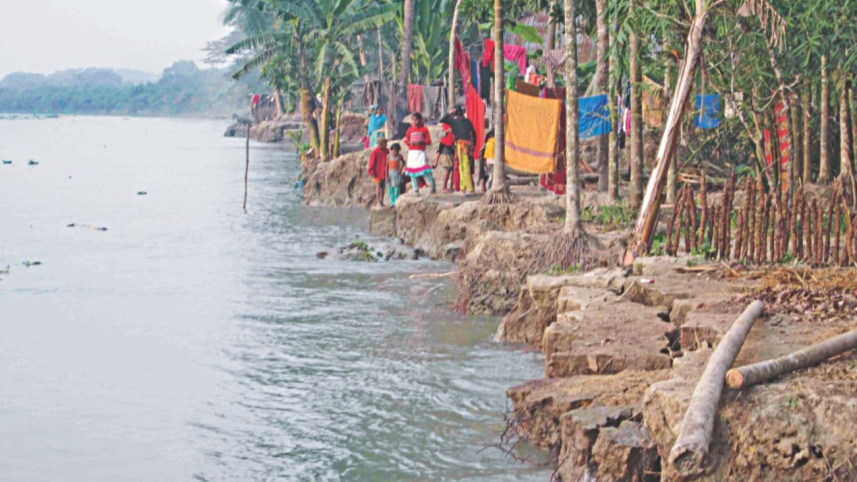
By age 75 most people aren't looking to start a new life. Sattar Mollah of Pirojpur's Asoa Amrajhuri village in Kawkhali upazila isn't any different. Indeed a poignant symbol that he had no choice but to move is the half clay oven still visible on his family's ancestral land. The culprit is the greedy Sandhya River which, through erosion, has claimed the property.
According to locals, Sattar has transferred the site of his house several times previously in response to the Sandhya's waves. But this time was different. He's had to leave the land altogether as there isn't enough left to build a new house on.

Sattar now resides at a government shelter for landless people in nearby Gandharbo village. Like him, over 50 of Asoa Amrajhuri's families have lost landholdings to the Sandhya over the past decade.
While for many Bangladeshi rivers it's the strong currents of the monsoon months that bring about the most treacherous erosion, in the case of the Sandhya the rate of erosion peaks in winter and spring. That's because the Sandhya's erosion is primarily man-made.
It's the sizeable waves created by river vessels, including the Dhaka-bound launches navigating the Sandhya that cause the greatest devastation. The waves are largest when nature's water flow is less.
Some days later and afternoon finds Sarwar Majhi shifting his house away from the riverbank after three large cracks arrived to inhabit the floor of the house. The river has taken most of his land too and there's little room left on which to build another.
"I don't know how long I'll be able to stay here," he says, adding that when the river completes its takeover he will have to leave the village for having nowhere to stay.
His neighbour Jakir Hossain has moved his house over five times during the last decade. "I already lost 1 bigha," he says, "I'm really anxious about my house since the houses in front of mine have already gone."
Locals report that serious erosion affects a one kilometre stretch of the Sandhya, starting from the Gabkhan Channel and that the situation has been serious for around 15 years. They lament that no major government initiative has been taken to save their village.
"Sometimes an official visited the area," says Majnu Howlader, 60, "They observe the erosion and leave. Yet we have seen no work to save the village."
Locals estimate around half a kilometre of village land has fallen into the river, including houses, mosques, graveyards, cowsheds and crop land. Many solvent villagers have become day labourers as a result. Currently 14 households are in a precarious position.
The Bangladesh Water Development Board is the authority responsible for protecting riverside land. Their executive engineer in Pirojpur, Sayeed Ahmed, says that 23 land protection proposals have been sent to Dhaka under the Bangladesh Riverbed Preservation Project, with proposals including Asoa Amrajhuri. "We will be able to start work once proposals are approved," he says.
But will it be soon enough for Aheda Begum, 45, who waits with worry in the kitchen of her now riverside home? If measures are not taken soon, her fate will mirror the usual story, the fate of so many of her neighbours.
 For all latest news, follow The Daily Star's Google News channel.
Comments