


Jackfruit yield aplenty, but scant profit for farmers
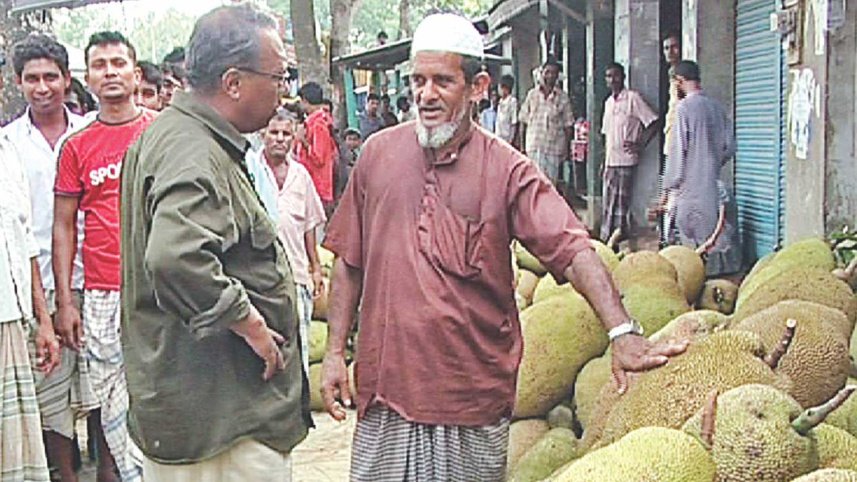
Alongside the road from Bhaluka in Mymensingh to Tangail are many jackfruit orchards and, as at a few days ago, there were thousands of ripe jackfruits on the trees. Although the fruit is ready for harvest, growers are not proceeding due to low market prices.
I stopped at one village, Meduari, to speak to farmer Nurul Islam who has thirty-five jackfruit trees in his orchard. He believes there are at least a thousand jackruits on his trees, which could give him a harvest that is double the size of last year's. Yet while last year he earned a tidy sum from selling his approximately 500 jackfruits, selling double that number this year will not even achieve the same.

"We're facing difficulties," says Islam. "The market price was Tk. 5 per jackfruit last year but now it's only Tk. 2."
Sirajul Islam is a local wholesaler who, like many, manages a pile of jackfruits on a nearby roadside, to be sold to traders for transportation to markets. "The price is much lower than in past years," he agrees, "I bought these jackfruits at different prices but now I can hardly sell them."
The scene was similarly dire at Tangail's Garo Bazaar where jackfruits arrive on vans and by cycle. While the market was full of jackfruit as to be expected, it seemed there were no traders or wholesalers to buy them. Eventually I found one, Chand Mahmud. "Have you ever seen the market so depressed?" I asked.
"No," he said, "Never in my life." When asked the reason for the price fall, Mahmud suggests that due to fasting and the hot weather the public is not encouraged to buy.
Anecdotally, low prices may be due to oversupply with many new orchards having been planted, while householders now commonly grow jackfruit trees at home to supply family needs.
Also, while jackfruit was once staple fare, nowadays it is less so. One trader suggests only those who have migrated to Dhaka from other districts are fond of eating jackfruit.
Another local fruit grower Moniruddin has arrived at the market with 36 jackfruits on two cycles. The price of his crop will be Tk. 360, only Tk 10 each: quite astounding when one recalls the markets of Birmingham in the UK where jackfruits are sold by weight at prices unimaginable to our orchardists.
Indeed, a decade ago in England I asked a grocer from where they imported their jackfruits. "From Bangladesh," he replied, while a person beside us disputed the fact and suggested they came from Sri Lanka. When, with a heavy, large jackfruit in hand I asked another fruiterer he said, "It's from Malaysia and costs 60 pounds." Dear readers, that's over Tk. 7,000!
Sazzad, another local from Garo Bazaar offers an agreeable explanation for a lack of buyers. "Some wholesalers inject chemicals in the fruit at the beginning of the season. When customers eat them they find no taste. It no longer appeals," he says. He also suggests that without preservation facilities available, a jackfruit processing plant would help.
In addition, according to Sazzad the body is heated when jackfruit is consumed and stomach acidity rises. He believes many are abstaining from jackfruit to avoid these symptoms.
In Madhupur's Mashimara village, another jackfruit growing area, the situation is similarly bleak. Famer Abdur Rashid adds insect attack as a further hazard facing the industry. "We're facing diseases that leave holes in the body of the fruit and red juice to seep out following insect attack."
Sub-Assistant Agriculture Officer Ershad Ali names an insect called majra, the jackfruit borer, as the culprit. He says that with rain water can enter the insect holes and rot the fruit from inside. Diazinon and Verison insecticides prevent attack, he advises.
Jackfruit is our national fruit. It'd be nice to see it used more broadly in jelly, jam, drinks and candy; and properly kept in cold storage warehouses so the public can enjoy jackfruit year-round while at the same time, orchardists can again earn a decent livelihood.

 For all latest news, follow The Daily Star's Google News channel.
Comments