


Demand equality at nat'l level, fight internal prejudices
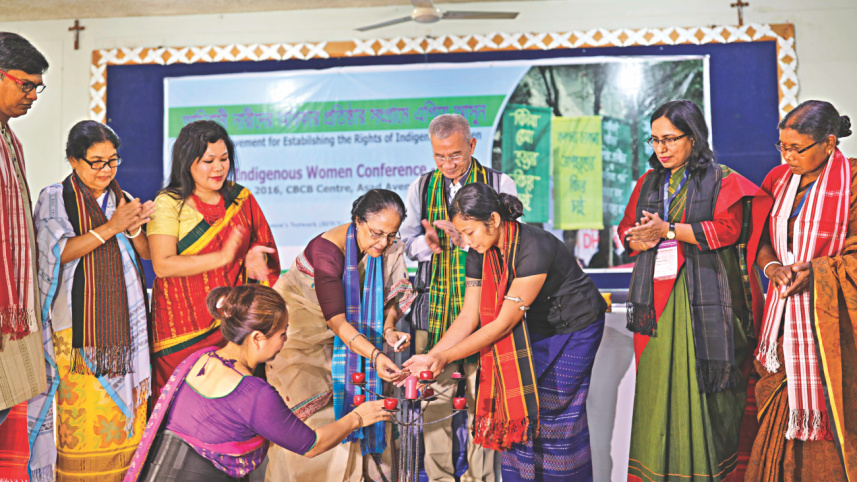
Ethnic minority women of the country need to raise their voice for equal rights at the national level while fighting against discriminatory customs at their individual community levels, speakers told the third National Indigenous Women Conference 2016 yesterday.
"Among the 54 indigenous communities of the country, many have their separate discriminatory practices and customs against women," said Ayesha Khanom, president, Bangladesh Mahila Parishad (BMP), at the two-day conference's inaugural.

The women rights activist noted that BMP at times faced difficulties in providing legal aid to some victims of domestic violence, including ethnic minority women, because of such customary practices.
"While both men and women face discrimination by the state, the structure of our societies often further discriminates against women," said Rani Yan Yan, the Chakma circle queen.
She said besides ensuring justice for female survivors of violence, their rehabilitation and reintegration into society should also be brought to focus.
The conference is being organised by Bangladesh Indigenous Women Network (BIWN) and Kapaeeng Foundation with support from Manusher Jonno Foundation (MJF) at CBCB in the capital's Asad Avenue.
The programmes include sessions on human rights condition of ethnic minority women of the country, sustainable development goals, climate change and ethnic minority women, gender sensitivity, barriers to growth and a solution for the development of ethnic minority women's organisations at the grassroots and strategic planning workshops for BIWN.
Jyotirindra Bodhipriya Larma, popularly known as Santu Larma, was the chief guest of the inaugural event. He urged women to engage in political movements to establish their rights.
On the Chittagong Hill Tracts Peace Treaty of 1997 yet to be implemented, he criticised the government, terming it undemocratic and reactionary.
"Our government, the ruling class is perpetually submerged up to the neck in extreme nationalism," he said referring to how the Bangalee identity was imposed on ethic minority people in 1972 and later through the 15th amendment to the constitution.
Tapoti Saha, programme coordinator, Economic Security and Rights, UN Women; Wasiur Rahman Tonmoy, programme coordinator, MJF, and Chaitali Tripura and Basanti Murmu, both joint conveners of BIWN, also spoke.
In the first session, Falguni Tripura presented a report on the overall human rights condition of the ethnic minority women.
The report highlighted 434 incidents of physical and sexual violence against ethnic minority women and children between 2007 and 2015.
In 2015, out of 69 incidents, 38 occurred in the Chittagong Hill Tracts and the rest in plain land. The violence included 14 rapes, 12 gang rapes, 11 physical assaults, six sexual harassments and 16 attempted rapes.
 For all latest news, follow The Daily Star's Google News channel.
Comments