


The outrage machine: How social media profits from fake literacy panics
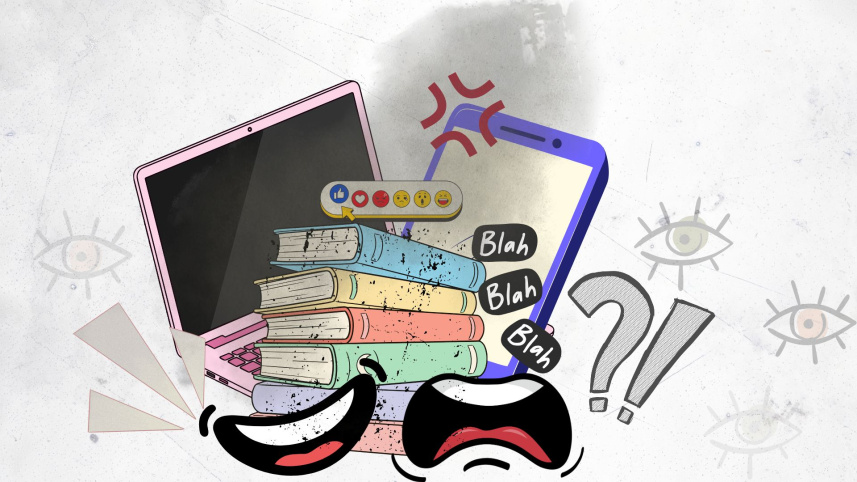
Every few weeks, the same performance unfolds across social media: a screenshot appears – usually from TikTok or Instagram – showing a comment so breathtakingly ignorant that it defies belief. The responses are swift and predictable: thousands of shares and quote-retweets lamenting the death of education, bemoaning Gen Z's supposed illiteracy, and declaring that humanity is doomed.
There's just one problem: most of these comments are jokes.

The practice of cherry-picking obviously facetious comments to manufacture outrage has become an industry on social media. Content creators will screenshot deliberate absurdities, strip away all context, and present them as genuine evidence of intellectual decline. The result is a self-perpetuating cycle of moral panic and fearmongering that generates clicks, engagement, and ad revenue, while telling us absolutely nothing true about young people's literacy or intelligence.
Anyone who has spent ten minutes on platforms dominated by teens and young adults will understand their particular brand of humour, where deadpan absurdity and deliberate obfuscation reign supreme. Comment sections are filled with people pretending to misunderstand basic concepts, making intentionally ridiculous statements, or committing to elaborate bits. "Shakespeare should've just used Grammarly" isn't a confession of ignorance—it's a joke that assumes everyone knows Shakespeare predated spell-check software by several centuries. The humour lies in the deliberate anachronism and obtusity.
But nuance doesn't generate engagement like outrage does. And so, these comments get screenshotted, stripped of their context, and presented to older audiences on other platforms as “Exhibit A” in the case against modern education. The people sharing them either don't understand the joke or, more cynically, understand it perfectly and don't care. A viral post lamenting youth stupidity can generate hundreds of thousands of interactions, while a post saying "This was obviously sarcasm" receives virtually none.
This mirrors older moral panics and fearmongering about new media. Comic books were supposed to rot children’s brains. Television was blamed for shortening attention spans. Video games were accused of destroying empathy. Each wave of panic used selective examples to stand in for an entire generation’s cognitive capacity. The current phenomenon of hand-wringing about generational decline is more of the same, perfectly adapted to the economics of clicks and popular internet discourse.
The irony is rich. The same people sharing these screenshots as evidence of deteriorating reading comprehension are demonstrating a failure of reading comprehension. They cannot recognise obvious satire, nor do they pause to consider context. They only see something that confirms their pre-existing biases about "kids these days" and immediately hit share, abandoning critical thinking.
What’s especially cynical is how often these posts frame themselves as a defence of intellectual rigour. The caption mourns “declining literacy” or “the death of reading comprehension”, positioning the poster as a beleaguered defender of knowledge, but the method of cherry-picking jokes and presenting them as representative is profoundly anti-intellectual. The very skills being lamented – contextual reading, inference, and charitable interpretation – are the ones being discarded.
There’s also a generational narrative at work. Older users repost these comments as evidence that “Gen Z can’t read", even though ironic illiteracy jokes have existed as long as comment sections have. The difference is scale: what once stayed in a niche forum now becomes a screenshot circulating far beyond its original audience. As a result, the humour collapses when removed from its native environment, and the misreading is then blamed on the younger generation rather than on the act of decontextualisation itself.
There’s another layer to this genre of social media outrage: it flatters the viewer. To laugh at a screenshot of someone “missing the point” is to implicitly place oneself on the right side of intelligence. The post doesn’t ask why someone might be joking, or how online humour works. It simply invites the audience to feel smarter than a caricature. That feeling is addictive, and it keeps people scrolling.
None of this is to deny that literacy gaps exist or that educational systems face real challenges. But serious issues don’t reveal themselves through viral screenshots chosen for maximum ridicule and content farming. They require data, a longitudinal study, and an understanding of how people actually communicate online. Treating irony as evidence of ignorance doesn’t diagnose a problem; it creates one by training audiences to read in the least generous way possible.
In the end, the real decline isn’t in literacy but in interpretive charity. When jokes are routinely reframed as proof of stupidity, we lose the ability to distinguish between bad faith, humour, and genuine misunderstanding. And that flattening of meaning, ironically enough, does more damage to critical thinking than any misspelt comment ever could.
Nuzhat is a compulsive doodler and connoisseur of bad early aughts television. Send her recommendations at nuzhat.tahiya@gmail.com
 For all latest news, follow The Daily Star's Google News channel.
Comments