


How Team Six Seven made Bangladesh proud in Hong Kong
There is a particular kind of pressure that descends the moment you realise you are no longer competing within the familiar boundaries of home. The rules change. The margin for error shrinks. And the competitors across the table are the best their respective countries have produced.
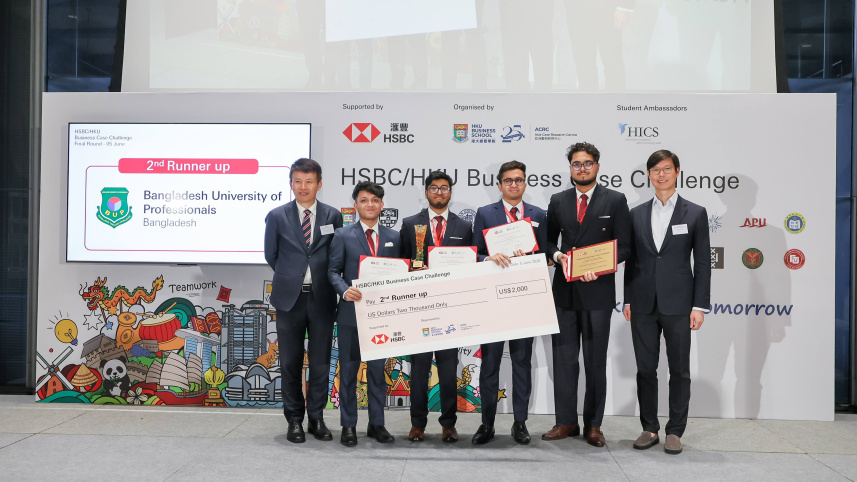
Team Six Seven—consisting of Shakhawat Salim, Naveed Abrar, Md Ridwan Sakib Anjum, and Mohammad Faiyad Hossain—walked into a similar kind of pressure at the HSBC/HKU Business Case Challenge 2026 in Hong Kong and emerged as the second runners-up. They are all students of Bangladesh University of Professionals (BUP), outperforming over 20 other undergraduate teams selected from across the globe.

Before the glory in Hong Kong, there were weeks of quiet, unglamorous preparation. After winning the national Business Case Competition organised by HSBC Bangladesh and BRAC University in April, Team Six Seven did not ease off.
HSBC Bangladesh opened doors that most university students never get to walk through. The team visited HSBC offices three times over the course of three weeks, solving cases inside actual boardrooms and presenting their proposals to senior company officials.
“We are very grateful to HSBC Bangladesh," said Shakhawat Salim. "They not only gave us the chance to compete but also helped us learn things we can use throughout our whole lives.”
Ridwan Sakib Anjum set the benchmarks for the team's mentality even before the flights were booked. In their group chat, before the international final began, he told his teammates, “To win the nationals, we need to improve ten times over. To win at the global stage, we would need to improve ten times further from there.”
When the team arrived in Hong Kong for the final round held from June 1 to 5, they were facing teams ranked among the top universities in the world – institutions with decades of case competition tradition and rich alumni networks. On paper, the rankings were not in their favour. But Team Six Seven chose to crumple it up and toss it away.
“I think it's really important for Bangladeshis to not focus on the rankings of teams because they'll have us beat every time,” Ridwan said. “We faced top-ranked universities, and we beat many of them. If we ever thought these teams were inherently better just because they come from better-ranked places, we would not have been able to do that.”
Self-belief is often dismissed as a soft quality, the kind of thing coaches say before a match that nobody quite takes seriously. Team Six Seven treated it as a tactical weapon. Their self-belief was not born of arrogance, but rather built on preparation. Hour after hour of learning, presenting, and being torn apart by feedback, and then coming back the next day to do it again.
What they brought to the competition that could not be taught in any lecture hall was perspective. Where teams from higher-ranked institutions may have defaulted to polished but formulaic answers, Team Six Seven offered insights shaped by a different perspective. That perspective, Ridwan noted, was their single greatest advantage.
The final round featured 24 teams competing across four real business challenges: managing leadership risks at an investment firm, sustaining growth for a consumer brand, demystifying stablecoins for a public audience, and scaling a fashion brand into a global operation. These were not textbook problems. They required frameworks, yes, but more importantly, they required the ability to hold an argument together under scrutiny from people who have made actual decisions at this scale.
Ridwan was candid about the difference in standard: “In Bangladesh, you might get away with a strategy that sounds good even if the logical backing is somewhat superficial. On the international stage, if you have any logical inconsistency, the judges will find that out really fast.”
Mohammad Faiyad Hossain offered advice to anyone who wants to compete at this level: "Be open to unlearning many things you have learnt in Bangladesh. At the global level, the landscape is completely different from what we are used to locally. Study international resources like Bloomberg, The Wall Street Journal, and relevant YouTube content. These global perspectives will provide you with a mindset that succeeds outside of the country. If you want to achieve international success, you must focus on global material."
Naveed Abrar put it most directly, saying case competitions offer what universities cannot. "Every case I have ever tackled gave me realistic problems that required realistic solutions,” he noted. “You cannot find these in textbooks or lectures. That is the skill you get when you actually compete in such business case competitions."
Finishing as second runners-up at the HSBC/HKU Business Case Challenge 2026, Team Six Seven proved that Bangladesh belongs on the global stage, and when young Bangladeshis strive to achieve something, nothing can stop them.
 For all latest news, follow The Daily Star's Google News channel.
Comments