


Snail-paced G2G economic zones show uneven progress

- Japanese zone nears operations despite bureaucracy
- Chinese zone awaits final land lease
- Two Indian economic zones officially scrapped
- G2G model struggles with slow progress
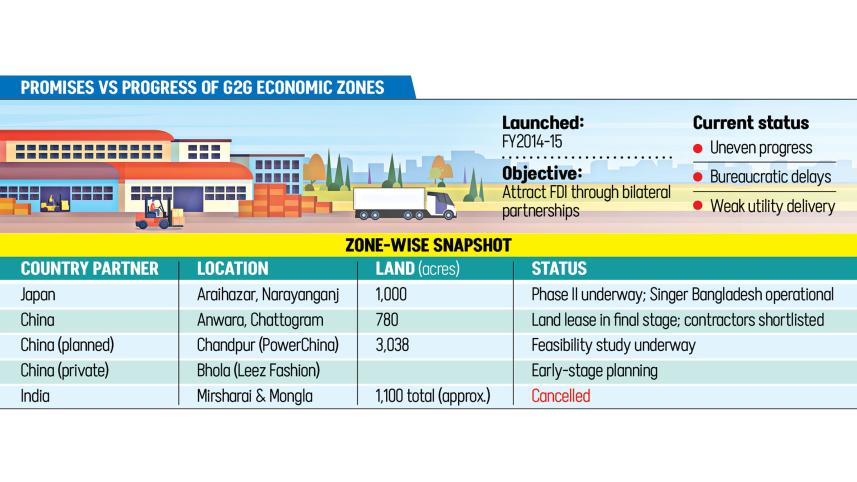
A decade after introducing the government-to-government (G2G) economic zone model to attract foreign investment in Bangladesh through bilateral partnerships, the overall progress now looks uneven.
While the Japanese zone is edging towards operational readiness, hampered but not halted by bureaucracy, the Chinese Special Economic Zone is just at the land lease agreement stage.
By contrast, the two Indian economic zones in Mongla and Mirsharai have been scrapped by the government.
To formalise scattered factories into designated industrial hubs, the previous government took the initiative to build as many as 100 economic zones across the country. The plan was to draw investors through preferential treatment and improved facilities.
In fiscal year 2014-15, the authorities also launched G2G economic zone partnerships with major trading partners.
Officials then estimated that the 100 public and private economic zones would generate 1 crore jobs and $40 billion in exports.
But after the political changeover in August last year, the Bangladesh Economic Zones Authority (Beza) has narrowed its focus to just five zones, prioritising quality and readiness over just the number of zones.
In G2G zones, investors from any country can invest, though entrepreneurs from the partner nation are usually given priority. Yet, officials and analysts say the model is struggling with fragmented coordination, sluggish utility delivery, and a reliance on political goodwill rather than institutional efficiency.
"The projects are progressing, but the speed is not what it could be," a senior BEZA official said, preferring anonymity, adding that success now depends more on getting essential utilities such as gas, water, and electricity than on diplomatic ties.
Major General (Retired) Md Nazrul Islam, executive member (Planning and Development) of BEZA, said the Japanese Economic Zone in Araihazar, Narayanganj, is "progressing at a satisfactory pace," with core infrastructure nearing completion.
"The first phase is done, and the second phase, which focuses on physical infrastructure, is moving forward at a good speed," he told The Daily Star.
The 1,000-acre project has been divided into two phases. Power, gas, and water connections are nearly ready, and complications over the Sylhet Bypass Road have been resolved.
With a $78 million investment, Singer Bangladesh has already begun operations in the Japanese Economic Zone.
Islam said they expect to ensure continuous electricity and gas connections at the economic zone by December this year. "Once these are resolved, major investments will start materialising," he added.
"If we can ensure reliable utility services like gas, water, and electricity, there will be no need to invite investors. They will come on their own," he commented.
CHINESE ECONOMIC ZONE NEARING LAND LEASE
The Chinese Economic and Industrial Zone in Anwara area of Chattogram is at the final stage of its land lease agreement.
 For all latest news, follow The Daily Star's Google News channel.
 Islam said that although it is called the Chinese Economic Zone, Bangladesh holds more than 30 percent of the total share.
The process, involving legislative vetting and multi-agency approval, is almost complete. Contractors for infrastructure work have also been shortlisted.
"If there are no election-related delays, I am hopeful that by December the land agreement process will be finalised smoothly, allowing official preparations to begin right after," he added.
The Anwara zone is being developed as a major industrial hub, targeting sectors such as leather goods, light engineering, electronics, readymade garment accessories, and furniture.
TWO MORE CHINESE ZONES PLANNED
The government plans two additional zones for Chinese investors, complementing the Anwara project.
Under a G2G deal, PowerChina will develop the Chandpur Economic Zone-1 on 3,038 acres in Matlab north.
Chinese-owned Leez Fashion Industries Ltd will privately develop the Bhola Eco-Development Economic Zone in Bhola Sadar and Daulatkhan.
The Bhola project expects to attract $1.8 billion in investment and create 40,000 jobs in garments, electronics, and ceramics.
Chandpur's investment will follow a feasibility study, prioritising renewable and agro-based industries due to limited connectivity.
BEZA has submitted the long-delayed Anwara Economic and Industrial Zone proposal for Executive Committee of the National Economic Council (ECNEC) approval.
TWO INDIAN ZONES SCRAPPED
In contrast, the government has cancelled two Indian Special Economic Zones (ISEZs) due to a lack of progress and investor interest, according to BEZA officials.
In 2019, Bangladesh approved a Tk 845 crore project to develop a 1,000-acre SEZ in the Bangladesh National Special Economic Zone (formerly Bangabandhu Sheikh Mujib Shilpa Nagar) for Indian investors.
BEZA signed an agreement with Adani Ports & SEZ Ltd and prepared a joint venture plan in 2022. But Adani did not respond to BEZA's operational framework. Two other Indian firms withdrew bids just before the February 2024 tender deadline.
Efforts to ease India's Line of Credit (LoC) conditions, which require 65 percent sourcing from India, also failed. Another proposed site near Mongla Port has been idle for more than two years.
Since the fall of the Awami League-led government in August last year, there has been no further contact with India, and Adani reportedly raised no objection to the cancellation.
Saleh Ahmed, executive member (investment promotion) at BEZA, said the land allocated for the Indian projects would now be reassigned.
"We sent several letters to the Indian authorities through the Economic Relations Division but received no response," he said.
"In the absence of any progress or communication, there was no alternative but to cancel the land allocation," Ahmed added.
M Masrur Reaz, chairman of Policy Exchange Bangladesh, expressed concern over the lack of progress in most SEZs except the Japanese one.
He attributed the weak performance to the G2G model, which he said often lacks private-sector efficiency and is weighed down by geopolitical and diplomatic complications.
Reaz argued that SEZs work best under public-private partnership models.
Citing India and China-led zones, he noted that shifting strategic priorities, such as health and river management, have sidelined economic collaboration, further slowing progress in these bilateral initiatives.
Comments