


Private credit growth remains slow as investors hold back
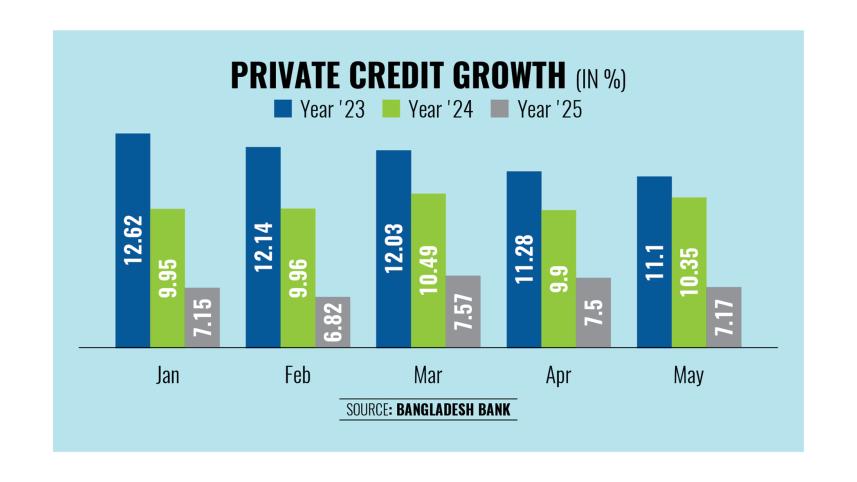
Private sector credit growth remained sluggish in May, with entrepreneurs holding back on investment amid political uncertainty and rising interest rates, according to Bangladesh Bank (BB) data.
Private credit expanded by 7.17 percent in May, well below the 10.35 percent recorded in the same month last year.
 For all latest news, follow The Daily Star's Google News channel.
 This followed a slight uptick in April, when growth reached 7.57 percent after dipping below 7 percent in March.
"It appears that investors are worried about uncertainties regarding domestic and global issues," said Syed Mahbubur Rahman, managing director and chief executive officer (CEO) of Mutual Trust Bank PLC.
One indicator of this cautious bank borrowing by private sector players is the sharp drop in letters of credit (LCs) for importing capital machinery.
In the July–April period of the fiscal year 2024–25, LC openings for capital machinery fell by 27 percent year-on-year to $1,419 million.
LC settlements, which show the actual imports, also dropped by 25 percent during the period. Imports of intermediate goods saw a similar decline, according to BB data.
"Of course, the law-and-order situation has improved. But political uncertainty persists," said Rahman.
He said the energy scenario is also not good. Many investors are not getting gas connections.
"Businesses are also concerned about the US tariff. They are looking at August 1, when the new tariff will take effect in the US," said the top banker.
"These are leaving investor sentiment damp and dull," he added.
Rahman also mentioned that slower government development spending is contributing to weak credit demand. "It seems that the overall situation might not improve in the short term," he added.
Ashikur Rahman, principal economist at local think tank Policy Research Institute of Bangladesh (PRI), echoed similar concerns.
He said the subdued appetite for credit is likely to continue until the next election.
"Investors are not willing to invest before the election," said the economist.
Two other factors—higher interest rates due to a tighter monetary policy and banks focusing more on the quality of loan disbursement—are weighing on credit flow, according to him.
The central bank has pursued a contractionary stance for nearly two years in a bid to contain inflation, which dipped below 9 percent in June for the first time in nearly three years.
The policy interest rate, or the repo rate, has been held at 10 percent since October last year, pushing up lending rates across the board. Accordingly, interest rates have been rising.
In April, the weighted average interest rate on bank deposits rose by six basis points to 6.23 percent compared with the previous month. The rate on loans edged up by one basis point to 12.05 percent, according to central bank data.
PRI economist Rahman said banks are disbursing quality credit now.
"What we see is borrowing by genuine investors and businesses, not wilful defaulters who would pocket part of the fund in the past," he said. "We see a lot of improvement as banks are giving credit based on a prudent framework."


Comments