


Panel formed to address post-LDC subsidy shift
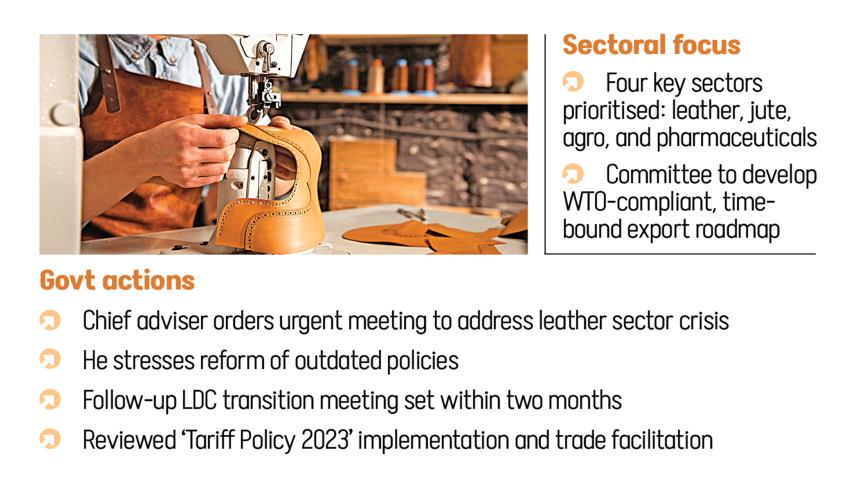
The finance ministry has formed a 16-member committee to identify alternatives to cash subsidies that comply with the rules of the World Trade Organization (WTO), as such facilities will be phased out following Bangladesh's graduation from least developed country (LDC) status.
Among its key priorities are four sectors identified as having high export potential in the post-LDC era: leather and leather goods, jute products, agriculture and agro-processing, and pharmaceuticals, according to a circular issued by the Ministry of Finance on Tuesday.
 For all latest news, follow The Daily Star's Google News channel.
 The committee, chaired by the principal secretary to the chief adviser, includes senior representatives from the ministries of commerce, foreign affairs and agriculture, as well as the Bangladesh Bank, the National Board of Revenue (NBR), and the Bangladesh Standards and Testing Institution (BSTI).
It has been tasked with developing a time-bound action plan to ensure sustained growth and competitiveness without relying on direct financial incentives.
Meanwhile, CA Muhammad Yunus yesterday expressed deep dissatisfaction over what he described as the prolonged neglect of the country's leather industry.
He instructed the relevant ministries to convene a follow-up meeting within the next two months to finalise the course of action for the country's LDC graduation, according to a press statement issued by the CA's press wing.
Yunus' remarks came during a high-level review meeting held at the Office of the Chief Adviser in Tejgaon, which reviewed Bangladesh's preparations for LDC graduation by November 2026. Although the meeting addressed a range of institutional and policy-level updates, the leather sector featured prominently in his comments.
"We have wronged the leather industry," Yunus said during the meeting. "We failed to assess its true value. This sector had the potential to contribute significantly to our economy, but we did not make it happen."
He emphasised that the sector deserves targeted attention to overcome existing bottlenecks and regain global competitiveness.
"We must act in our own economic interest," he said. "Policies and laws that no longer serve us must be reformed. We need to chart a path forward, and these are fundamental tasks. For the sake of our future and economic survival, we must carry them out."
"We cannot afford to transition into a middle-income economy while leaving behind high-potential sectors. The leather industry is a test case of whether we are serious about inclusive, diversified growth," Yunus also said.
The meeting also reviewed progress on several key initiatives, including the implementation of the Tariff Policy 2023, operational updates on major industrial projects, and inter-agency collaboration on export diversification.
Also speaking at the event, NBR Chairman Md Abdur Rahman Khan reported on the progress of the national single window initiative, which has so far integrated 19 agencies to streamline trade procedures.
He also briefed the meeting on the phased implementation of the Tariff Policy 2023.
Salehuddin Ahmed, economic adviser; Adilur Rahman Khan, industry adviser; Syeda Rizwana Hasan, environment adviser; M Sakhawat Hossain, shipping adviser; Noorjahan Begum, health adviser; Sheikh Abdur Rashid, cabinet secretary; and Ahsan H Mansur, governor of Bangladesh Bank, were also present at the meeting.


Comments