


Khaleda Zia laid foundations of private sector-led growth
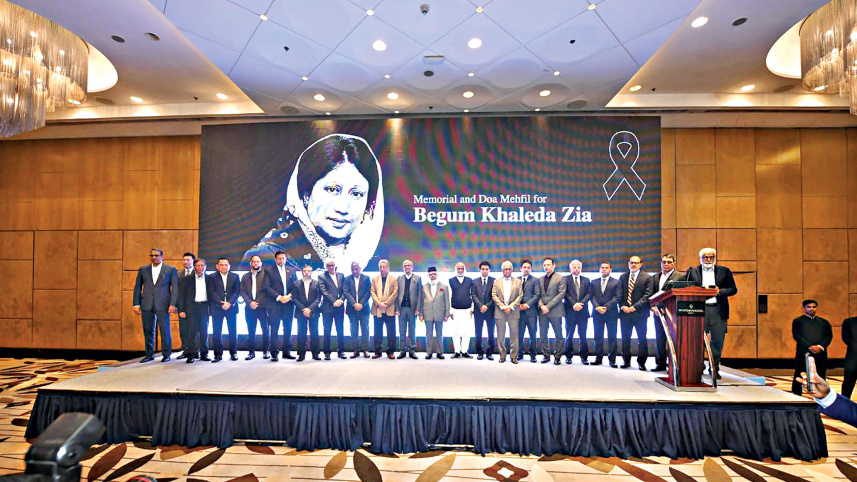
Business leaders yesterday credited former prime minister Khaleda Zia with laying the foundation for private sector-led growth through market-oriented reforms introduced during her first term in office.
After becoming the premier in 1991, she undertook many economic reform initiatives, encouraging entrepreneurs to invest in the private sector, they said at a memorial and prayer session (doa mahfil) jointly organised by 18 leading trade bodies in Dhaka.

Khaleda Zia, the country's first female premier, died on December 30 in a Dhaka hospital after prolonged illness.
Delivering the inaugural speech at the event, Mahbubur Rahman, president of International Chamber of Commerce–Bangladesh (ICC-B), said Khaleda Zia's leadership was instrumental in re-establishing parliamentary democracy and strengthening democratic institutions in Bangladesh.
"Her administration also pursued policies to encourage private sector development, expand trade and investment, and integrate Bangladesh more actively into the global economy, contributing to the foundations of long-term growth," said Rahman.
Khaleda Zia's leadership earned wide international recognition, he said, adding that her journey also involved significant personal hardship, including periods of imprisonment, legal challenges and long-term health struggles.
DCCI President Taskeen Ahmed said: "With remarkable foresight, Khaleda Zia introduced an open-market approach, private sector-led development and entrepreneurial policies to revitalise economic activities."
Abdur Rahim Khan, administrator to the Federation of Bangladesh Chambers of Commerce and Industry (FBCCI), said she knew how to unite people from all walks of life and would be remembered for her contributions.
Also speaking at the event, Amir Khosru Mahmud Chowdhury, former commerce minister and BNP Standing Committee member, said Khaleda Zia did not pursue a country-specific foreign policy but instead based it on multilateralism.
He said the private sector in Bangladesh was able to thrive because of her reform initiatives.
Taskeen Ahmed, president of Dhaka Chamber of Commerce and Industry (DCCI), said when she assumed office in 1991, the economy was stagnant and constrained by structural limitations.
"With remarkable foresight, she introduced an open-market approach, private sector-led development and entrepreneurial policies to revitalise economic activity," he said.
Through landmark reforms, including the enactment of VAT, banks and financial institutions laws, and the establishment of the privatisation board and the Securities and Exchange Commission, she significantly strengthened revenue mobilisation, the financial sector and the capital market, Ahmed added.
Kamran T Rahman, president of Metropolitan Chamber of Commerce and Industry (MCCI), said the economy transformed during Khaleda Zia's tenure due to policy-driven industrialisation, remittance and export growth.
"Employment also grew a lot, and she was bold and determined about democracy," he said.
Mohammad Iqbal Chowdhury, vice president, Foreign Investors' Chamber of Commerce and Industry (FICCI), noted that during Khaleda's tenure, Lafarge Surma Cement made a half a billion dollars of investment and she had inaugurated the cement plant.
He also praised the VAT system that was adopted in 1991.
Anwar-Ul-Alam Chowdhury (Parvez), president of Bangladesh Chamber of Industries (BCI), said under her leadership, democracy and economic progress made a permanent footprint in Bangladesh, which were vital for the private sector. "Entrepreneurship and investment flourished during her time."
Abdul Hai Sarker, chairman of Bangladesh Association of Banks, said Khaleda Zia used to talk less but listen more. Industrialisation and development bloomed during her tenure.
Meanwhile, Mohammad Hatem, president of Bangladesh Knitwear Manufacturers and Exporters Association, recalled a meeting with Khaleda Zia in 2002, when he was the vice-president of the association.
 For all latest news, follow The Daily Star's Google News channel.
 "After listening to the sector's challenges, she took key decisions that helped the industry grow into the world's second-largest knitwear exporter after China," he said.
Inamul Haq Khan, senior vice-president of Bangladesh Garment Manufacturers and Exporters Association, said Khaleda Zia was an uncompromising leader and she would be remembered for her contribution to the garment sector.
"We are indebted to her as she contributed a lot to the garment industry such as free market economy, economic development and female empowerment," he said.
Syed Ishtiaq Ahmed, vice-president of Bangladesh Association of Publicly Listed Companies, said Khaleda Zia's journey was difficult, but she stood firm and made sacrifices for democracy.
She governed the country during a defining moment of Bangladesh, he said, adding that her silence spoke more than words.
Abdul Muktadir, president of Bangladesh Association of Pharmaceuticals Industries, said the pharmaceutical sector was indebted to her for a landmark decision taken in 1994, which reduced government control on drugs pricing.
"Other countries such as India and Pakistan adopted similar moves much later. The decision helped the sector grow," he said.
MA Jabbar, president of Bangladesh Semiconductor Industry Association, defined the tenure of Khaleda Zia as a period of leadership and sacrifice.
Bangladesh Cement Manufacturers Association President Amirul Haque said Khaleda Zia made Chattogram the country's commercial capital.
He added that her husband, former president Ziaur Rahman, established the Export Processing Zone, and that the business community was indebted to the family.
BNP Standing Committee member Abdul Moyeen Khan said Khaleda Zia was brought into leadership after the assassination of Ziaur Rahman through a well-judged decision by senior BNP leaders.
"She fought for parliamentary democracy defeating autocracy. Khaleda made the private and public sectors unique combinations," he said.
BNP Secretary General Mirza Fakhrul Islam Alamgir said 1,700 party supporters and activists faced the enforced disappearance and six million false cases were filed against them during the Awami League-led regime.
Some 47 cases were filed against Khaleda Zia, he said.
He said, the possibility of democracy in the country was destroyed because of such a culture. "Khaleda Zia stood against this culture. She was an icon of the people, a fact that was proven during her funeral, when millions attended spontaneously."
ICC-B Vice-president AK Azad said she dedicated her life to democracy, development and establishing the rights of people. "She was a symbol of patriotism."
ICC-B President Mahbubur Rahman chaired and moderated the discussion. Representatives from the insurance sector also spoke on the occasion.
Comments