


Interim govt's ambitious reforms may challenge elected successors: Wahiduddin Mahmud
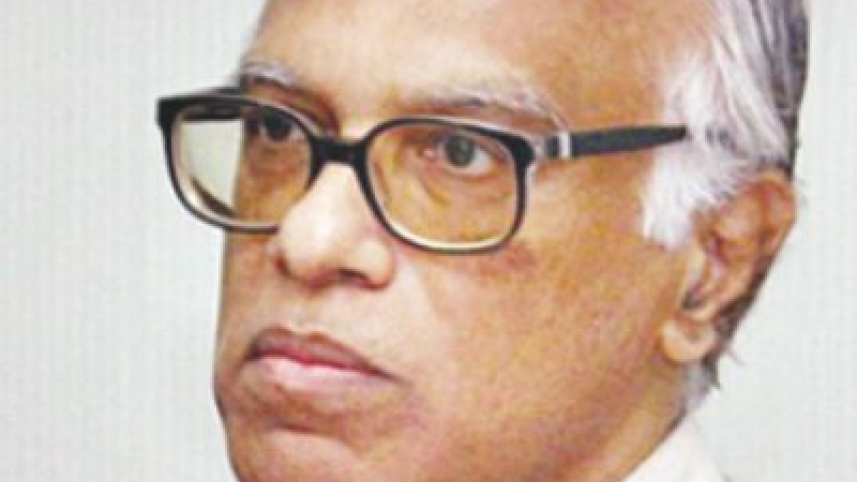
The interim government has carried out more ambitious reforms than expected—some of which may be difficult for an elected government to tolerate or digest, said Planning Adviser Wahiduddin Mahmud.
"Some major reforms are being rolled out through ordinances, and even we don't yet fully grasp their implications. It will take time to understand their full impact," he said.

"But these were all long-standing recommendations of various reform committees, and many proposals had already been prepared within our own ministries," he added.
The adviser made these remarks today while responding to a question about the reforms of the Bangladesh Bureau of Statistics at a press briefing at the Ministry of Planning in Dhaka, following a meeting of the Executive Committee of the National Economic Council.
"My personal view is that the interim government has carried out far more reforms—and more ambitious reforms—than expected. Some of these may be difficult for an elected government to digest or tolerate," he reiterated.
He expressed hope that, even if not all the reforms are retained, at least most of them—or at least their essence and the core principles behind them—would be accepted.
"Because an elected parliament is ultimately the one best aligned with the people's expectations."
Prof Mahmud also cited the recent ordinances on judiciary reforms and public procurement policy as examples.
"We are passing many such ordinances. An elected government cannot simply say, 'It is done.' They will review each one and keep what they find appropriate."
"I believe this Public Procurement Policy ordinance will become law in parliament," he said.
The adviser attributed lower project implementation rates to a shortage of project directors.
"Nobody wants to become a project director anymore, and contractors are less enthusiastic," he said.
The new Public Procurement Act has made the process far more transparent, ending monopolies and requiring contractors to fully disclose business and tax information.
While this makes participation harder for some, it ensures that new contractors can enter the market, according to Mahmud.
On the topic of corruption, Prof Mahmud said: "Though I'm not fully certain, corruption, extortion, and similar practices still exist in some form."
"But the scope for corruption through contracting has likely shrunk, creating hesitation among those who were previously accustomed to exploiting the system. [Contractors] are unsure whether the usual opportunities still exist."
The adviser also urged caution regarding foreign-funded projects, particularly due to higher spending on unnecessary components, including foreign consultants.
He explained that whenever a foreign-funded project reaches the ministry, there is a tendency to finalise it hastily.
"We must stop approving projects simply because development partners offer them. Many technical assistance projects have been ineffective—foreign consultants stay in our offices, collect allowances, write reports, and do little meaningful work before leaving," he said.
"I have seen this repeatedly throughout my career. We want to break free from this reliance on foreign consultant-driven projects," he added.
 For all latest news, follow The Daily Star's Google News channel.
 However, he acknowledged that in some areas, Bangladesh genuinely needs foreign expertise—for example, in upgrading technology in the garments sector, improving export diversification, microchip manufacturing, and large-scale assembly.
"We can learn these skills. We already assemble mobile phones and motorcycles, but we need to move to higher value addition. In these areas, foreign experts are necessary," he said.
Comments