


Rain brings relief to Boro farmers amid fuel crunch

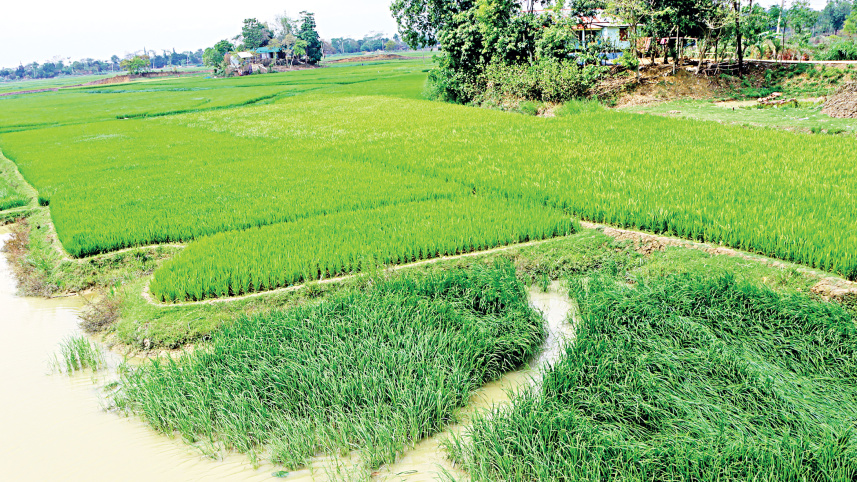
Consecutive days of rainfall across the country recently have brought some relief to farmers struggling to irrigate crops -- mostly Boro rice -- amid the supply shortage of fuel oil gripping the nation.
The government had restricted fuel supply for a few days earlier this month. Even after the fuel purchasing cap was withdrawn, supply remained strained, and farmers struggled to run pumps to irrigate their fields.

After the rainstorms, farmers say they no longer need to worry about the fuel shortage, as there is now standing water in the fields, cutting the need to pump up groundwater.
Jamal Mia, a farmer from Brahmanbaria Sadar upazila, said he has cultivated Boro rice on four acres this season, and has faced difficulties irrigating his fields for a few days due to the ongoing diesel shortage.
However, the recent rainfall over the past few days has brought much-needed relief, he said.
Md Omar Faruq, a meteorologist at the Bangladesh Meteorological Department (BMD), said that rainfall was recorded in multiple districts over the past seven days, with varying intensities.
Sylhet received 53 millimetres (mm) of rain between 6:00 am and 12:00 am yesterday. The previous day saw the highest rainfall in Dinajpur (48 mm), followed by Rangpur (40 mm), Saidpur (30 mm), and Rajarhat in Kurigram (29 mm), he told The Daily Star.
He added that Tangail recorded 21 mm the day before, while Manikganj had 51 mm on Thursday.
Earlier, Netrokona received 34 mm on Tuesday. Panchagarh saw 26 mm on the 21st of this month after a dry spell, he said.
“Rainfall was not limited to a single district on any given day, as precipitation occurred in several districts, with only a few stations reporting no rain,” Faruq added.
“The recent rainfall has been beneficial for Boro rice cultivation, particularly in easing irrigation challenges amid the ongoing diesel situation,” said Mohammad Khalequzzaman, director general at the Bangladesh Rice Research Institute.
He said such rainfall supports crop growth as long as it is not accompanied by hailstorms, which can cause severe damage.
“While prolonged rainfall can sometimes disrupt pollination, the current short-duration showers during this stage in March are unlikely to pose any risk.”
Khalequzzaman also said that although there were reports of minor hailstorms in some villages, no significant damage has been reported so far, indicating that the overall impact of the recent weather has remained positive for farmers.
Md Ataur Rahman, director general at the Bangladesh Agricultural Research Institute, said the recent rainfall has largely been beneficial for crops, including Boro paddy and seasonal vegetables, as it has not been excessive or accompanied by storms.
“Most vegetables, such as tomatoes, eggplants, and beans, are currently in the harvesting stage, and the rainfall has not caused noticeable damage,” he said.
He added that only crops like potatoes in poorly drained clay soils may face some risk, while areas with sandy or silty soil have remained largely unaffected.
Rahman also said moderate rainfall at this stage can be helpful for upcoming Kharif cultivation by improving soil moisture for land preparation, although excessive rainfall could create challenges.
He further mentioned that crops like watermelon, bitter gourd, and amaranth are performing well, and while market prices for some produce like watermelon may decrease slightly due to the rain, overall crop quality is expected to remain good.
“The recent rainfall over the past several days has generally been beneficial for Boro rice, though its overall impact is still being assessed,” said Md Jamal Uddin, additional director for monitoring and implementation at the field service wing at the Department of Agricultural Extension.
 For all latest news, follow The Daily Star's Google News channel.
 He added that preliminary information on affected areas is expected soon, but a comprehensive assessment of crop damage and coverage will take another one to two days to complete.
Talking about the government’s fuel rationing decision earlier this month, Jahangir Alam Khan, an agricultural economist, said the decision was understandable given the global oil crisis.
“However, agriculture must receive top priority. Boro cultivation depends heavily on irrigation, with 62–65 percent of land using diesel-powered pumps. Diesel for irrigation should be subsidised, just like electricity for power generation,” he said.
As per Bangladesh Petroleum Corporation (BPC) data, 15.41 percent of petroleum oil supplied by the corporation in the 2024-25 fiscal year was used in the agriculture sector.
Comments