


Stagnant Saarc exports reveal Bangladesh’s trade risks

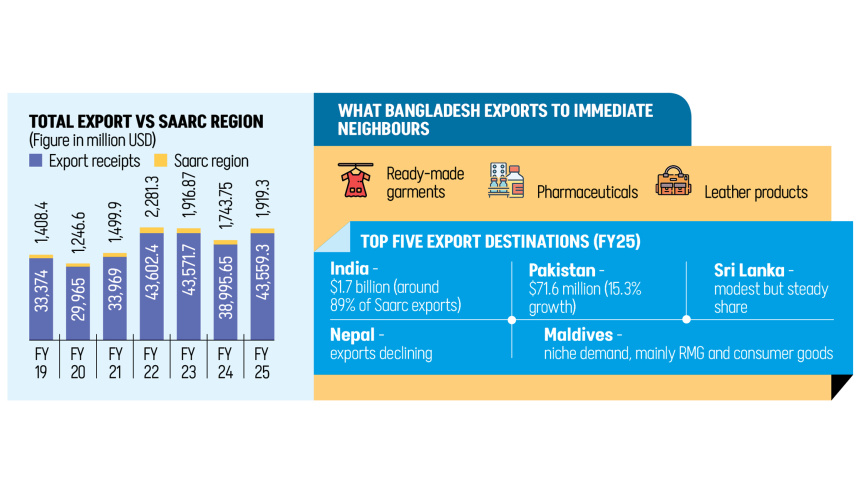
Bangladesh’s exports have become a powerhouse for its economy, increasing by some $10 billion over the last six years. But when it comes to its immediate South Asian neighbours, the outward trade has remained trapped in a narrow range, failing to grow by even a billion dollars throughout.
Total global export earnings reached $43.6 billion in fiscal year 2024-25 (FY25), up from $33 billion six years ago, Bangladesh Bank (BB) data shows.
 For all latest news, follow The Daily Star's Google News channel.
 Meanwhile, exports to seven member countries of the South Asian Association for Regional Cooperation (Saarc) stood at just $1.9 billion in FY25, a mere 4.4 percent of the total. The figure was $1.4 billion in FY19.
A recent report by the central bank on the country’s economic engagement points out that while Bangladesh’s relationships with major partners in the European Union, the United States and the Middle East are well documented, “its economic linkages within Saarc remain surprisingly underexplored yet vitally important.”
Experts identify persistent non-tariff barriers, limited connectivity, logistical bottlenecks and weak regional cooperation frameworks as major constraints to expansion.
ONE MARKET, ONE BASKET
Even within Saarc, the trade is heavily concentrated, with India alone absorbing nearly 89 percent of Bangladesh’s regional exports, making the bloc effectively a one-market story.
Pakistan, Sri Lanka, Nepal and Bhutan remain peripheral, their combined share too thin to move the needle. While exports to Pakistan and Sri Lanka have shown some improvement, their scale remains too small to shift the overall trajectory. Nepal, meanwhile, has seen declining exports.
The concentration poses a huge risk – any policy shift or demand shock in New Delhi ripples immediately through Bangladesh’s entire regional trade position.
The export basket is equally narrow, dominated by ready-made garments, pharmaceuticals and leather goods.
The central bank notes that this lack of diversification limits growth prospects, especially in markets where production structures are similar and competition is high. Unlike Bangladesh’s global trade, which has gradually moved into higher-value segments, regional exports have seen little structural transformation.
The limitations of regional exports are also evident in the widening trade imbalance. Bangladesh bought $10.5 billion worth of goods from Saarc nations last fiscal year, more than five times what it sold, yielding a trade deficit of $8.6 billion.
India supplied over 90 percent of those imports, covering essential commodities and industrial inputs. Bangladesh is far more integrated with its neighbourhood as a buyer than as a seller.
THE ROADS NOT TAKEN
Policy experts point to infrastructure as the primary constraint. Except for India, Bangladesh has no direct land links with its South Asian neighbours, pointed out Khandker Golam Moazzem of the Centre for Policy Dialogue (CPD). This makes trade with the neighbours less lucrative.
For instance, he said, “Exporting to Hong Kong can sometimes cost less than trading with India, a reflection of poor logistics, inadequate land ports and inefficient customs systems.”
Outdated Safta (South Asian Free Trade Area) negative lists and persistent non-tariff barriers add further friction, he added.
Moazzem stressed the need for improved port facilities, modernised land ports and digitalised one-stop border services. He also highlighted the importance of sub-regional initiatives like BBIN and BIMSTEC to enhance connectivity through India.
Ahsan Khan Chowdhury, chairman of Pran-RFL Group, which exports nearly $100 million annually to India, identified demand mapping in each market as a prerequisite for expansion. “Saarc countries hold significant trade potential, but identifying demand in each market remains crucial for expansion.”
He flagged the “northeastern Indian states as a particular opportunity” for Bangladesh, while noting that trade became harder to sustain during the interim government period due to strained bilateral ties.
Chowdhury also called for upgrading Bangladesh’s standards testing infrastructure to meet Indian requirements and proposed an ASEAN-style duty-free framework for the bloc.
At the same time, he emphasised the need to negotiate with India to reduce trade barriers and improve port efficiency.
The contrast with ASEAN (Association of Southeast Asian Nations) -- which has built integrated regional value chains sustaining high intra-regional volumes – illustrates the scale of South Asia’s failure to deepen economic ties.
Sub-regional frameworks such as Bangladesh-Bhutan-India-Nepal (BBIN) initiative and Bay of Bengal Initiative for Multi-Sectoral Technical and Economic Cooperation (Bimstec) offer a partial path forward, but analysts say physical connectivity remains the essential precondition for any meaningful expansion.
Comments