


Import rules eased for specialised fabrics used in niche apparel

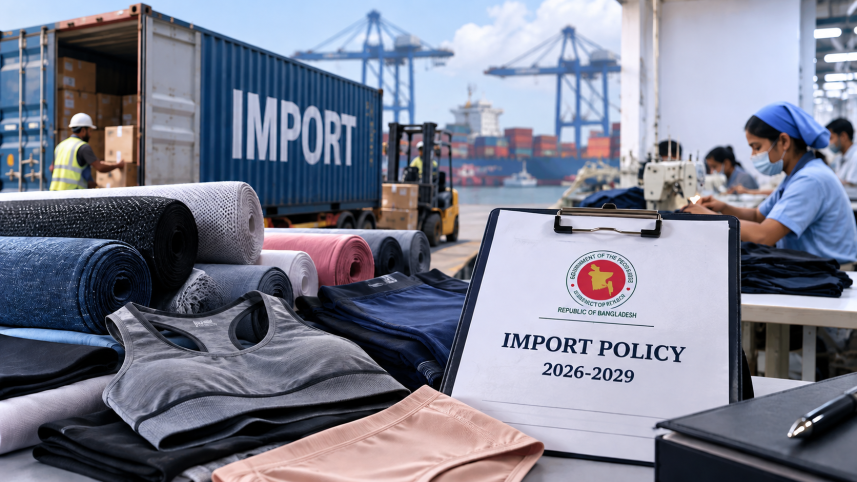
Apparel exporters will now be able to import specialised fabrics and materials used to produce niche products such as seamless sportswear, underwear and functional garments more easily, as the government has relaxed several provisions of the country's import policy.
The commerce ministry amended the Import Policy Order 2026-2029 through a notification issued on Sunday, with the changes taking immediate effect.

Under the amended provision, specialised fabrics and materials required for producing certain types of garments can be imported on the recommendation of either the Bangladesh Garment Manufacturers and Exporters Association (BGMEA) or the Bangladesh Knitwear Manufacturers and Exporters Association (BKMEA).
The move is expected to ease sourcing of inputs for manufacturers producing specialised apparel, which often require fabrics and materials that are not commonly used in mainstream garment production.
The latest amendment also removes some procedural requirements that had created additional complications for exporters, according to Mohammad Hatem, president of the BKMEA.
Speaking to The Daily Star, Hatem said the changes were largely aimed at correcting inconsistencies and unnecessary restrictions in the Import Policy Order 2026-2029.
One of the major changes concerns the import of fabrics and yarn.
Under the previous provision, importers in certain cases were required to obtain approval from the Ministry of Commerce to import knit fabrics and yarn.
“That requirement did not make much sense when imports were already being made under the utilisation declaration (UD) system and within the framework of the import policy,” Hatem said.
He said the requirement could have forced businesses to approach the ministry for approval for individual letters of credit, adding another layer of paperwork to the import process.
The amended policy has removed the requirement, he said.
The government has also scrapped a provision concerning the import of spare parts for industrial machinery.
Previously, the value of spare parts that could be imported was capped at 2 percent of the value of machinery in the first year and 5 percent in subsequent years.
“Suppose a machine breaks down. If the required spare part costs more than the prescribed limit, the machine could remain idle,” Hatem said.
The restriction has now been removed, he added.
Hatem said the amendment also addressed several other inconsistencies, including contradictory and unclear wording in the previous policy.
“These corrections will make import procedures easier for businesses and reduce disruptions caused by inconsistencies in the policy,” he said.
The amendment is particularly relevant as Bangladesh's apparel industry is expanding beyond conventional basic garments into higher-value and specialised products, including sportswear, underwear and functional clothing.
The notification, however, does not provide any specific duty concession or quantitative limit for the import of the specialised fabrics and materials. Rather, it sets out the conditions under which such inputs can be imported.
Hatem welcomed the government's move, saying the corrections would help exporters source necessary inputs and machinery with fewer administrative hurdles.
 For all latest news, follow The Daily Star's Google News channel.
 “We welcome this initiative by the Ministry of Commerce and thank them for correcting these provisions,” he said.
Comments