


Govt aims to save Tk 3,000 crore annually on fertiliser: agri secretary
The interim government is planning measures that will save Tk 2,000 crore to Tk 3,000 crore annually on fertiliser costs, said Mohammad Emdad Ullah Mian, agriculture secretary.
Already, Tk 1,000 crore has been saved on fertiliser this year alone, he added.

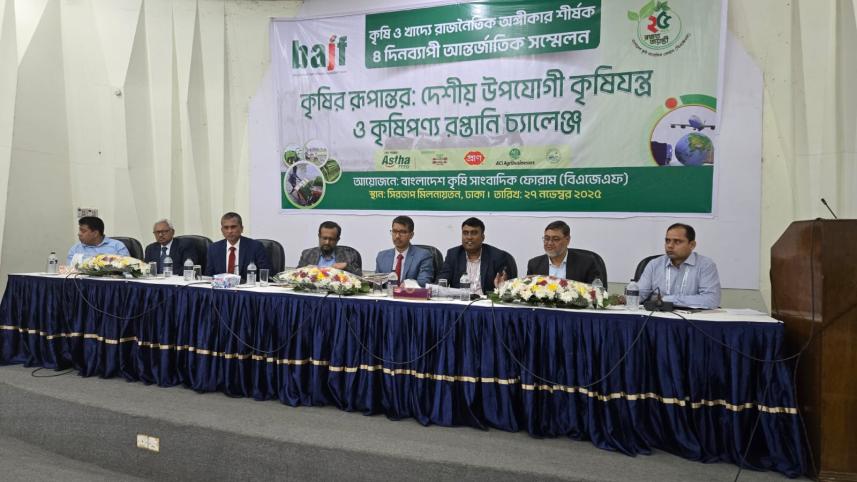
He made these remarks today during a seminar titled "Transforming agriculture: locally appropriate farm machinery and the challenges of exporting agricultural products" at the Cirdap auditorium in Dhaka.
The event was organised by the Bangladesh Agricultural Journalists Forum (BAJF) to celebrate its 25th anniversary. It marked the first day of the four-day international conference "Political commitment in agriculture and food."
Mian also said that a long-term plan for the next 25 years is being formulated to ensure overall development and modernisation of the country's agricultural sector.
The final draft of this plan will be ready by December, he informed, adding that Tk 600 crore from the mechanisation project has been returned to the government.
Md Durrul Huda, chief scientific officer and head of the Farm Machinery and Post-Harvest Technology Division at the Bangladesh Rice Research Institute, said the main challenge in producing modern agricultural machinery in Bangladesh is the lack of a skilled workforce, modern infrastructure, and advanced equipment.
He highlighted that the light engineering sector and foundries are not modern, making it difficult to maintain interchangeable parts or adopt assembly-line production.
Additionally, the absence of state-owned institutions capable of producing engines has hindered both public and private sector development in this area, he added.
He stressed that producing these machines in Bangladesh requires state support, long-term planning, and low-interest loans. He also called for stronger synergy between the government and private sector to make domestic production feasible.
Kamruzzaman Kamal, marketing director at PRAN-RFL Group, said although the global agro-processing market is worth $4 trillion, Bangladesh's share is only $1 billion, indicating significant potential. However, due to gaps in variety and quality, not everyone can produce high-standard products.
The complexity of obtaining approvals from 18 different departments for agricultural exports increases both time and costs, making a one-stop service and country branding essential, he said.
There is a shortage of quality control and internationally accredited laboratories in the country, requiring many tests to be conducted abroad, and BSTI standards are not accepted globally, he added.
He emphasized the need to ensure quality from the farm level to guarantee safe food.
Md Fazlul Kader, managing director of the Palli Karma-Sahayak Foundation, emphasized that mechanisation and the adoption of agricultural technologies are crucial both for reducing costs and increasing revenue, ultimately paving the way for agriculture to become a dignified profession.
He said locally adapted machinery, proper planning of subsidies, and the involvement of extension workers are essential for effective mechanisation, ensuring that farmers fully benefit from these innovations.
Arifur Rahman, project director of the Department of Agricultural Extension's exportable mango production project, said that in the past five years, mango exports have tripled, while mango imports have dropped to zero.
Currently, mangoes are being exported to 38 countries.
There is potential to expand into the European market, but transportation and air freight costs are limiting export growth. Often, even when higher freight charges are paid, space on planes is not available, he said.
Shahanuare Shaid Shahin, president of the BAJF, said that political commitment is necessary to protect the interests of farmers and producers. Every political party must include a clear and long-term strategy on this issue in their election manifesto.
 For all latest news, follow The Daily Star's Google News channel.
 Abu Khalid, general secretary of the BAJF, said that to make agricultural transformation sustainable, advanced technology and farmer-friendly policies must be formulated.
Comments