


Farming superfood in the sea

Anwara Begum reads the sea much like others read a calendar. She knows what the tide will leave behind, where it will settle, and when to go looking. For years, that instinctive knowledge earned her money from collecting and selling seashells.
So, when she noticed something new at the Burmese Market in Cox’s Bazar about 15 years ago, she recognised it instantly.

Thin, black, hair-like strands were being sold by Rakhine traders. The vermicelli-like seaweed was stacked beside jars of pickles and piles of dried fish. To many buyers, it was just another unfamiliar coastal ingredient.
But to Anwara, a local of Nuniachhara in the beach town, it was something she had seen countless times clinging to rocks along the Moheshkhali Channel during low tide.
The seaweed, used by the local Rakhine community in soups, curries and pickles, was coming from Myanmar. Anwara quickly realised the same marine plant was already washing up near her home.
At the time, she made her living collecting seashells from the shore and selling them at the Burmese Market, long known as a must-visit spot for tourists looking for showpieces and souvenirs to take home.
Seaweed was not then a part of Anwara’s trade. But the demand was visible, and the resource cost nothing. She began gathering the black seaweed from the beach and selling it to the same Rakhine buyers.
What started as a small addition to her shell business would quietly grow into something much bigger in the years that followed.
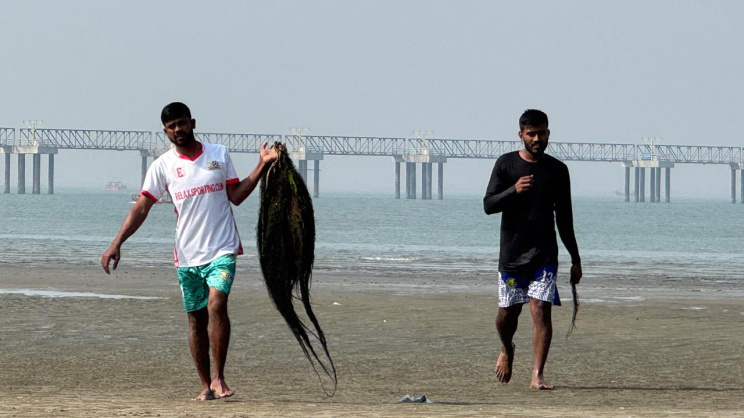
For generations, ethnic communities in the southeastern regions have consumed seaweed for its nutritional and medicinal value, using it as vegetables and salads. The practice of collecting seaweed is therefore not new. What is new is cultivating it as a livelihood.
ROPES OF HOPE
Anwara’s shift from foraging to farming came unexpectedly.
A scientist from the Bangladesh Agricultural Research Institute (Bari), Mostaq Ahmed, approached her and several other coastal women with a proposal to cultivate seaweed on a commercial scale. At first, the idea was met with doubt.
“We did not know how to grow it,” Anwara recalls. “We only knew how to collect it from the shore.”
Bari stepped in with training, seedlings and simple tools, such as bamboo poles and 10-metre ropes. Farmers were taught how to plant seaweed underwater, how long to leave it in the water, and when to harvest.
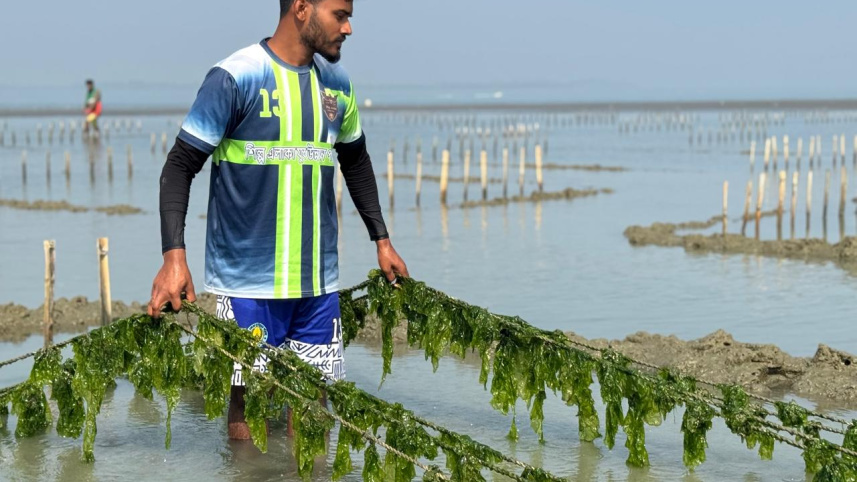
Initially, two species were introduced -- black, hair-like Gracilaria and green, lettuce-like Ulva. The Ulva variety was brought from Japan due to strong market demand.
Farmers adapted quickly, learning to work with the seasons. From November, seaweed is cultivated along Nuniachhara beach for the next seven months. In winter, lower rainfall increases salinity and water clarity, creating ideal conditions for growth. Seaweed also grows naturally along the coast during this period and is used as seed for cultivation.
Around 500 farmers are now growing seaweeds under the programme of Bari. Another 500 cultivate seaweed across Cox’s Bazar with support from the Japan International Cooperation Agency (Jica) and several non-government organisations.
According to farmers, seaweed is grown mainly through long-line and floating raft methods.
In the long-line system, seedlings are tied every 20 centimetres along a rope, which is then secured with small poles and left floating in shallow water. In the raft system ropes are similarly hung from a bamboo raft and used to hang seedlings. Within 15 days, the first harvest is ready. Farmers can then harvest at least twice a month. Each green lettuce-like plant can weigh up to 400 grammes.
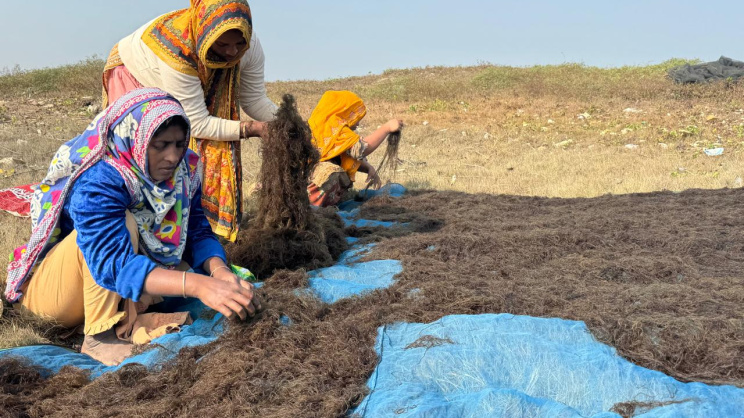
After harvesting, the seaweed is washed, cleaned and dried on the beach. Apart from planting and harvesting, the work requires little labour.
 For all latest news, follow The Daily Star's Google News channel.
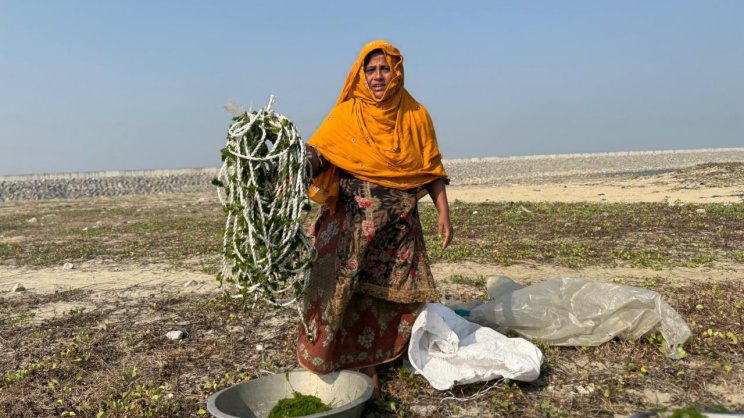
 Anwara now cultivates both species and, due to her experience, produces more than most newcomers.
She sells her harvest not only in the local Rakhine market but also in ethnic communities at Lama and Alikadam in Bandarban. Each harvest brings her around Tk 3,000-Tk 4,000.
Mariam Begum, another early adopter, said interest continues to grow as the income potential becomes clearer.
In popularising the cultivation, Bari’s role has been crucial. Since 2016, Mostaq Ahmed and his team have led experimental trials, gradually building confidence through training and demonstration.
Maksudul Haque, a research assistant at Bari, said they distributed 1,000 ropes last year and plan to distribute 2,000 this year. Each rope produces about two kilogrammes of Ulva a month.
Apart from income, the initiative has created a sustainable livelihood model, especially for women and marginalised coastal households.
FROM SHORELINE TO MARKET
Seaweed farming is now reshaping local trade as well as household incomes in Cox’s Bazar.
Fresh black seaweed sells for about Tk 100 per kilogramme, while dried black fetches around Tk 300. Dried green seaweed, which has a higher demand, sells for about Tk 1,000 per kilogramme.
Farmers like Shafi Alam supply markets at Lama, Alikadam and Bandarban town. Others sell directly to hotels in Cox’s Bazar. Traders, seeing the opportunity, have also entered the business. They buy directly from farmers and supply markets in Dhaka and Mymensingh.
Md Noman, owner of Messrs Alamgir Store in the beach town, purchased Tk 1.5 lakh worth of dried green seaweed last year and expects to buy more this season.
He supplies five-star hotels in Cox’s Bazar and receives orders from abroad. In some cases, traders provide financial support to farmers so they can expand production to meet rising demand.
Hotels are already adapting their menus. Mohammad Milton, chef at the Ramada by Wyndham Cox’s Bazar, said a consistent local supply allows them to diversify seafood dishes and experiment with new textures and flavours.
According to him, seaweed has become a premium ingredient, valued for both nutrition and novelty.
Although interest and demand are rising fast, supply has yet to catch up. Farmers cannot meet large purchase orders, which has pushed prices higher and underlined the economic potential of scaling up production.
For many coastal families, seaweed is emerging as the most profitable option among traditional livelihoods.
WHY SEAWEED MATTERS
Apart from local trade, seaweed is recognised worldwide as both a superfood and an industrial resource. Rich in vitamins B, C, D, E and K, as well as beta-carotene, it is eaten directly and processed for a wide range of products.
Agar, carrageenan and sodium alginate extracted from seaweed are used in ice cream, mayonnaise, chocolate, toothpaste, ointments, cosmetics and even paint. Although Bangladesh has suitable coastal conditions, it still imports nearly all of its agar powder.
Globally, seaweed production has grown rapidly over the past two decades.
According to the Food and Agriculture Organization (FAO), total seaweed output reached 36.3 million tonnes in 2021, nearly three times the level recorded in 2001.
About 97 percent of production comes from aquaculture. China accounts for around 60 percent of global output, followed by Indonesia with 25 percent. The Republic of Korea and the Philippines together contribute about 9 percent, said FAO in its “Seaweed Trade and Market Potential” report.
Wild harvesting has remained largely unchanged at around 900,000 tonnes a year. Between 2021 and 2023, global exports reached 819,000 tonnes, valued at $3.2 billion. Carrageenan accounted for nearly half of all trade, while edible seaweed made up roughly a third, according to the UN agency.
The edible seaweed trade is concentrated in East Asia, while developing countries supply most dried seaweed for industrial use.
In Bangladesh, seaweed grows naturally along the shores of Saint Martin’s Island, Inani Beach and parts of the Cox’s Bazar coast. With a 710-kilometre unbroken coastline and an expanded maritime territory of 118,813 square kilometres, Bangladesh sits on a resource that could reshape coastal economies if developed carefully.
BLUE ECONOMY, MOSTLY UNTAPPED
As seaweed cultivation spreads across the coastal communities, entrepreneurs are paying attention.
Lutfor Rahman, executive director of GreenTech Foundation Bangladesh, a non-profit organisation dedicated to promoting environmental sustainability and social responsibility, recently visited Nuniachhara to assess production capacity. “Returns from seaweed cultivation are enormous compared to most crops,” he said. Industrial investment, he believes, could turn small farms into a scalable sector and open a new chapter in the blue economy.
The limits are practical. Seed supply is still tight, and farmers lack proper drying, storage and transport facilities to scale up production.
Anwara still works along the same stretch of coast. The sea dictates when she plants and when she harvests. What has changed is the return. What was once an uncertain day’s earnings from shells has turned into a predictable income during the season.
Comments