


Startups, venture capital can hold shares in microfinance banks
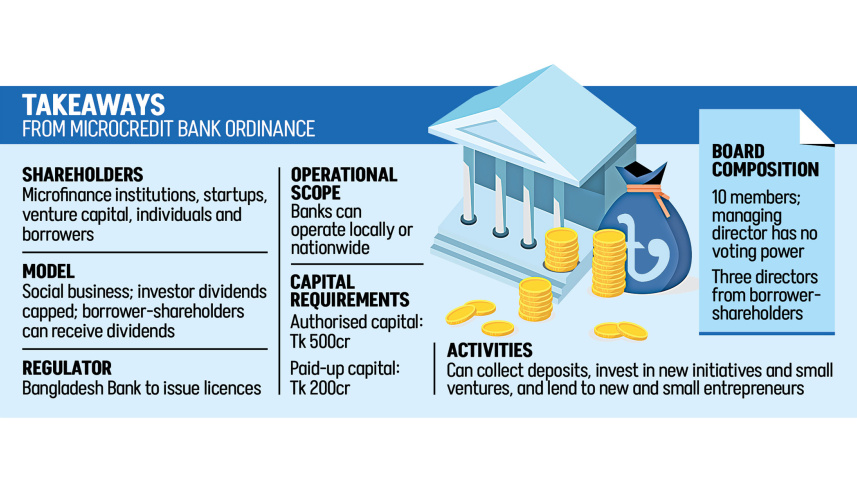
The government has issued the ordinance on the establishment of long-discussed microfinance banks, opening the door for microcredit institutions, startups and venture capital firms to become shareholders alongside individual entrepreneurs.
Titled as the Microcredit Bank Ordinance 2026, the law allows these banks to operate as social business entities, capping dividends for investors at the level of their total investment.

Borrower-shareholders, however, will be eligible to receive dividends.
Under the law, microfinance banks will take deposits from individuals, organisations and borrowers. They will also be able to borrow funds from the banks by pledging their assets as collateral.
The ordinance says the banks will lend to new entrepreneurs to support job creation and poverty reduction, with or without collateral.
The banks will also make capital investment directly in businesses run by young and small entrepreneurs. It will finance the purchase and storage of industrial and agro-based products, fisheries and livestock, as well as machinery and spare parts.
The Bangladesh Bank will issue licences for the new institutions, which may operate in a single district, across multiple districts or divisions, or nationwide.
Before applying for a licence, prospective banks will have to be registered under the Bank Company Act 1994, according to the ordinance issued by the law ministry on Wednesday.
The gazette notification was published two weeks after the approval by the Advisory Council and amid concerns from leading microfinance institutions that the new banks could weaken the sector’s role in poverty alleviation and financial inclusion.
As per the law, the authorised capital of a microfinance bank will be Tk 500 crore, with a minimum paid-up capital of Tk 200 crore at inception.
Each bank will be governed by a 10-member board, comprising three directors from borrower-shareholders, two nominated by the Bangladesh Bank and three representing other shareholders. The managing director will also sit on the board but will not have voting rights, according to the notification.
Asif Saleh, executive director of BRAC, one of the country’s largest microfinance institutions, described the ordinance as a positive step, saying it formally recognises startups and venture capital within Bangladesh’s regulated financial system.
“Innovation finance has long needed a clear policy framework,” he said.
He added that the regulation appears to strike a balance by enabling risk capital for startups while maintaining safeguards for financial stability. “Whether the regulators will understand risk for such an initiative and be more flexible and innovative is another question,” he also noted.
Saleh said access to patents and appropriate capital has long constrained entrepreneurs, especially younger founders, and that the new framework creates the possibility of easing that gap over time.
“It is also important to be realistic. This is not an overnight solution. Its impact will depend heavily on how it is implemented in practice, how it will be regulated within the current realities of the banking sector and whether an entrepreneur will be able to raise institutional capital for such a venture soon,” he said.
“Considering the current scenario of the banking sector, I do not see major private or impact capital flowing in this direction at this stage,” he added.
Murshed Alam Sarkar, chairman of the Credit Development Forum, a national network of microfinance institutions, said the ordinance opens a new window for innovation.
“If anyone wants to pursue social business, they can,” he said, but added that how microfinance banks will operate is still unclear.
“This will become evident after the rules under the ordinance are formulated,” he commented.
 For all latest news, follow The Daily Star's Google News channel.
 Mustafa K Mujeri, executive director of the Institute for Inclusive Finance and Development (InM), said microfinance banks will operate as specialised institutions rather than conventional banks.
They are expected to focus on rural and suburban areas, which could create competition in deposits and lending and may prompt restructuring within the banking sector, he added.
Given the sector’s fragile condition, Mujeri suggested issuing a few licences on an experimental basis to assess the impact. He reminded that past wholesale licence approvals for private banks had negatively affected the sector.
Prof Mohammed Helal Uddin, executive vice chairman of the Microcredit Regulatory Authority (MRA), said that under the ordinance, investors in such social business ventures will receive dividends only up to the amount of their investment.
“However, it may take 10-15 years to recover the capital through dividends. After adjusting for inflation, the investor will recover only a portion of the real investment,” he said.
He added that both the banking and microfinance sectors are under strain. “At this stage, it is unclear how a hybrid entity like this will operate. This will become evident once the law is implemented,” he said.
Comments