


Buying a flat or renting a better life?

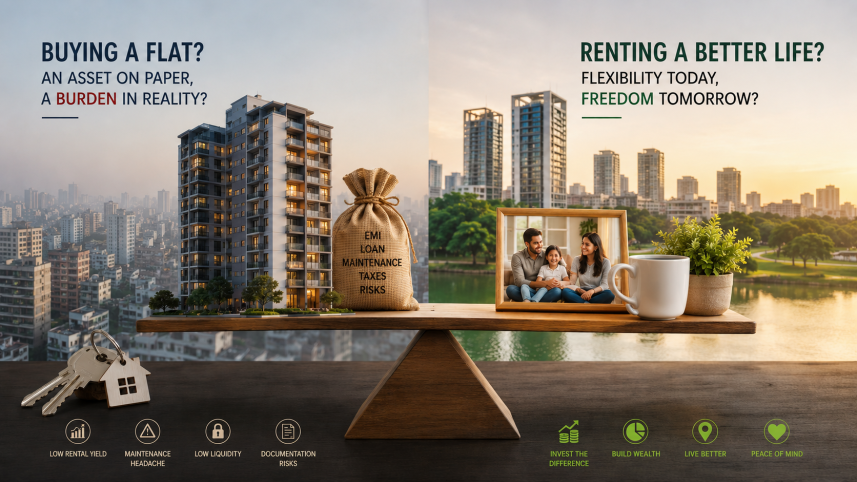
For many middle-class families in Bangladesh, especially in Dhaka, buying a flat is seen as a safe and respectable financial achievement. The common belief is that a flat is a valuable asset, that rent will provide a steady income, and that its price will rise over time. For family security and social prestige, this thinking is understandable.
But from a purely financial point of view, the picture is different. A flat may be valuable, yet it may not always be a good investment. The real question is whether the same money could generate better returns elsewhere with lower risk, higher liquidity, and less stress.

This matters because a large portion of middle-class savings in Bangladesh goes into residential property without properly comparing returns from flats with those from alternative financial assets.
In Dhaka, apartment rental yields are often only around 2.5 percent–3.5 percent, and the net return becomes even lower after maintenance costs, vacancies, service charges, and taxes. Therefore, rental income from a flat should not automatically be considered attractive.
The first flat may be justified for living, even if its financial return is low, because it offers residential stability and emotional comfort. But a second flat is different. Once a family already has a place to live, any additional flat should be judged strictly as an investment.
It must compete with alternative financial assets in terms of return, risk, and liquidity. In many cases, a second flat fails this test because rental yields are low, maintenance and documentation risks remain, and the asset cannot be sold quickly. If bank borrowing is used, the financial case becomes even weaker.
Renting a Better Life or Buying a Compromised Flat
Another issue is often overlooked: even for the first flat, a rational family should ask whether it is buying a home or accepting a lower quality of life for the next twenty years. Many middle-income families cannot afford flats in Gulshan, Banani, Dhanmondi, Baridhara, prime sectors of Uttara, or other well-serviced areas.
They therefore buy in distant suburbs or less-developed urban pockets, where schools, hospitals, supermarkets, cafés, parks, security, reliable utilities, and community facilities may be inadequate.
In such cases, renting may be wiser. A family may pay high rent to live in a better area, but that rent may still be lower than the EMI required to buy a flat. Renting also avoids ownership burdens such as property taxes, building maintenance, lift and generator repairs, plumbing problems, common-area disputes, utility disruptions, documentation risks, and illiquidity.
This matters because a 20-year housing loan may cover a person's most productive working years and the most important growing years of his or her children.
If ownership forces the family into a poorly connected area, the hidden cost is not only financial; it also affects education, lifestyle, health, mobility, and social exposure. Therefore, the real comparison is not merely owning versus renting, but where one can live by renting versus where one can afford to buy.
Investing the EMI Difference
Assume a middle-income family has savings of Tk 1 crore and wants to buy a flat costing Tk 2 crore. To complete the purchase, they borrow Tk 1 crore from a bank at 12 percent interest for 20 years. The monthly EMI would be around Tk 1.10 lakh.
Now assume the same family instead rents a good flat in Gulshan, Banani, Dhanmondi, or a similar well-serviced area for Tk 80,000 per month. In that case, they save around Tk 30,000 every month compared with the EMI.
If this monthly saving is invested regularly in government securities or other non-equity financial assets earning around 9 percent annually, it may grow to about Tk 2 crore in 20 years. At the same time, the family's original Tk 1 crore in savings, if also invested at 9 percent annually, may grow to about Tk 5.60 crore over the same period.
Together, the accumulated amount may reach around Tk 7.60 crore. Renting is not necessarily a waste of money; if the EMI difference and original savings are invested with discipline, renting may become a stronger wealth-building strategy than loan-financed flat ownership.
The second-flat decision becomes riskier when bank borrowing is involved. Suppose a person has Tk 1 crore in savings and borrows another Tk 1 crore at 12 percent interest for 20 years to buy a Tk 2 crore flat. The monthly EMI would be around Tk 1.10 lakh, while net rent might be only Tk 38,000-Tk 45,000.
This creates a large monthly deficit. In effect, the buyer is borrowing at 12 percent to purchase an asset that may generate only around 3 percent in gross rental income. The only way to justify the gap is through strong future price appreciation.
That is speculation, not stable investment. If price growth slows, the area becomes less attractive, the building deteriorates, or the owner needs to sell early, the investment may underperform significantly.
A More Rational Way to Think About Flats
Capital appreciation is often the main hope behind purchasing a flat, but a flat should not be treated like vacant land. While Dhaka's land scarcity and urban pressure may support prices in some locations, a flat also carries the burden of an aging building.
After 15–20 years, issues related to lifts, generators, plumbing, electrical systems, dampness, maintenance quality, and resale preferences become significant. Therefore, flat-price appreciation should not be assumed indefinitely. For investment comparisons, 10–15 years is more realistic, while 20 years may be used only as an extended scenario.
 For all latest news, follow The Daily Star's Google News channel.
 Bangladesh is not alone in having low apartment rental yields, but its case is more pronounced because fixed-income returns are relatively high. Countries such as Malaysia, the UAE, Saudi Arabia, Qatar, the United Kingdom, the United States, Canada, Italy, the Netherlands, Thailand, and Japan generally show stronger apartment rental yields, making flats more competitive as investments.
By contrast, Bangladesh is closer to India, Pakistan, Sri Lanka, Nepal, and China, where apartment rental yields are relatively weak and financial assets often appear more attractive. This comparison suggests that, in Bangladesh, buying an additional flat is harder to justify purely as an investment.
When a large portion of middle-class savings goes into low-yield residential flats, national savings are diverted into relatively unproductive assets. Excess demand for flats pushes up urban land and housing prices, making housing less affordable for genuine end-users.
Middle-class families become more indebted and less financially flexible. Banks may also end up financing consumption-oriented real estate rather than more productive enterprises.
Middle-class investors should not blindly reject property, but neither should they worship it. A flat may be financially sensible when the price is reasonable, the location has strong future demand, the rental yield is attractive, the documentation is clean, and the buyer can hold it without financial stress.
For the first flat, the real comparison is often between owning a compromised flat in a less-developed area and renting a better flat in a better neighbourhood.
If renting offers better schools, security, urban facilities, shorter travel times, and a better environment for children while allowing the family to invest the EMI difference, renting may be the more rational choice. For a second flat, the test should be much stricter because it is no longer a shelter decision but an investment decision.
The rental-yield figures used in this write-up are indicative and based mainly on Global Property Guide's 2026 residential rental-yield data and Numbeo's property-investment data for Bangladesh and Dhaka.
The writer is a senior banker based in Bangladesh. He can be reached at farhad1168@gmail.com
Comments