


Bangladesh’s LNG expansion: can we afford the bill?

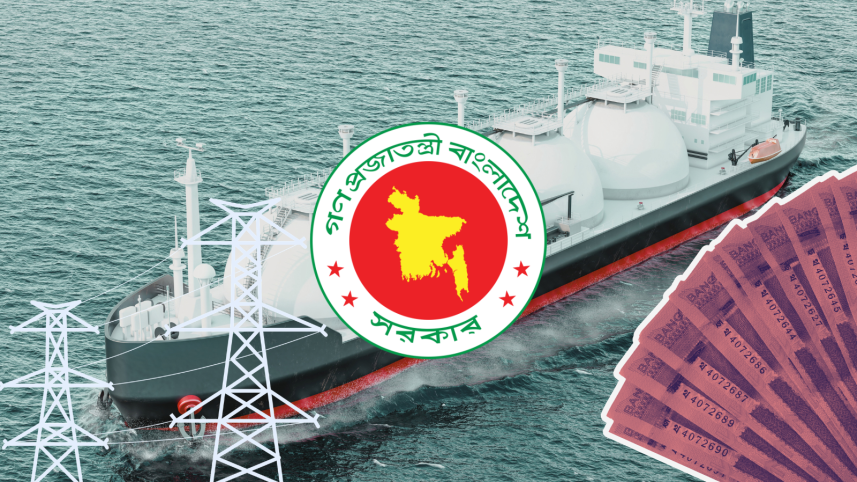
Bangladesh’s energy planning has created an uncomfortable contradiction. A country struggling to afford its current LNG (liquefied natural gas) imports is planning to more than double its import capacity within the next two years. The question is not whether Bangladesh needs LNG, but whether it can afford such a massive expansion.
Is the government creating another LNG trap, similar to the one in the power sector? People are already bearing the costs of capacity payments, loan interest and fuel imports, while high energy prices are pushing up the cost of living. Yet households and industries continue to face unreliable energy supplies.

With mounting debt and growing subsidy requirements for state-owned Petrobangla and the Power Development Board (PDB), the government must carefully assess the economic costs and benefits of expanding LNG infrastructure before committing public resources to another long-term financial burden.
One-third of the national budget could go towards LNG imports
Bangladesh currently operates two floating LNG terminals with a combined capacity of 1,100 million cubic feet per day (mmcfd). The government plans to add three more by 2029, raising the total capacity to 2,700 mmcfd to address gas shortages and ensure supplies to industries.
The rationale is understandable. Domestic gas reserves are declining, industries are facing shortages, and gas-fired power plants cannot operate at full capacity. But the ability to import gas does not necessarily mean the country can afford it.
Following the Iran war, Bangladesh had to purchase LNG from the spot market at around $29-30 per million British thermal units (MMBtu), reflecting the volatility seen after Russia’s invasion of Ukraine in 2022. These crises demonstrate how geopolitical tensions can disrupt global energy markets and make future prices extremely difficult to predict.
If Bangladesh operates LNG import infrastructure with a combined capacity of 2,700 mmcfd, the annual import bill could reach around $29 billion at an average price of $28 per MMBtu. At $30, the bill could approach $30 billion.
Although Bloomberg’s Global LNG Market Outlook 2030, published in September 2025, projected average global prices below $10 per MMBtu in 2026 and potentially below $5 by 2030, such forecasts cannot account for every geopolitical crisis or supply disruption. Indeed, the report was published before the Iran war and the closure of the Strait of Hormuz.
Bangladesh’s national budget for FY2026-27 stands at Tk 9.38 trillion. In a future wartime scenario at $28 per MMBtu, importing LNG equivalent to the planned capacity could cost more than Tk 350,000 crore annually at the current exchange rate—over one-third of the national budget. Any further depreciation of the taka would increase the burden.
Limited foreign currency earnings, massive spending
According to Bangladesh Bank, the country earns around $80 billion in foreign currency annually. Earnings stood at $83.5 billion in FY2025-26. An annual LNG import bill of $30 billion would therefore place enormous pressure on foreign exchange reserves.
Bangladesh must also spend billions of dollars importing food, fertiliser, edible oil, industrial raw materials, machinery, pharmaceutical ingredients and other forms of energy. The country already spends around $12 billion annually on oil, gas and coal imports, while its trade deficit exceeded $27 billion in FY2025-26.
The country’s foreign currency earnings remain heavily dependent on readymade garment exports and remittances, both of which are vulnerable to global economic uncertainty. Although increased energy supplies could support industrial growth and exports, high energy costs could undermine the competitiveness of local industries.
Many factories are already struggling with rising production costs and cannot afford significantly higher gas prices if subsidies are withdrawn. Without diversifying its export base and moving towards higher-value products, Bangladesh cannot assume that expensive LNG imports will generate enough additional foreign currency to cover their costs.
Lower prices will not eliminate the problem
LNG prices will not remain at $28-30 per MMBtu indefinitely. However, even if prices fall to $10, importing LNG equivalent to 2,700 mmcfd would still cost Bangladesh more than $10 billion annually.
For an economy with a narrow export base, this would remain a substantial burden, competing with essential imports, debt repayments and investment in other sectors. LNG at $28 per MMBtu would be prohibitively expensive, but even at $10, it would not be cheap.
The hidden costs of LNG infrastructure
The financial burden does not end with purchasing LNG. Individual terminals can cost between Tk 5,000 crore and Tk 11,000 crore to construct, depending on their capacity.
 For all latest news, follow The Daily Star's Google News channel.
 Bangladesh’s first LNG terminal, built by US-based Excelerate Energy in 2016-17, cost around $180 million, or Tk 2,214 crore at the time. Petrobangla currently pays Tk 2.9 crore a day in capacity charges for the terminal, amounting to approximately Tk 1,064 crore annually. Over its 15-year contract, these payments will total around Tk 16,000 crore.
Using this terminal as a reference, three additional terminals could cost at least Tk 10,000 crore each on average. Their capacity payments could reach around Tk 50,000 crore. Including the costs associated with all five terminals, the total could rise to approximately Tk 75,000 crore, or $7 billion.
There are also concerns about the proposed rental charge for a third LNG terminal, approved for a Chinese company. The proposed daily charge of $342,000, equivalent to Tk 4.2 crore, is around 40 percent higher than the rates for existing terminals. If approved without changes, it would further increase capacity-payment obligations.
The risk of stranded assets
Bangladesh could complete these terminals but later struggle to import sufficient LNG because of high prices, foreign currency shortages or global market volatility. Yet rental payments, loans and interest obligations would continue regardless of how much gas the terminals handle.
The power sector offers a clear warning. Many power plants remain idle, but Bangladesh pays more than Tk 25,000 crore annually on average in capacity charges. In 2025 alone, these payments exceeded Tk 42,000 crore.
Bangladesh’s public debt exceeded Tk 22 lakh crore in early 2026 and is increasing by around Tk 1.5 lakh crore annually. Rising interest payments are adding further pressure. Expensive energy imports and infrastructure financed through borrowing could create a cycle in which efforts to secure energy undermine broader economic security.
The government is simultaneously planning three new LNG terminals, expanding domestic gas exploration through 150 wells and pursuing a target of 10,000 MW of solar power by 2030. If domestic gas exploration and renewable energy programmes succeed, expensive LNG infrastructure could be underused or become stranded assets.
A report by Zurich-based SolAbility, Global LNG Market Outlook 2026–2035, notes that several countries, including Pakistan, Vietnam and the Philippines, are cancelling LNG projects as they expand renewable energy. One key reason is the high cost of LNG-based electricity, estimated at $80–120 per megawatt-hour (MWh), compared with just $30–40 per MWh for solar power combined with battery storage.
Before approving additional terminals, the government should publish transparent economic assessments based on LNG prices of $10, $20 and $30 per MMBtu. These should detail annual foreign currency requirements, funding sources and capacity charges, including payments for underutilised infrastructure.
The government must also compare LNG investments with domestic gas exploration, rehabilitation of ageing gas wells, improvements in transmission infrastructure, industrial energy efficiency, renewable electricity and grid modernisation.
Has the energy strategy really changed?
In 2023, the previous government finalised the Integrated Energy and Power Master Plan (IEPMP) with Japanese assistance. The plan opened the way for LNG imports of up to 5,000 mmcfd by 2040 and proposed $179 billion in energy infrastructure investments, including LNG terminals.
Some experts have raised concerns about the influence of Japan’s commercial interests, given its position as a major LNG re-exporter and its investments in LNG trading infrastructure and gas-fired power plants across Asia.
Although the IEPMP lost relevance following the departure of the Awami League government, questions remain about how much Bangladesh’s fundamental energy strategy has changed. The current administration also appears interested in pursuing several similar initiatives.
Bangladesh does need LNG in the short term as domestic gas production declines and industries face shortages. But LNG cannot be a permanent solution to the country’s energy crisis.
If Bangladesh is struggling to secure 1,100 mmcfd today, how will it manage to secure 2,700 mmcfd within the next two years—and, more importantly, how will it afford the bill?
The writer works at an international development organisation.
Comments