


Bangladesh has ‘great potential’ to become regional hub: ADB president

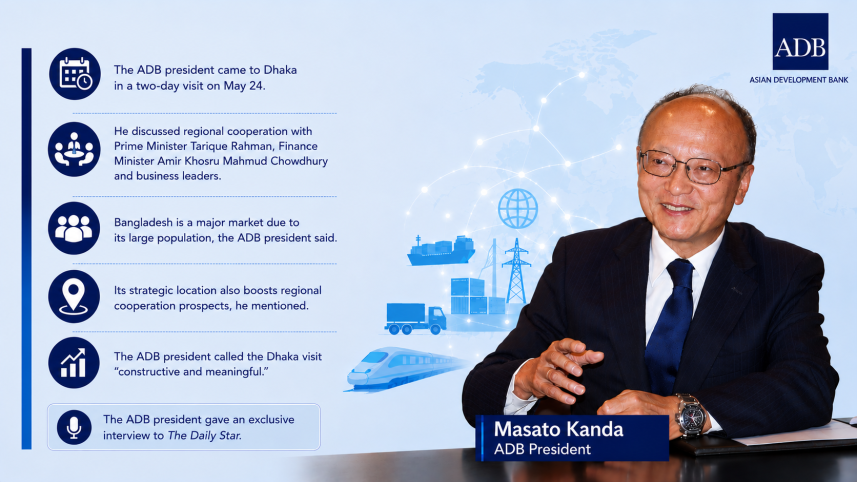
Bangladesh has “great potential” to become a regional hub for transportation, logistics, energy and digital connectivity because of its strategic location between South and Southeast Asia, Asian Development Bank (ADB) President Masato Kanda has said.
“There are also lots of opportunities for growth and economic security,” he said in an interview with The Daily Star during his visit to Dhaka.

Kanda arrived in Dhaka on May 24 and is scheduled to leave Bangladesh tonight.
During his two-day stay, he met with Prime Minister Tarique Rahman, Finance and Planning Minister Amir Khosru Mahmud Chowdhury, other senior officials, and private sector leaders.
The ADB president said Bangladesh itself represents a huge market because of its large population, while its geographic position further enhances its prospects of benefiting from regional cooperation.
Regional cooperation was one of the issues he discussed with the prime minister and finance minister, said Kanda, who assumed leadership of the ADB in February 2025.
They recognise that Bangladesh has the ‘great potential’ to benefit from regional cooperation and contribute as a regional hub for transportation, logistics, energy and digital connectivity, he said.
However, South Asia lags behind in terms of integration because of factors such as weak transport networks and congested borders caused by bureaucratic requirements.
“Transport, trade and logistics costs are therefore quite high, jeopardising cross-border integration,” he said.
“But despite these challenges, I am very optimistic. There is huge potential in this region for a radical increase in regional cooperation and integration.”
Kanda, who previously served as special adviser to Japan’s prime minister and finance minister, said regional cooperation and integration is one of his priorities as ADB president.
“This is an effective tool for encouraging economic growth because it improves efficiency across borders, creates broader markets, and generates economies of scale.
“Another thing is that countries can build collective resilience. One country alone may be vulnerable, but together with neighbouring countries they can become more resilient against external shocks like last year’s trade war or this year’s Middle East conflict,” he said.
He added that ADB supports Bangladesh’s efforts to engage in regional initiatives such as the South Asia Subregional Economic Cooperation (SASEC).
Constructive and meaningful visit
In the interview, Kanda also discussed the fallout of the Middle East conflict on Bangladesh and his meetings with top government officials, including the prime minister.
He described the visit to Dhaka as “constructive and meaningful” and said ADB wants to deepen its partnership with Bangladesh.
The ADB chief said the lender had signed four loan agreements worth $1.42 billion, including budget support and financing for transport and urban development projects.
“The results were quite significant. We produced very tangible and concrete results,” he said. “More importantly, we agreed on many things, and ADB committed considerable support.”
Kanda presented to the prime minister the Integrated Growth Network Development Initiative, a comprehensive development plan under which ADB plans to provide $5 billion over five years.
“This is quite significant.”
 For all latest news, follow The Daily Star's Google News channel.
 The Manila-based lender is increasing its annual lending to Bangladesh by 20 percent to $2.4 billion annually.
Kanda said ADB wants to support the preparation and implementation of a five-year reform framework by the government.
It will provide $2 million in technical assistance for this initiative, and capital market development is likely to be included in the package.
Impact of Middle East crisis
He acknowledged that the Middle East conflict could place strain on Bangladesh’s economy.
“The price hikes in energy, fuel, fertilisers and other spin-off costs are really serious,” he said, adding that the impact would gradually spread to food prices and agriculture.
Mentioning Bangladesh’s heavy reliance on remittances from Gulf nations, he said ADB was “very much concerned” about the potential consequences of prolonged instability in the region.
The multilateral lender has increased its budget support to Bangladesh by an additional $250 million, bringing total budget support this year to $1 billion to help maintain macroeconomic stability.
“I believe this is quite a significant fiscal buffer, particularly for protecting the most vulnerable segments of the population,” he said.
“Still, the impact may continue or even worsen, so we are closely watching the situation.”
ADB remains in daily contact with the government and development partners and is ready to provide additional support, including mobilising co-financing from the private sector if needed, he said.
“In this situation, mobilising private capital is extremely important,” Kanda said.
Huge potential for growth
Looking ahead, he said ADB’s priorities remain aligned with Bangladesh’s long-term ambitions, including building a diversified, job-rich economy and becoming a $1 trillion economy by 2034.
“What we want to see is the realisation of these ambitions. One of the things we need to prioritise is private sector development. There is huge potential, but because of the lack of policy predictability and consistency, private capital has not yet been fully mobilised.
“If we can trigger this dynamism, I expect huge and radical growth.”
Kanda, who earlier served as an alternate executive director for Japan at the World Bank, said Bangladesh has a significant demographic dividend because of its large youth population.
“We need to provide them with good jobs, which in turn will strengthen consumption and create a virtuous cycle.”
To achieve that, he said strategic investment is important, but sustainable and impactful growth also requires an enabling environment for private firms.
“That includes regulatory reform, policy reform, quality infrastructure and human capital development. There are many things we need to work on together with the government, partners and the people on the ground.”
Comments