


Bangladesh economy might have expanded faster in May than April
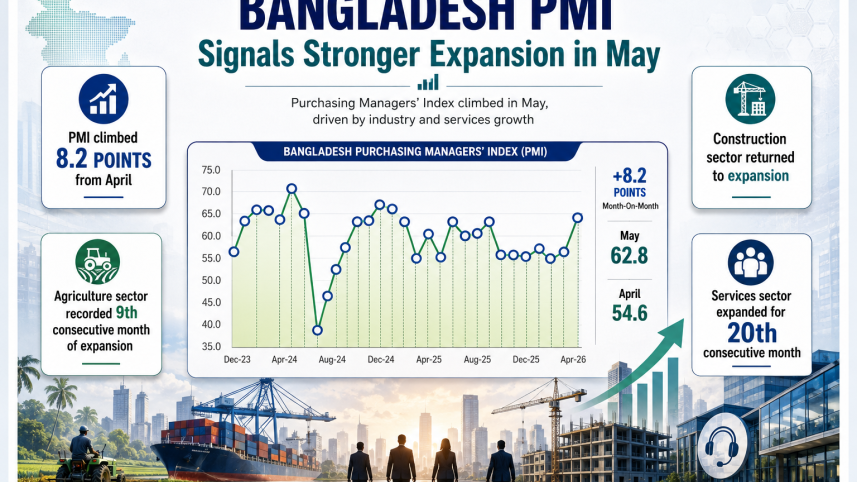
Bangladesh's economy appears to have expanded at a faster pace in May than in the previous month, supported largely by stronger activity in the manufacturing and services sectors, as the Bangladesh Purchasing Managers' Index (PMI) climbed 8.2 points from April to 62.8 in May.
Meanwhile, the construction sector returned to expansion, while growth in the agriculture sector slowed, according to the May PMI report released by the Metropolitan Chamber of Commerce and Industry (MCCI), Dhaka, and Policy Exchange Bangladesh (PEB).

"The May PMI shows that the Bangladesh economy moved onto a stronger expansionary path, with manufacturing, construction and services recording faster growth compared with April," said M Masrur Reaz, chairman and CEO of PEB.
"Although the Middle East conflict has continued to raise energy costs, disrupt supply chains and sustain inflationary pressures, stronger domestic demand and increased business activity ahead of Eid appear to have supported broader-based expansion across major sectors."
The PMI is a pioneering initiative designed to provide timely and accurate insights into the country's economic health, helping businesses, investors and policymakers make informed decisions.
It was developed by MCCI and Policy Exchange, with support from the UK government and technical assistance from the Singapore Institute of Purchasing & Materials Management (SIPMM).
According to the report, the agriculture sector recorded its ninth consecutive month of expansion, albeit at a slightly slower pace.
Business activity and employment posted stronger growth, while new business and input costs expanded at a slower rate. However, the order backlogs index remained in contraction.
The manufacturing sector registered faster expansion, marking its second consecutive month of growth. The stronger performance was driven by robust increases in new orders, new exports, input purchases and employment.
Growth in factory output and input prices moderated. Contractions in finished goods persisted, although supplier deliveries contracted at a slower pace. Both imports and order backlogs returned to expansion.
The construction sector returned to growth after three consecutive months of contraction. New business, construction activity and employment all reverted to expansion.
Input costs expanded at a faster pace, while the growth of order backlogs slowed.
The services sector expanded for the 20th consecutive month and at a faster pace than in April. Business activity, employment and input costs all recorded stronger growth, while new business returned to expansion. However, order backlogs contracted at a faster pace.
Respondents across Bangladesh's major economic sectors said business conditions remained challenging in May 2026 due to persistent electricity and energy shortages, rising fuel prices, increasing labour costs and higher transportation expenses.
Many firms reported that electricity disruptions continued to affect productivity and production schedules, while escalating input costs further squeezed profit margins.
Several respondents expressed concerns over the potential economic impact of ongoing geopolitical tensions in the Middle East, particularly the risk of higher fuel prices, supply-chain disruptions and weaker export demand.
Agricultural businesses highlighted weather-related uncertainties affecting seed sales and production planning. Some firms also raised concerns about imported rice, high bank interest rates and the broader slowdown in domestic economic activity.
Despite these challenges, a number of respondents remained cautiously optimistic, expecting business conditions to improve if the energy situation stabilises, economic conditions strengthen and supportive policy measures are introduced for businesses, particularly SMEs.
 For all latest news, follow The Daily Star's Google News channel.
Comments