


AkijBashir joins RE100, pledges 100% renewable power by 2050
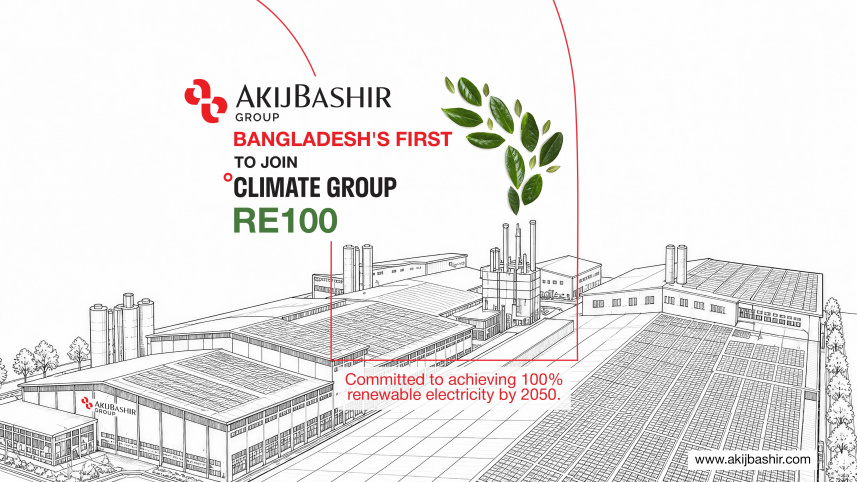
AkijBashir Group has become the first Bangladeshi company to join RE100, a global corporate renewable energy initiative, committing to use 100 percent renewable electricity across its operations by 2050.
RE100 is led by Climate Group, an international non-profit organisation working with businesses and governments to accelerate the transition to a clean and sustainable economy.

The initiative brings together more than 400 companies globally that have committed to using 100 percent renewable electricity by 2050 at the latest.
For AkijBashir Group, the commitment provides a framework to make its renewable-energy transition more structured and measurable while strengthening accountability around renewable electricity sourcing.
“Joining RE100 is more than a renewable energy commitment for AkijBashir Group; it is a step towards transforming how we power our business and build sustainable growth,” said Sk Bashir Uddin, managing director of AkijBashir Group.
“As the first company from Bangladesh to join this global initiative, we are proud to take a pioneering step towards 100 percent renewable electricity,” he said.
The group said its RE100 commitment builds on renewable-energy and energy-efficiency investments already underway across its particle board, ceramics, glass and other manufacturing facilities.
AkijBashir Group has already developed around 90 megawatts (MW) of solar generation capacity and continues to expand its renewable-energy portfolio.
At Akij Ceramics in Trishal, a 24.39 MWp rooftop solar project is expected to generate around 28,050 megawatt-hours of clean electricity annually and reduce about 22,440 tonnes of carbon dioxide emissions each year.
Of the total capacity, 10 MW has been connected to the national grid through net metering.
AkijBashir Glass in Habiganj has installed an 18.2 MW rooftop solar system supported by battery energy storage, allowing the facility to use solar-generated electricity beyond daylight hours and reduce exposure to load-shedding.
The glass facility also combines solar power with waste-heat-recovery steam-turbine generation. AkijBashir Group said 71 percent of the facility’s energy is sourced from renewable sources.
At Janata Jute Mills, rooftop solar meets the mill’s full electricity demand, supported by battery storage that extends the use of renewable energy beyond daytime generation.
Meanwhile, Akij Particle Board Mills has installed an 8.1 MWp rooftop solar photovoltaic system, which is expected to generate around 9.3 million kilowatt-hours of clean electricity annually and avoid about 7,452 tonnes of carbon dioxide emissions each year.
The group has also worked with Infrastructure Development Company Limited (IDCOL) on renewable-energy and energy-efficiency projects and is pursuing measures such as waste-heat recovery, water reuse, net metering and more efficient production technologies.
 For all latest news, follow The Daily Star's Google News channel.
Comments