


ADB president urges Asia-Pacific to act together for shared development

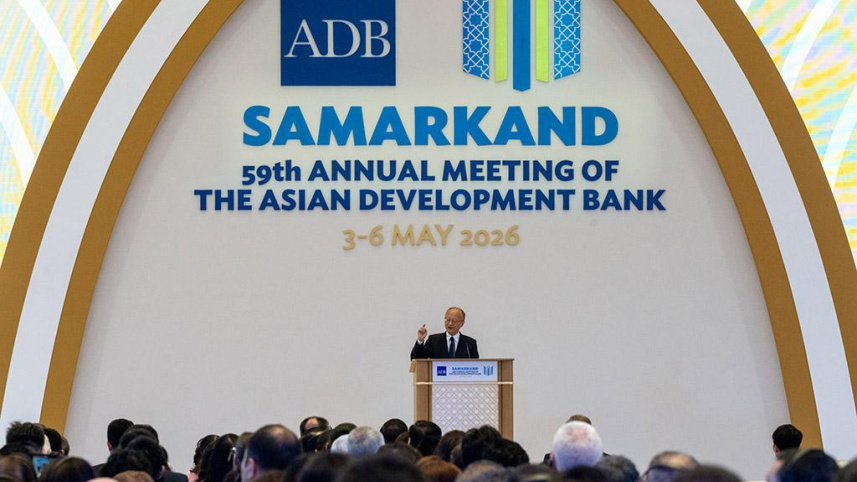
The 59th annual meeting of the Board of Governors of the Asian Development Bank (ADB) opened today, with its President Masato Kanda urging countries in Asia and the Pacific to “act together to develop together” through stronger cross-border connections to secure the next generation’s future.
“The decisions we make at this new crossroads will secure the future for the next generation,” he told the opening session in Samarkand, Uzbekistan.

“In this fragmented world, traditional and isolated development responses will fail. To survive and thrive in this new era, we must build deeply connected and resilient systems,” he said.
More than 4,000 participants, including policymakers, private sector leaders, development partners, and innovators from over 100 countries, are attending the meeting under the theme “Crossroads of Progress: Advancing the Region’s Connected Future.”
From Bangladesh, Finance Minister Amir Khosru Mahmud Chowdhury, Economic Relations Division Secretary Md Shahriar Kader Siddiky, and senior officials are attending the event.
Kanda highlighted how shocks now travel rapidly across borders—through energy markets, supply chains, and digital networks—hitting communities least able to absorb them. Addressing these challenges requires coordinated regional solutions that go beyond national boundaries, he said.
The ADB is responding by scaling up investments and accelerating reforms to help countries integrate infrastructure, markets, and institutions across the region, he added.
Kanda noted that the ADB has moved decisively to provide crisis-response support to its members during the ongoing Middle East conflict, becoming the first development partner to offer financial assistance to affected countries, which are expected to face heightened economic pressures.
Last year, the ADB provided $29.3 billion in financial support to the region while implementing reforms to deliver assistance more quickly and at scale.
The ADB president cited the launch of a $70 billion initiative to build regional systems, including $50 billion for a pan-Asian power grid to integrate renewable energy across borders, enhance energy security, and lower emissions.
Another $20 billion initiative aims to expand cross-border digital connectivity and narrow the region’s digital divide.
Kanda described the ADB as “an anchor of stability,” uniquely positioned to help steer the region through geopolitical fragmentation, conflict, economic disruptions, and escalating environmental stress.
“ADB is the main bank for the region. We have an unmatched regional mandate,” he said.
However, the ADB’s work is far from finished, Kanda added, noting that the bank will leverage its operational capabilities as a financier, advisor, and mobiliser to address challenges such as mobilising private sector funds for development and reversing environmental degradation.
“The work ahead is immense, but our purpose is clear. We have the strategy. We have the resources. We have the collective will to execute,” he said.
Founded in 1966, the ADB is a multilateral development bank supporting inclusive, resilient, and sustainable growth across Asia and the Pacific. It is owned by 69 members, including 50 from the region.
Bangladesh joined the ADB in 1973. As of December 31, 2025, the ADB had committed 758 public sector loans, grants, and technical assistance totalling $35.6 billion to Bangladesh. Its current public sector portfolio in the country includes 57 loans and 4 grants worth $9.5 billion, according to the ADB.
 For all latest news, follow The Daily Star's Google News channel.
Comments