


34-member body formed to assess binna grass use
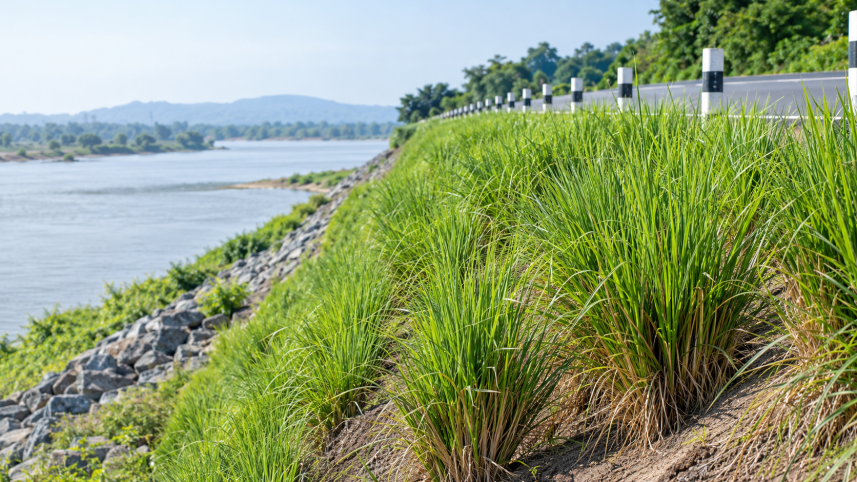
The government has formed a 34-member technical committee, including eight state ministers and 16 secretaries, to assess the feasibility of planting binna grass (vetiver grass) across the country to protect vulnerable slopes from erosion and other damage.
The Planning Division formed the committee through a notification issued on September 5, which was made public today.

Headed by Finance and Planning Adviser to the Prime Minister Rashed Al Mahmud Titumir, the committee will examine whether binna grass can be used as a cost-effective method of protecting slopes under development projects.
It will assess the technical feasibility and estimated cost per kilometre of planting the grass along roads, highways, riverbanks, canals, haors and embankments.
The committee will also examine the space required to plant binna grass along roads and embankments and assess its feasibility in the three hill districts, including on road slopes, lake banks and at the foot of hills.
The committee includes state ministers and senior officials from the Planning Commission and the ministries of water resources, environment, disaster management, housing and public works, road transport and bridges, agriculture, and local government.
Representatives of the Roads and Highways Department, Public Works Department, Local Government Engineering Department, Bangladesh Water Development Board, Department of Environment and Department of Agricultural Extension are also members.
Prof Mohammad Shariful Islam, pro-vice-chancellor of Bangladesh University of Engineering and Technology, is among the members. The secretary of the Planning Division will serve as the member-secretary.
The committee may co-opt additional members if necessary and will meet as required. It has been asked to begin work immediately.
Binna or vetiver grass is a perennial aromatic grass found abundantly across the country. It is used in more than 100 countries to stabilise soil and prevent erosion. The World Bank first developed the “Vetiver System” for soil and water conservation in the 1980's.
On August 16, Water Resources Minister Shahid Uddin Chowdhury Anee spoke at a meeting on “Vetiver Grass Policy for Bangladesh”.
Anee said the roots of vetiver grass penetrate deep into the soil and firmly hold it in place, helping reduce soil erosion caused by rainwater, waves and currents.
He said the use of the grass on river and canal banks, embankments, hilly slopes and in haor areas could help maintain environmental balance and increase the durability of infrastructure.
 For all latest news, follow The Daily Star's Google News channel.
Comments