


Asia boosts US LPG imports to replace Middle East supply
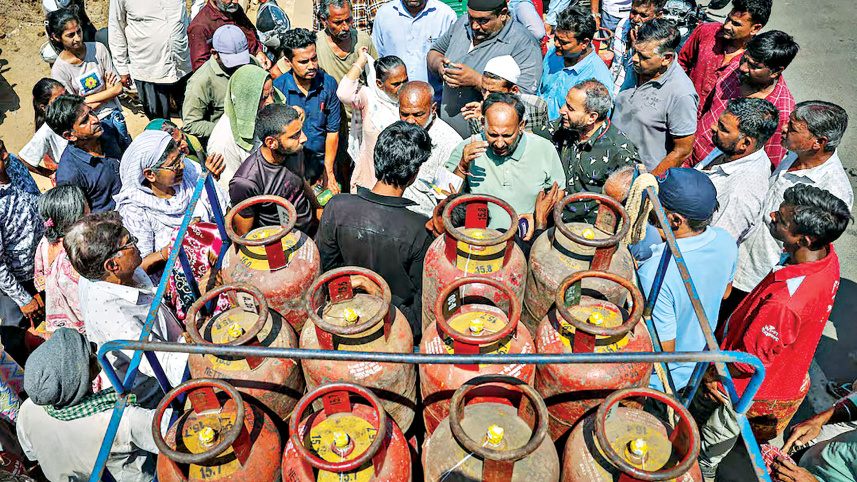
Asia’s biggest liquefied petroleum gas (LPG) importers, including India and China, are racing to replace disrupted Middle East supplies with cargoes from the Americas, driving spot premiums to record highs, analysts and traders said.
LPG exports from the Middle East, Asia’s top supplier of the fuel used for cooking and feedstock for petrochemical plants, have plunged since the US-Israeli war with Iran started in late February.
 For all latest news, follow The Daily Star's Google News channel.
 The supply shock is squeezing Asian petrochemical producers’ margins, forcing them to cut output, and raising costs for millions of Asian households, analysts and traders said. India and China are the biggest importers of LPG from the Middle East.
Middle Eastern LPG exports tumbled 73 percent to 419,000 barrels per day (bpd) in March from the previous month, data from analytics firm Kpler showed,
The supply shock drove spot premiums for propane and butane loading in April from the Gulf to record highs of $250 per metric ton to March Saudi contract price swaps on March 30, according to pricing agency Argus.
Saudi Aramco sharply raised its April official selling prices amid the supply crunch. The April propane price rose by $205 per ton to $750, while butane increased by $260 per ton to $800.
“Key importers such as India are actively diversifying their sourcing strategies, increasing procurement from the United States, Norway, Canada, and other regions alongside remaining Gulf supplies,” said Vasudev Balagopal, global head of petrochemical trading at financial services platform Marex.
ALTERNATIVE SUPPLY
To meet Asia’s shortfall, US LPG exports are expected to surge to a record 2.7 million bpd in April, with about 1.8 million bpd headed to Asia, 14 percent higher than March, preliminary Kpler data showed. That drove US Gulf spot terminal fees for propane and butane to a record $273.525 and $240.09 per ton, respectively, on March 19, Argus data showed.
“We saw some additional propane still being offered to Asia for May arrivals,” said Marex’s Vasudev.
However, Greg Bower, a broker at New Stone, said the US cannot replace the Middle East fully, adding that export terminals were already operating close to capacity before the conflict.
According to US Energy Information Administration data, the country had 48.4 million barrels of ready-for-sale propane as of March 27.
Moreover, transit times from the US Gulf Coast to Asia take more than 30 days, significantly longer than a two-week voyage from the Middle East, traders said, adding to supply strains amid uncertainty over when Iran will allow the strategic Strait of Hormuz to reopen as part of a fragile ceasefire deal.
Last year, the Middle East accounted for about 48 percent of total Asian LPG imports at 1.54 million bpd, while the US sent about 39 percent or 1.26 million bpd, Kpler data showed.
LOSS IN DEMAND
Insufficient LPG supply led to demand destruction in March, analysts said.
Consultancy Rystad Energy estimated LPG demand loss from regional steam crackers at about 135,000 barrels per day in March from February levels, with a further 35,000 bpd decline expected in April and 11,000 bpd in May.
In China, propane dehydrogenation (PDH) plants, already operating at around 60 percent to 65 percent before the conflict because of poor margins, are expected to trim runs by a further five percentage points in April due to feedstock shortages, according to Rystad. Such plants product propylene, a key building block for plastics and other chemicals.
For cooking gas, India’s demand dropped around 205,000 bpd in March.
“The supply situation in India is gradually improving but shortages persist even as long-haul cargoes arrive in India from as far as Argentina and the US,” Rystad analyst Manish Sejwal said.
Rystad expects Indian LPG demand to recover from April, with losses narrowing by about 70,000 bpd.
Comments