


2021: a year of regaining confidence in stocks

The outgoing year bears special significance for Dhaka stocks for quite a number of developments.
The benchmark index soared to its historical high thanks to a rebound in investors' confidence after many years.

Average daily turnover was the second biggest in recent memory, more than double that of the preceding year.
Yet two perennial pains prevailed: rumour-based trading and manipulation of select scripts.
The DSEX, the benchmark index of Dhaka Stock Exchange (DSE), ascended to 7,367 points on October 10, the highest since its inception in 2013.
The DSE's daily average trading amounted to Tk 1,475 crore, coming second after that of 2010, according to the DSE data.
This was a year-on-year jump of 126 per cent from Tk 648 crore in 2020. Progress also came though the launch of secondary trading of government securities.
The start of trade of treasury bonds in the secondary market ended a wait of over a decade, creating one more investment tool for retail investors reliant only on shares and mutual funds.
Meanwhile, small and medium enterprises (SMEs) also got a scope to raise funds from the stock market.
Six SMEs raised Tk 70.5 crore, a first for the SME platform launched in 2019. Trading at the new board started too.
More funds were also raised by companies this year.
A total of 23 companies raised Tk 1,653 crore through initial public offerings (IPO). In contrast, Tk 985 crore was raised by eight companies in 2020.
One drawback, however, was a fall in foreign investors' participation.
Foreign investors reduced their investment in October and November by Tk 1,962 crore and Tk 1,139 crore respectively as their sales surpassed purchases.
The year was comparatively better for the capital market in context to recent times as investors' confidence returned and turnover more than doubled, said Faruq Ahmad Siddiqi, a former chairman of the Bangladesh Securities and Exchange Commission (BSEC).
Many investors became interested to invest here. However, the scenario centring manipulation has not improved, he said.
Stock prices of small paid-up capital based companies soared abnormally and illogically and some people took advantage of it, he said.
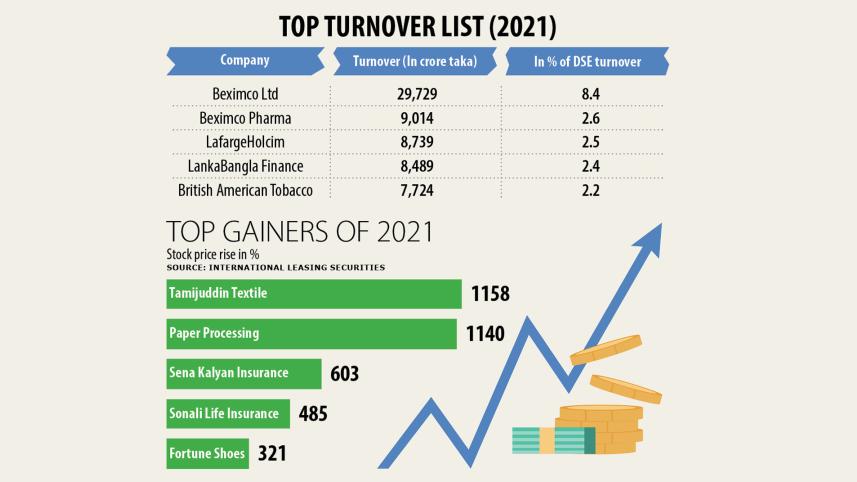
One of the entities was Tamijuddin Textiles, a low-paid up capital based company. The price of its stocks rose the highest, 1,158 per cent.
Hot on its heels were peers Paper Processing (1,140 per cent), Sena Kallyan Insurance (603 per cent), Sonali Life Insurance (485 per cent) and Fortune Shoes (321 per cent).
On the companies which raised funds through IPO this year, he said, "I hoped to see better companies in the IPO list."
 For all latest news, follow The Daily Star's Google News channel.
 The year started off well but a rift between Bangladesh Bank and the BSEC spooked investors' confidence, said a top official of a merchant bank, preferring anonymity.
One issue of contention has been resolved recently but tension prevails over two others, he said.
One is over the BSEC ordering all listed companies, including banks and non-bank financial institutions (NBFIs), to deposit their unclaimed dividends to a stock market stabilisation fund.
The other is over the BSEC allowing the banks and NBFIs to declare dividends from the current year's profits even if there were cumulative losses.
The central bank is against the moves. It went as far as telling the banks and NBFIs not to abide by the BSEC orders, leaving them in a quandary.
Criticism also came from some stakeholders over the stock market regulator using listed companies' CSR funds to hold roadshows abroad, he said.
The roadshows were held in the US, UK, United Arab Emirates and Switzerland.
The year showcase one of the best performances, as the index of the DSE rose around 25 per cent, said Mohammad Emran Hasan, chief executive officer (CEO) of Shanta Asset Management.
Thanks to the lower interest rate and higher liquidity, the market was on a positive vibe.
Earnings of most listed companies retuned to the pre-pandemic level and the government reduced corporate tax by two percentage points, he said.
However, foreign investment in the stock market underwent a falling trend due to their apprehensions over currency devaluation, he added.
The BSEC radiated its strong commitment to establishing a vibrant bond market, for which some banks got the nod to issue perpetual bonds while a listed company sukuk, he added.
The DSE's market capitalization to GDP stood at 18.01 per cent and price earnings ratio of the market was 17.58, shows the DSE data.
Comments