


Youth unemployment contributing to social risks

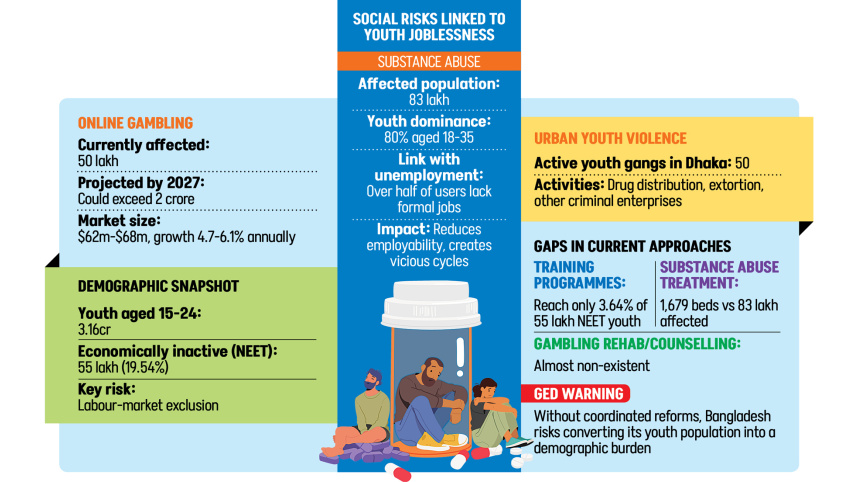
Youth joblessness is emerging as a serious concern in Bangladesh, with social consequences including substance abuse, online gambling, urban violence, and gender-based harassment, according to a new policy paper by the General Economics Division (GED).
“These social risks are not isolated problems but interconnected consequences of youth marginalisation and limited economic opportunity,” the paper said.

The policy brief, titled “Harnessing the Potential of Youth: A Policy Framework for Youth Development in Bangladesh”, also said that the country’s large youth population could either drive economic growth or exacerbate social instability, depending on the effectiveness of existing policies.
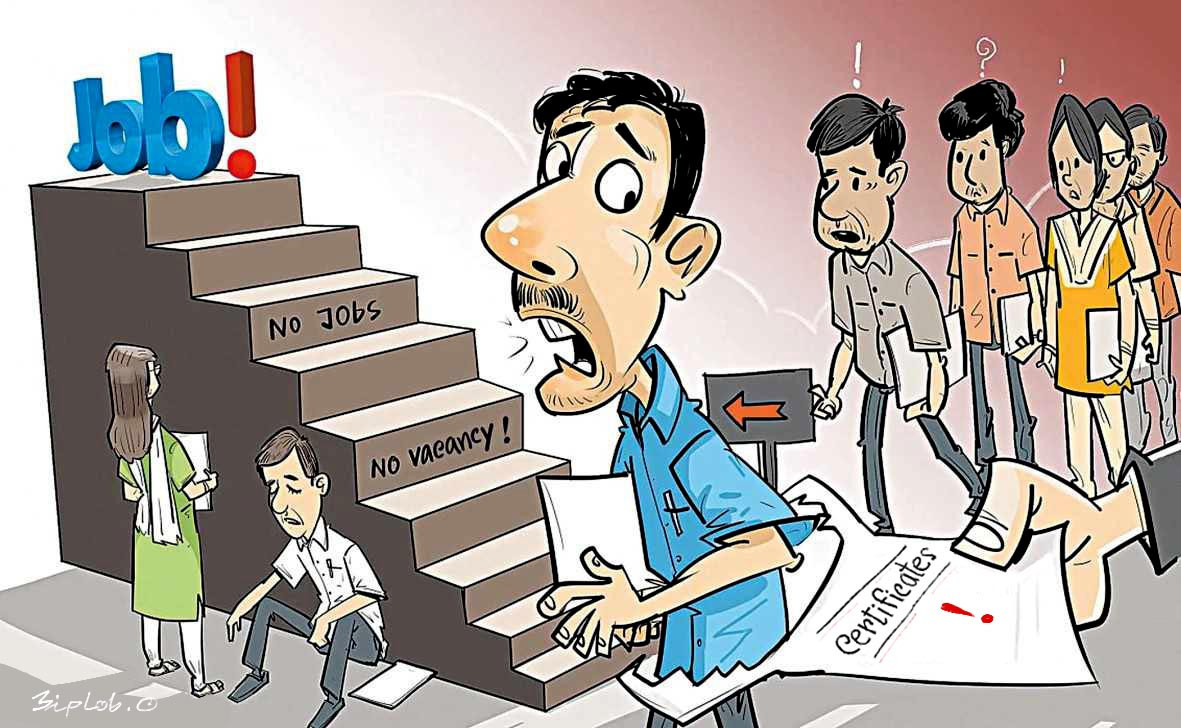
“Without decisive, well-coordinated reforms, Bangladesh risks converting its youth population into a demographic burden marked by unemployment and social unrest,” the report mentioned.
Roughly 19.54 percent of young people aged 15 to 24, which is around 55 lakh, are economically inactive, neither in education, employment, nor training (NEET), according to the Bangladesh Bureau of Statistics (BBS).
The report said this inactivity represents deeper labour-market exclusion rather than simple unemployment, raising concerns over the efficiency of the country’s transition from education to work.
The report said substance abuse has reached “near-epidemic levels”.
Earlier narcotics surveys conducted across 16 districts suggest that an estimated 83 lakh people, nearly 5 percent of the population, are addicted to substances, with young people aged 18 to 35 comprising 80 percent of users.
The GED report said initial drug exposure usually occurs between 15 and 18, often by peers.
The policy paper draws a link between unemployment and drug use. Over half of those addicts do not have formal jobs, highlighting how economic exclusion can contribute to social vulnerabilities.
The paper identified online gambling as another rapidly expanding threat.
More than 50 lakh people are already involved in such activities, a figure that could cross 2 crore by 2027 without intervention.
The online gambling market, estimated at $62 to $68 million, is growing 4.7 to 6.1 percent annually, largely through platforms operating via foreign servers with Bangla-language interfaces.
Despite its illegality, transactions are carried out through mobile financial services, with more than 1,000 agents. The paper said that idle time and economic frustration make quick wealth promises from gambling especially attractive to young people.
Urban youth violence is another concern. In Dhaka, there were nearly 50 youth gangs in 2024. These groups were reportedly engaged in drug distribution, extortion, and other criminal activities.
The GED noted a cyclical link, saying gang involvement increases exposure to substance abuse, while addiction can, in turn, drive recruitment into criminal networks.

Monzur Hossain, author of the paper and also a member of the GED, said, “Unemployment provides the idle time and economic frustration that makes quick wealth promises from gambling attractive and increases vulnerability to substance abuse.”
“Addiction undermines employability, creating vicious cycles. Gang involvement offers both economic opportunity and social belonging for those excluded from legitimate pathways. Gender-based violence reflects broader power imbalances that limit women’s economic participation and educational attainment,” Hossain added.
 For all latest news, follow The Daily Star's Google News channel.
 The report highlights a serious mismatch between the scale of social risks and the capacity of interventions.
Training programmes currently cover only 3.64 percent of the 55 lakh economically inactive young people, severely limiting potential impact.
The government’s plan to expand substance abuse treatment will provide just 1,679 beds, a fraction of the 83 lakh affected individuals. Similarly, counselling and rehabilitation for online gambling remain almost non-existent.
This scale mismatch is further compounded by fragmentation. Multiple agencies run programmes with limited coordination, unclear accountability, and weak monitoring and evaluation.
The absence of systematic tracking makes it difficult to measure success or cost-effectiveness, reducing the overall impact of youth development initiatives.
Selim Raihan, an economics professor at Dhaka University, backed the government report on youth unemployment and its contribution to social risks.
“Yes, employed youth can also contribute to social risks, but those without work, income, or stable jobs are far more vulnerable,” he said. “Their frustration increases exposure to issues like drug use, social instability, and even extremism.”
He added that many young people who have completed their education but are unable to enter the job market experience a prolonged “gap period,” during which they are particularly susceptible to these risks.
Comments