


Less than 3% of manufacturing units use computers
Highlights
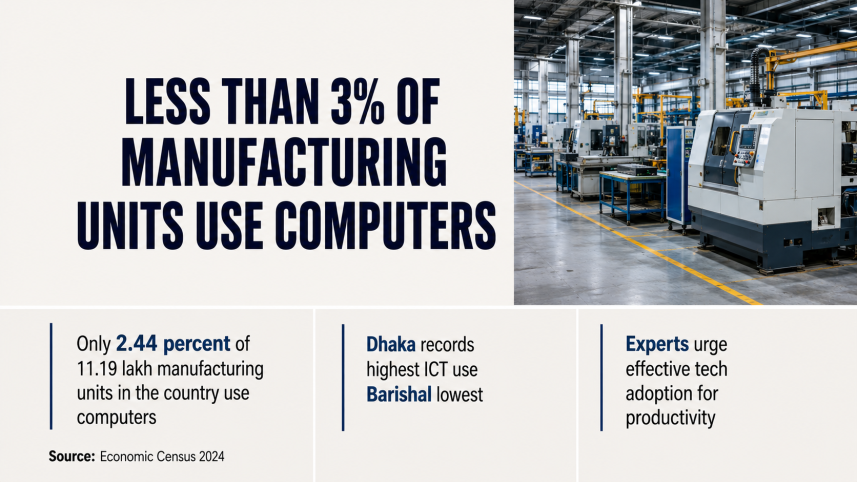
- Under 3% manufacturing units use production computers
- Dhaka records highest ICT use, Barishal lowest
- Experts urge effective tech adoption for productivity
Fewer than 3 percent of manufacturing units in Bangladesh use computers or information technology (IT) in their production work, according to the latest Economic Census 2024.
The census shows that only 2.44 percent of 11.19 lakh manufacturing units in the country use computers or IT in the production processes.

Use varies by type of establishment. Among permanent units, 4.74 percent use computers in production. The rate falls to 1.36 percent for temporary units and just 0.80 percent for economic households.
There are also wide regional differences. Dhaka division records the highest rate of ICT use in production at 5.65 percent, while Barishal division has the lowest at 1.14 percent.
According to sector-wise data, 9.06 percent of establishments in electricity, gas, steam and air-conditioning supply use computers in production. In construction, the rate is the lowest at 0.92 percent.
Across industrial units as a whole, the rate stands at 2.41 percent.
There are also wide regional differences. Dhaka division records the highest rate of ICT use in production at 5.65 percent, while Barishal division has the lowest at 1.14 percent.
Location also matters for computer use by businesses. In urban areas, 4.03 percent of businesses use computers in production, while the rate drops to 1.60 percent in rural areas.
The figures come after years of Digital Bangladesh campaigns by the previous Awami League government. Yet technology use in productive work remains limited, especially outside large cities.
The contrast is stark because manufacturing contributes about 21.9 percent to GDP. Even so, most factories and business units still depend on manual processes.
A 2021 World Bank study found that more than 40 percent of firms in Bangladesh still use handwritten records for business administration. Nearly three-quarters carry out quality checks by hand. The report said that the country risks losing competitiveness unless firms adopt better technology and raise productivity.
Over the past decade, internet access has expanded quickly in the country. Bangladesh now has more than 130 million internet subscribers.
In fiscal year 2024-25, 53.4 percent of the population was online, according to the latest survey by the Bangladesh Bureau of Statistics (BBS). That still leaves nearly half the population without internet access.
Experts say wider connectivity has not led to greater use of technology inside factories, workshops and small businesses. According to them, access to the internet alone does not improve productivity.
Other countries in the region have moved faster. Vietnam and India have introduced more automation, software systems and digital supply tools in manufacturing. This has helped them attract higher-value investment.
Fahim Mashroor, founder and CEO of BDjobs.com and former president of Bangladesh Association of Software and Information Services (Basis), said Bangladesh should now focus less on expanding access and more on using technology effectively in production, logistics and business management.
Greater use of software and digital systems could reduce productivity losses across industries, he said.
“We have a large number of SMEs in the country, but technology adoption remains concentrated among bigger firms,” he said. “The more businesses become mechanised, computerised and automated, the more productivity will improve.”
He said wider use of ICT is essential if Bangladesh is to remain competitive in global markets.
“Without wider adoption of digital tools in businesses, particularly among small and rural enterprises, Bangladesh may struggle to improve productivity,” he added.
 For all latest news, follow The Daily Star's Google News channel.
Comments