


Traders wary about Teknaf port ‘reopening’ as Myanmar conflict persists

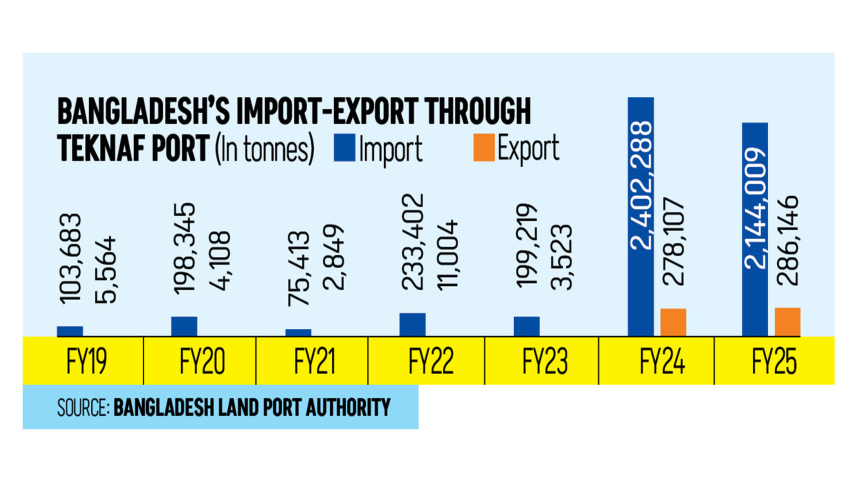
Traders have expressed mixed reactions following the government’s announcement to resume operations at Teknaf Land Port after about a year of disruption, citing ongoing security risks and uncertainties linked to the situation in Myanmar.
State Minister for Shipping Razib Ahsan made the announcement on April 6 during his first visit to the port since his appointment, saying the decision followed consultations with relevant stakeholders.

“We have decided to resume operations from today, ensuring security through coordination among the port authority, customs, Coast Guard, BGB, and other law enforcement agencies,” he said.
However, the reality on the ground is more complex, with port officials saying trade activities have yet to resume in practice.
Traders said while the government’s move has reopened the possibility of trade, its normalisation will depend on border security, navigability of the river route, and developments in the neighbouring country.
CONFLICT DETERS TRADE
Abu Morshed Chowdhury Khoka, former president of Cox’s Bazar Chamber of Commerce and Industry (CBCCI), welcomed the government’s decision to resume operations at the port.
“This is positive for traders. Essential items like onions, ginger, and garlic can be imported at lower costs, and government revenue will increase,” he said.
However, the state minister’s words could not entirely curb traders’ concerns over safety along the Naf River route and the broader trade environment, as fighting in Myanmar -- particularly in Rakhine State -- continues to stall cross-border movement.
Ehteshamul Haque Bahadur, president of the Teknaf Port C&F Agent Association, said although a trade agreement exists between Bangladesh and Myanmar, normal import activities have yet to resume in practice.
“Trade activities have remained largely stagnant for a long time,” he said.
However, recent initiatives and announcements from the government have given traders some encouragement, he noted.
Meanwhile, Home Minister Salahuddin Ahmed visited the port on Tuesday, further raising hopes for a trade revival.
Recalling State Minister Ahsan’s words, Bahadur said, “We believe the state minister made such statements after discussions with relevant parties and seeing some positive prospects.”
He said traders are not sitting idle and are preparing to restart import-export operations.
“Since trade has been halted for a long time, documentation, financial settlements, LCs, and dollar transactions all need to be reorganised. Even if operations resume, goods will not start arriving immediately -- it will take some time to get the whole process running.”
Bahadur also clarified that there is no question of traders holding any direct or indirect talks with the Arakan Army regarding the normalisation of trade.
“This is a state-level matter, and only the government can make decisions on such issues. We believe the Myanmar government and relevant stakeholders will resolve the situation.”
He expressed hope that if conditions improve, import and export activities through the port will return to normal in the future.
One of the government’s steps to improve the port’s operations is to introduce scanners.
 For all latest news, follow The Daily Star's Google News channel.
 Abed Ahsan Sagar, former director of CBCCI, said the state minister proposed installing scanners inside the port to monitor goods movement.
“With scanners in place, goods can be verified during loading and unloading, while BGB can carry out checks at designated points,” he said.
A YEAR OF IDLING
Bangladesh-Myanmar border trade began in 1995, while the Teknaf Land Port was formally launched on November 5, 2003, on 27 acres of land.
Trade at this port remained suspended due to the hindrance of the Myanmar rebel group Arakan Army. Since December 2024, most of the Rakhine state and the whole 271 kilometres border area with Bangladesh have come under their control.
They have also established influence over the Naf River, stopping cargo vessels and extorting money, traders allege.
Import activities effectively came to a halt after April 13, 2025, when the last timber-laden trawler arrived. Prior to that, several cargo vessels were reportedly detained, and extortion demands were made by the rebels.
The port’s General Manager Jasim Uddin last week said that trade activities have yet to resume in practice, and that the port was never technically closed.
“The port was technically open all along. We are ready, but operations will only begin once goods start arriving,” he said. Former CBCCI director Sagar noted that just reopening the port will not solve the problem unless vessels can avoid Myanmar waters.
“If dredging is carried out on the Bangladesh side, an alternative route could be created to reduce these risks,” he suggested.
Without this measure, he warned that the port could face disruption again in the near future.
He said a significant amount of money remains stuck with Myanmar traders. “About $9 million remains held in drafts. Once goods start moving, this can be adjusted.”
Comments