


Trade deficit hits three-year high at $27.3b
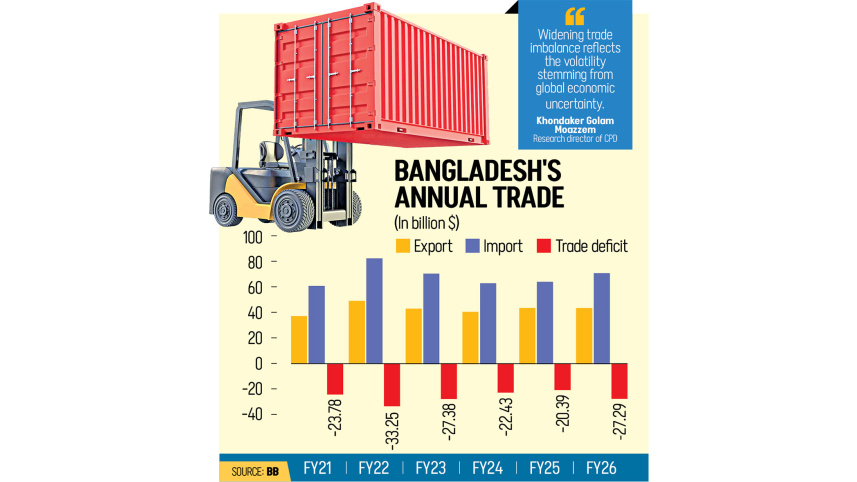
Bangladesh’s trade deficit widened to a three-year high in fiscal year 2025-26, as import bills climbed even as export earnings stagnated, according to the latest Bangladesh Bank data.
The deficit stood at $27.28 billion for the year, a jump of 34 percent from FY25, said the central bank.

The country exported $43.85 billion worth of goods in FY26, almost unchanged from the previous year. Imports, meanwhile, rose 10.5 percent year-on-year to $71.14 billion, the largest annual import gain since FY22.
“Definitely, it indicates weak external performance, and global factors are more responsible for this than domestic ones,” said Khondaker Golam Moazzem, research director at the Centre for Policy Dialogue (CPD).
He said imports grew mainly for inflationary reasons, particularly higher petroleum prices, while tariffs imposed by the Donald Trump administration, rising inflation in the West, and war-related supply disruptions have dampened orders from international buyers.
“So, this widening trade imbalance reflects the volatility stemming from global economic uncertainty,” he said.
Abdur Razzaque, chairman of the Research and Policy Integration for Development (RAPID), cautioned against reading the higher import bill as a sign of stronger investment or domestic activity.
“Bangladesh Bank’s import data show that capital-machinery imports have remained weak, while imports of industrial raw materials have also been subdued. This suggests that the increase in aggregate imports has not yet been accompanied by a broad-based revival in productive investment,” he said.
The RAPID chairman, however, noted that some recovery in imports is not necessarily a bad sign after years of import compression amid persistent inflation.
According to him, greater availability of food, fuel, essential consumer goods and production inputs can help ease domestic supply constraints, improve competition and reduce price pressures.
The more serious concern, he said, is what Bangladesh is importing, and what is happening to investment and exports at the same time. “If imports recover while capital machinery remains depressed and exports stagnate, the wider trade deficit is generating less additional productive capacity than one would normally hope to see.”
CPD’s Moazzem echoed the concern, saying, “Given that private credit growth stood at a historic low, it cannot be said that domestic demand and investment have spiked.”
For a developing economy, Razzaque said, a larger trade deficit can in fact be healthy when it reflects imports of machinery, technology and other inputs that expand future productive and export capacity.
He said, “What is unusual in the present situation is the combination of a sizeable increase in total imports with continued weakness in investment-oriented imports and virtually no export growth.
“This suggests that Bangladesh is experiencing some normalisation of domestic import demand, but not yet a strong investment-led recovery.”
Despite the widening deficit, Razzaque said it has not triggered an immediate balance of payments (BoP) crisis.
He noted that remittances rose to a record $35.6 billion in FY26, providing what he called an exceptionally large cushion that helped contain the current-account deficit to around $1.6 billion.
The overall BoP recorded a surplus of $6.6 billion for the year.
“This creates an interesting asymmetry in the economy: external-sector stability has improved considerably, but the improvement has not yet been matched by a comparable recovery in investment, industrial activity and export dynamism,” Razzaque said.
“Remittances and stronger reserves are giving Bangladesh valuable macroeconomic space. The challenge now is to convert that stability into productive investment and export growth,” he added.
 For all latest news, follow The Daily Star's Google News channel.
 Meanwhile, CPD’s Moazzem called on the government to focus on alternative energy sources such as renewables to reduce imports as he fears the volatility in the energy market could prevail in the coming months.
Comments