


Trade deals, LDC deferment top agenda at WTO summit

Bangladesh will prioritise bilateral trade negotiations, deferment of its graduation from least developed country (LDC) status, among other issues, at the World Trade Organisation’s (WTO) 14th Ministerial Conference, which opens tomorrow in Cameroon’s capital, Yaoundé.
The country has scheduled talks with the European Union (EU) on signing a free trade agreement (FTA) on the sidelines, Commerce Minister Khandakar Abdul Muktadir, who will be leading the Bangladesh delegation at the conference, told The Daily Star over the phone yesterday.

“We have a plan to discuss trade agreements and business issues with several countries and trade blocs apart from participating in the regular consultation meetings at the summit,” Muktadir said.
The four-day summit comes as the rules-based multilateral trading system under the WTO faces mounting pressure from bilateral deals, regionalism and protectionism by developed nations.
On the sidelines, Bangladesh will also seek EU support for delaying its LDC graduation, said the minister. The country applied to the United Nations last month to defer its LDC graduation by three years to November 2029. The UN Committee for Development Policy discussed the request at its annual meeting in New York last month and has set up a process to evaluate the application.
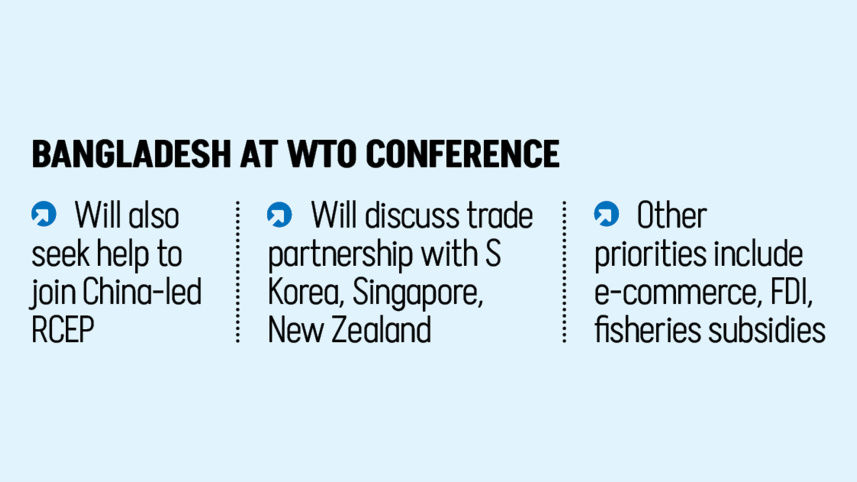
The Bangladesh delegation will also seek cooperation from member countries as it tries to join the China-led Regional Comprehensive Economic Partnership Agreement (RCEP). Trade partnership discussions are scheduled with South Korea, Singapore, and New Zealand, scheduled during the summit, which runs until March 29.
Other priorities on Bangladesh’s agenda include e-commerce, foreign direct investment and fisheries subsidies. On the latter, Bangladesh has agreed to reduce funding for the fishing of rare and endangered species.
Mohammad Abdur Razzaque, chairman of the Research and Policy Integration for Development (RAPID), recently said it is difficult to predict how much support Bangladesh can secure for deferring graduation.
Gambia, as LDC coordinator, has proposed allowing LDCs and graduating LDCs with per capita real income below $1,000 -- measured using 1990 US dollar exchange rates – to continue providing subsidies.
Under that criterion, Razzaque said, Bangladesh would qualify to maintain subsidies in various sectors.
Gambia has also sought an extension of the agreement on Trade-Related Aspects of Intellectual Property Rights (TRIPS) for graduating LDCs, which would benefit Bangladesh by preserving its patent waiver facility on goods such as medicines beyond graduation.
But concrete decisions at the ministerial conference will be difficult given fragmentation in global trade caused by US reciprocal tariffs and the US-Israel war on Iran, Razzaque said.
“If all the LDCs and graduating LDCs can raise their voice collectively, a few good decisions may come from the conference, because the WTO also has an agenda for LDCs,” he added.
Ministers from across the world will attend the conference to discuss challenges facing the multilateral trading system and decide on the WTO’s future work. The conference will be chaired by Luc Magloire Mbarga Atangana, Cameroon’s minister of trade.
The opening session begins at 10am tomorrow with welcome remarks by the chair, the WTO director-general, and guests, including heads of state or government. This will be followed by a ministerial breakout session covering WTO foundational issues.
Thursday’s breakout sessions will focus on WTO reform, with each session facilitated by a minister. A plenary session on WTO reform will be held at the end of the day.
Friday will begin with an update on dispute settlement reform, followed by ministerial sessions on fisheries subsidies, incorporation of the Investment Facilitation for Development Agreement, the e-commerce work programme and moratorium, agriculture, and development, including LDC issues.
The final day will begin with a heads of delegation meeting at ministerial level in preparation for the closing session, scheduled for midday.
 For all latest news, follow The Daily Star's Google News channel.
Comments